The Business Research Company’s 2026 market reports are designed to deliver research that is more actionable and strategically valuable. Key offerings include market attractiveness scoring, total addressable market sizing, company benchmarking matrices, interactive Excel dashboards, deeper supply chain intelligence, emerging startup tracking, and granular product-level insights.
Which Factors Will Shape The Vacuum-Optimized Rocket Engines Market Size Through 2030?
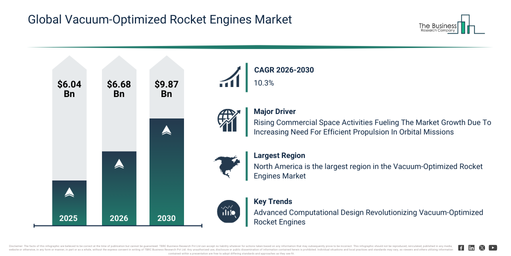
The vacuum-optimized rocket engines market size has experienced rapid growth in recent years. It is projected to expand from $6.04 billion in 2025 to $6.68 billion in 2026, demonstrating a compound annual growth rate (CAGR) of 10.6%. The historical growth can be ascribed to factors such as the early development of upper-stage rocket engines for space missions, advancements in nozzle design for vacuum efficiency, government and space agency funding for propulsion research, the integration of thrust chambers optimized for low-pressure environments, and the initial deployment of vacuum-optimized engines in orbital launch vehicles.
The vacuum-optimized rocket engines market is anticipated to experience substantial expansion in the coming years, reaching a valuation of $9.87 billion by 2030, propelled by a compound annual growth rate (CAGR) of 10.3%. This projected increase is primarily driven by the growing need for vacuum-optimized engines in both commercial and deep-space ventures, the advancement of next-generation upper-stage propulsion systems, the integration of cutting-edge materials to improve thrust and fuel efficiency, the proliferation of reusable rocket initiatives demanding vacuum-optimized stages, and heightened cooperation among aerospace companies and propulsion technology innovators for superior space engines. Key trends during this period are expected to encompass the rise of high-performance upper-stage propulsion systems, a growing preference for methane-based vacuum engines, the broadening of commercial launch services necessitating vacuum-optimized engines, innovations in lightweight materials for large-area nozzles, and the incorporation of modular propulsion components to accelerate engine development.
Request A Free Vacuum-Optimized Rocket Engines Market Sample To Support Your Strategic Planning:
What Is Propelling The Vacuum-Optimized Rocket Engines Market Toward $9.87 Billion By 2030?
The vacuum-optimized rocket engines market is anticipated to expand due to an increase in commercial space endeavors. These activities encompass private sector operations in space, including satellite launches, space tourism, and various in-orbit services. This surge in commercial space operations is largely driven by the rising need for satellite-based internet and communication services, which facilitate worldwide connectivity, assist remote regions, and foster progress in technologies like 5G, the Internet of Things (IoT), and real-time data transmission. Vacuum-optimized rocket engines are crucial for these activities because they enhance efficiency and thrust in the void of space, supporting extended missions, increased payload capacity, and superior overall performance. An example illustrates this trend: in January 2024, The Space Foundation, a US-based non-profit, reported that global launch activity reached unprecedented levels for the third consecutive year in 2023, with 223 launch attempts and 212 completions. Furthermore, commercial launches experienced a 50% increase compared to 2022. Consequently, the growing volume of commercial space activities is fueling the expansion of the vacuum-optimized rocket engines market.
What Are The Key Segments And Subsegments In The Vacuum-Optimized Rocket Engines Market?
The vacuum-optimized rocket engines market covered in this report is segmented –
1) By Type: Cryogenic, Hypergolic, Solid, Liquid, Hybrid
2) By Component: Nozzle, Combustion Chamber, Turbopump, Other Components
3) By End User: Aerospace, Defense, Space Exploration, Other End Users
Subsegments:
1) By Cryogenic: Liquid Oxygen (LOX) And Liquid Hydrogen (LH2) Engines, Liquid Oxygen (LOX) And Liquid Methane (LCH4) Engines, Liquid Oxygen (LOX) And Liquid Natural Gas Engines, Liquid Fluorine And Hydrogen Engines
2) By Hypergolic: Unsymmetrical Dimethylhydrazine (UDMH) And Nitrogen Tetroxide (NTO) Engines, Monomethylhydrazine (MMH) And Nitrogen Tetroxide (NTO) Engines, Aerozine 50 And Nitrogen Tetroxide (NTO) Engines, Hydrazine And Inhibited Red Fuming Nitric Acid (IRFNA) Engines
3) By Solid: Single-Grain Solid Motors, Multi-Grain Solid Motors, Cast-Cured Composite Propellant Motors, Extruded Double-Base Propellant Motors
4) By Liquid: Pressure-Fed Liquid Engines, Pump-Fed Liquid Engines, Staged Combustion Cycle Engines, Gas Generator Cycle Engines, Expander Cycle Engines
5) By Hybrid: Hydroxyl-Terminated Polybutadiene (HTPB) And Liquid Oxygen (LOX) Engines, HTPB And Nitrous Oxide Engines, Paraffin-Based And Liquid Oxygen (LOX) Engines, Acrylonitrile Butadiene Styrene (ABS) And Nitrous Oxide Engines
Vacuum-Optimized Rocket Engines Market Trends Behind The 10.3% CAGR Forecast
Major companies operating in the vacuum-optimized rocket engines market are focusing on developing advanced technologies such as autonomous next-generation-driven computational design models to accelerate the development of highly complex propulsion systems. These autonomous models leverage artificial intelligence to independently generate intricate engine geometries, significantly reducing design timelines while optimizing performance across diverse pressure environments. For instance, in December 2024, LEAP 71, a UAE-based computational engineering company, developed a hot-fired 5,000-Newton Aerospike rocket engine, which was autonomously designed by a next-generation large computational engineering model. This engine, produced in a matter of weeks, was 3D printed as a single copper structure and demonstrated successful ignition on its first attempt. It features a toroidal combustion chamber encircling a central spike, eliminating the traditional bell nozzle for improved efficiency across altitudes. Aerospike’s compact architecture and performance in both atmospheric and vacuum conditions mark a significant advancement in rocket propulsion.
Major Companies Profiled In The Vacuum-Optimized Rocket Engines Market Report
Major companies operating in the vacuum-optimized rocket engines market are Space Exploration Technologies Corp, Blue Origin Enterprises LP, Relativity Space Inc., ispace Inc., Rocket Lab USA Inc., Firefly Aerospace Inc., AgniKul Cosmos Private Limited, Ursa Major Technologies Inc., Rocket Factory Augsburg AG, Stoke Space Technologies Inc., Isar Aerospace Technologies GmbH, Dawn Aerospace BV, Phase Four Inc., ABL Space Systems Inc., Astra Space Inc., Payload Aerospace SL, Skyrora Limited, Skyroot Aerospace Private Limited, Bellatrix Aerospace Private Limited, LandSpace Technology Corporation Ltd, ExPace Technology Co Ltd.
Explore The Business Research Company’s Complete Vacuum-Optimized Rocket Engines Market Report:
Where Does The Vacuum-Optimized Rocket Engines Market Generate The Most Revenue?
North America was the largest region in the vacuum-optimized rocket engine market in 2025. The regions covered in the vacuum-optimized rocket engines market report are Asia-Pacific, South East Asia, Western Europe, Eastern Europe, North America, South America, Middle East, Africa.
Reach Out To Our Team:
The Business Research Company: https://www.thebusinessresearchcompany.com/
Americas: +1 310-496-7795
Asia: +44 7882 955267 & +91 8897263534
Europe: +44 7882 955267
Email us at: marketing@tbrc.info
Follow us on:
LinkedIn: https://in.linkedin.com/company/the-business-research-company
YouTube: https://www.youtube.com/channel/UC24_fI0rV8cR5DxlCpgmyFQ
Global Market Model: https://www.thebusinessresearchcompany.com/global-market-model

Wasay has over a decade of experience in market research, data modelling, and analytics, with prior experience at GlobalData and Decision Tree Consulting Services. At The Business Research Company , he leads research operations across syndicated studies, customized consulting engagements, and the Global Market Model platform. His professional experience includes supporting organizations such as Boston Consulting Group, KPMG, and Ernst & Young. Wasay holds a degree in Electronics and Communications Engineering, postgraduate management qualifications from International Management Institute Belgium and Indian School of Business and Entrepreneurship, and completed the Integrated Program in Business Analytics from Indian Institute of Management Indore.