
Designed to make market research more actionable and strategically valuable, The Business Research Company’s 2026 market reports feature market attractiveness scoring, total addressable market sizing, company benchmarking matrices, interactive Excel dashboards, deeper supply chain intelligence, emerging startup tracking, and granular product-level insights.
What Is The Projected CAGR Of The Wireless In-Flight Entertainment Market Through 2030?
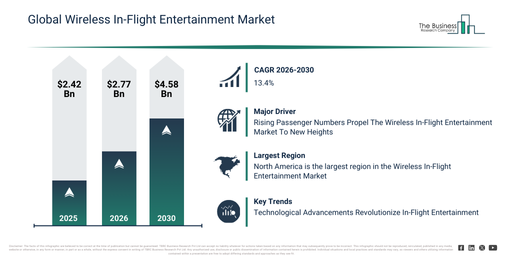
The wireless in-flight entertainment market has experienced rapid expansion in recent years. It is projected to grow from $2.42 billion in 2025 to $2.77 billion in 2026, demonstrating a compound annual growth rate (CAGR) of 14.6%. The historical growth of this market can be attributed to factors such as the early adoption of onboard wireless networks to reduce reliance on seatback screens, the rising demand for digital entertainment access on personal devices during flights, the initial development of airplane software enabling wireless content distribution, an increasing focus by airlines on enhancing passenger experience through value-added services, and the growth in availability of offline Wi-Fi systems to support basic in-flight content delivery.
The wireless in-flight entertainment market is projected for significant expansion over the coming years. It is anticipated to reach $4.58 billion in 2030, exhibiting a compound annual growth rate (CAGR) of 13.4%. This growth during the forecast period stems from factors such as the increasing incorporation of high-speed connectivity for enhanced media streaming, the rising implementation of sophisticated entertainment software designed for personal devices, airlines’ growing investments in unique digital service offerings, the broadening of cloud-based content management systems for in-flight applications, and passengers’ increasing desires for uninterrupted wireless access to travel data and entertainment. Key trends anticipated during this period involve the wider adoption of wireless in-flight entertainment across commercial airlines, the integration of personalized features and interactive content for passengers, the expansion of retrofitting options for older aircraft, a surging demand for high-speed connectivity and smooth streaming experiences, and an increasing reliance on multi-band satellite and Air-To-Ground (ATG)-based systems.
Claim Your Free Wireless In-Flight Entertainment Market Sample Report With Key Data And Trends:
Wireless In-Flight Entertainment Market Demand Analysis: The Driving Force Behind Expansion
The increasing volume of air travelers is anticipated to propel the expansion of the wireless in-flight entertainment market moving forward. These air passengers encompass both domestic and international individuals flying on carriers registered within the country, traveling between various destinations. Wireless in-flight entertainment systems provide travelers with convenient internet access, browsing capabilities, video streaming, and a range of other activities directly on their personal devices during flights. For instance, in December 2024, Eurostat, a Luxembourg-based government agency, reported that 2023 witnessed a total of 973 million passengers traveling by air within the EU, marking a 19.3% increase from 2022, when 816 million passengers were recorded. The available data further indicated that all EU member states experienced a rise in air passenger numbers compared with the previous year. Therefore, the growing number of passengers is a primary force driving the growth of the wireless in-flight entertainment market.
Breaking Down The Wireless In-Flight Entertainment Market By Segment
The wireless in-flight entertainment market covered in this report is segmented –
1) By Aircraft Type: Narrow-Body, Wide-Body, Regional Jet
2) By Fitment Type: Retrofit, Line Fit
3) By Hardware: Antennas, Wireless Access Points, Modems, Other Hardware
4) By Technology: ATG, Ku-Band, L-Band, Ka-Band
Subsegments:
1) By Narrow-Body: Single-Aisle Jets, Short-Haul Aircraft
2) By Wide-Body: Long-Haul Aircraft, Twin-Aisle Jets
3) By Regional Jet: Regional Turboprop Aircraft, Regional Jets
Top Trend Influencing The Wireless In-Flight Entertainment Market Outlook
Technological advancements like cloud-based content delivery, portable wireless IFE servers, high-definition seatback displays, immersive virtual reality experiences, real-time passenger analytics, 5G connectivity, and AI-driven personalized entertainment recommendations have emerged as a significant trend gaining traction in the wireless in-flight entertainment market. Companies operating within the wireless in-flight entertainment market are actively developing innovative technologies to solidify their market position. For instance, in August 2024, Air India, the India-based flag carrier airline, launched wireless in-flight entertainment on its wide-body aircraft, responding to customer feedback regarding previous system issues. This new service, named Vista, allows passengers to stream content directly onto their personal devices during flights. The Vista W-IFE system utilizes Bluebox’s Blueview digital services platform, enabling content to be streamed to passengers’ devices in the cabin through Bluebox Wow, which is a wireless network system housed in a lunchbox-sized unit and stored in overhead compartments.
Wireless In-Flight Entertainment Market Competitive Landscape And Major Players
Major companies operating in the wireless in-flight entertainment market are Panasonic Avionics Corporation, SITA AG, Astronics Corporation, Burrana Pty Ltd., Collins Aerospace, FDS Avionics Corp., Global Eagle Entertainment Inc., Gogo LLC, Honeywell International Inc., Lufthansa Systems GmbH & Co. KG, Thales Group, Viasat Inc., Inmarsat plc, Sitaonair SA, Bluebox Aviation Systems Ltd., digEcor Inc., Kontron AG, Lufthansa Technik AG, Spafax Group Inc., VT Miltope LLC, AirFi Co., Global Onboard Partners LLC, Immfly Group
Read The Full Wireless In-Flight Entertainment Market Report By The Business Research Company:
Where Is The Wireless In-Flight Entertainment Market Largest? Key Regional Insights
North America was the largest region in the wireless in-flight entertainment market in 2025. Asia-Pacific is expected to be the fastest-growing region in the wireless in-flight entertainment market report during the forecast period. The regions covered in the wireless in-flight entertainment market report are Asia-Pacific, South East Asia, Western Europe, Eastern Europe, North America, South America, Middle East, Africa.
Reach Out To Our Team:
The Business Research Company: https://www.thebusinessresearchcompany.com/
Americas: +1 310-496-7795
Asia: +44 7882 955267 & +91 8897263534
Europe: +44 7882 955267
Email us at: marketing@tbrc.info
Follow us on:
LinkedIn: https://in.linkedin.com/company/the-business-research-company
YouTube: https://www.youtube.com/channel/UC24_fI0rV8cR5DxlCpgmyFQ
Global Market Model: https://www.thebusinessresearchcompany.com/global-market-model

Wasay has over a decade of experience in market research, data modelling, and analytics, with prior experience at GlobalData and Decision Tree Consulting Services. At The Business Research Company , he leads research operations across syndicated studies, customized consulting engagements, and the Global Market Model platform. His professional experience includes supporting organizations such as Boston Consulting Group, KPMG, and Ernst & Young. Wasay holds a degree in Electronics and Communications Engineering, postgraduate management qualifications from International Management Institute Belgium and Indian School of Business and Entrepreneurship, and completed the Integrated Program in Business Analytics from Indian Institute of Management Indore.

