
Market attractiveness scoring, total addressable market sizing, company benchmarking matrices, interactive Excel dashboards, deeper supply chain intelligence, emerging startup tracking, and granular product-level insights are among the key offerings featured in The Business Research Company’s 2026 market reports, designed to deliver more actionable and strategically valuable research.
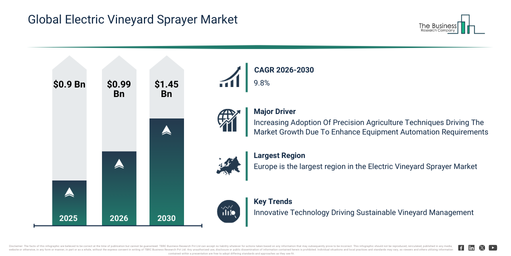
Electric Vineyard Sprayer Market Valued At $0.99 Billion In 2026, Projected To Reach $1.45 Billion By 2030
The market for electric vineyard sprayers has experienced substantial growth in recent years. The market is forecast to grow from $0.9 billion in 2025 to $0.99 billion in 2026 at a compound annual growth rate (CAGR) of 10.1%. This historical growth can be attributed to factors such as increasing vineyard mechanization, a rising awareness of chemical overuse, expanded vineyard acreage, dependence on manual or fuel-based sprayers, and the early adoption of sustainable farming tools.
The electric vineyard sprayer market is projected to experience substantial expansion over the coming years. Its valuation is anticipated to reach $1.45 billion by 2030, exhibiting a compound annual growth rate (CAGR) of 9.8%. This expansion during the forecast period is driven by factors such as a growing move towards electric agricultural equipment, increasing requirements for precise viticulture, an escalating need to reduce chemical use, the spread of high-value vineyard cultivation, and increasing government initiatives supporting environmentally friendly farming methods. Significant patterns expected during this period include a heightened demand for accurate spraying, a rising preference for vineyard machinery with lower emissions, greater uptake of electric sprayers due to their cost-effectiveness, the development of specialized sprayer designs for vines, and an increasing need for enhanced canopy penetration technology.
Request A Complimentary Electric Vineyard Sprayer Market Research Sample:
Key Factor Propelling The Electric Vineyard Sprayer Market Forward
The growing integration of precision agriculture methods is projected to boost the expansion of the electric vineyard sprayer market in the future. These techniques involve farming management approaches leveraging technology and data analysis to enhance crop management at the field level and improve resource efficiency. The implementation of precision agriculture is increasing partly due to labor scarcity, as automated and GPS-guided machinery minimizes manual labor requirements while preserving operational effectiveness. Electric vineyard sprayers facilitate precision agriculture through their integration of GPS-guided systems and variable-rate technology, allowing for targeted chemical application at exact points, thereby optimizing resource consumption and lessening waste and ecological footprint. For example, in January 2024, data from the Government Accountability Office, a US-based government agency, indicated that by 2023, 27% of farms and ranches across the U.S. had embraced precision agriculture practices for crop or livestock management. Consequently, the heightened embrace of precision agriculture techniques is fueling the expansion of the electric vineyard sprayer market.
Electric Vineyard Sprayer Market Segments And Subsegments Explained
The electric vineyard sprayer market covered in this report is segmented –
1) By Product Type: Self-Propelled Electric Sprayers, Tractor-Mounted Electric Sprayers, Handheld Electric Sprayers, Other Product Types
2) By Power Source: Battery-Powered, Solar-Powered, Hybrid
3) By Capacity: Small, Medium, Large
4) By Distribution Channel: Direct Sales, Distributors, Online Retail, Other Distribution Channels
5) By Application: Disease Control, Pest Management, Fertilizer Application, Other Applications
Subsegments:
1) By Self-Propelled Electric Sprayers: Battery-Powered Self-Propelled Electric Sprayers, Solar-Powered Self-Propelled Electric Sprayers, Hybrid Self-Propelled Electric Sprayers, Large-Capacity Self-Propelled Electric Sprayers
2) By Tractor-Mounted Electric Sprayers: Compact Tractor-Mounted Electric Sprayers, Mid-Size Tractor-Mounted Electric Sprayers, High-Capacity Tractor-Mounted Electric Sprayers, Specialized Tractor-Mounted Electric Sprayers
3) By Handheld Electric Sprayers: Portable Battery Handheld Electric Sprayers, Cordless Handheld Electric Sprayers, Lightweight Handheld Electric Sprayers, Multi-Nozzle Handheld Electric Sprayers
4) By Other Product Types: Drone-Based Vineyard Sprayers, Autonomous Vineyard Spraying Robots, Mounted Multi-Row Sprayers, Customizable Vineyard Sprayer Units
Emerging Trends Transforming The Electric Vineyard Sprayer Market
Major companies within the electric vineyard sprayer market are concentrating on developing advanced products, such as electric autonomous herbicide sprayers, to enhance efficiency, decrease chemical usage, and promote sustainable vineyard practices. These self-driving, battery-operated machines automatically navigate vineyards for precise herbicide application, thereby cutting down on labor, chemical waste, and environmental footprint, while simultaneously boosting operational effectiveness. For example, GUSS Automation LLC, a US-based agricultural technology firm, introduced the Electric GUSS in January 2024, presenting the world’s first electric autonomous herbicide sprayer designed for orchards and vineyards. This sophisticated machine integrates GPS, LiDAR, and proprietary technology to ensure accurate weed detection and spraying, allowing a single individual to supervise up to eight units concurrently from a vehicle. The Electric GUSS achieves up to a 90% reduction in chemical consumption, diminishes CO2 emissions, and lowers labor and maintenance expenditures, signifying a major leap forward in sustainable and efficient orchard management. Featuring adjustable hydraulic booms that adapt to diverse row spacing and berm heights, the Electric GUSS guarantees minimal crop damage and maintains high operational efficiency. Its durable battery sustains operations for an entire 10–12-hour shift, enabling continuous work throughout the day.
Electric Vineyard Sprayer Market Key Players: Major Companies In The 2026 Report
Major companies operating in the electric vineyard sprayer market are John Deere & Company, Kubota Corporation, Yamaha Motor Co. Ltd., AGCO Corporation, Kuhn Group, XAG Co. Ltd., Croplands Equipment Ltd., Bertolini S.p.A., Tecnoma S.A., Cima S.p.A., Agromehanika d.d., Tifone Srl, Fede Pulverizadores S.A., Pulverizadores Fede S.A., Naïo Technologies SAS, Agrobot Inc., Smart Guided Systems Pty Ltd, Grapetek Pty Ltd, Nobili S.p.A., TRS Sprayers & Equipment Ltd.
Explore The Full Electric Vineyard Sprayer Market Report With Forecasts To 2030:
Electric Vineyard Sprayer Market By Region: Where Is Demand Strongest?
Europe was the largest region in the electric vineyard sprayer market in 2025. Asia-Pacific is expected to be the fastest-growing region in the forecast period. The regions covered in the electric vineyard sprayer market report are Asia-Pacific, South East Asia, Western Europe, Eastern Europe, North America, South America, Middle East, Africa.
Reach Out To Our Team:
The Business Research Company: https://www.thebusinessresearchcompany.com/
Americas: +1 310-496-7795
Asia: +44 7882 955267 & +91 8897263534
Europe: +44 7882 955267
Email us at: marketing@tbrc.info
Follow us on:
LinkedIn: https://in.linkedin.com/company/the-business-research-company
YouTube: https://www.youtube.com/channel/UC24_fI0rV8cR5DxlCpgmyFQ
Global Market Model: https://www.thebusinessresearchcompany.com/global-market-model

Wasay has over a decade of experience in market research, data modelling, and analytics, with prior experience at GlobalData and Decision Tree Consulting Services. At The Business Research Company , he leads research operations across syndicated studies, customized consulting engagements, and the Global Market Model platform. His professional experience includes supporting organizations such as Boston Consulting Group, KPMG, and Ernst & Young. Wasay holds a degree in Electronics and Communications Engineering, postgraduate management qualifications from International Management Institute Belgium and Indian School of Business and Entrepreneurship, and completed the Integrated Program in Business Analytics from Indian Institute of Management Indore.

