
The Business Research Company’s 2026 market reports are designed to deliver research that is more actionable and strategically valuable. Key offerings include market attractiveness scoring, total addressable market sizing, company benchmarking matrices, interactive Excel dashboards, deeper supply chain intelligence, emerging startup tracking, and granular product-level insights.
Laser Weed Control Robot Market Revenue Projected To Rise To $1.38 Billion By 2030
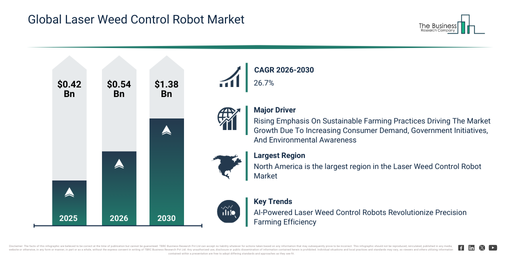
The laser weed control robot market size has seen significant expansion in recent years. It is forecast to grow from $0.42 billion in 2025 to $0.54 billion in 2026, achieving a compound annual growth rate (CAGR) of 27.0%. This historical growth can be attributed to factors such as rising herbicide resistance in weeds, increasing labor shortages, early adoption of precision farming tools, heightened demand for sustainable weed management, and rising operational costs of manual weeding.
The laser weed control robot market is projected to experience substantial growth over the coming years, with its valuation anticipated to reach $1.38 billion by 2030, driven by a compound annual growth rate (CAGR) of 26.7%. This growth during the forecast period is primarily fueled by a growing inclination towards autonomous farming systems, the increasing incorporation of AI-based recognition models, a heightened demand for chemical-free weed management, expanding applications in small and medium-sized farms, and the accelerated embrace of robotics in large-scale agricultural operations. Key trends expected during this period involve the increasing uptake of chemical-free weed management strategies, the expansion of precision laser targeting functionalities, a surge in demand for highly accurate weed identification, the development of multi-crop laser weed removal solutions, and enhancements in on-field safety and compliance characteristics.
Want Deeper Laser Weed Control Robot Market Insights? Get A Free Sample Report:
Primary Growth Driver Shaping The Laser Weed Control Robot Market Outlook
The increasing focus on sustainable agricultural methods is anticipated to drive expansion in the laser weed control robot market. These practices involve agricultural techniques that prioritize environmental preservation, soil well-being, and resource efficiency, all while sustaining long-term output. This heightened attention to sustainability stems from growing consumer desire for eco-friendly food production, prompting farmers to embrace approaches that lessen chemical use and environmental harm. Such practices encourage the adoption of laser weed control robots, given that these automated solutions allow for accurate weed removal without chemical herbicides, consistent with organic and conservation farming principles. As an example, the Department for Environment, Food and Rural Affairs (DEFRA), a UK-based government body, reported in May 2025 that the UK’s organic farming land reached 503,000 hectares in 2024, representing a 1.0% rise compared to 2023. Ultimately, the increasing importance of sustainable farming practices is accelerating the expansion of the laser weed control robot market.
Laser Weed Control Robot Market Structure: A Detailed Look At Segments And Subsegments
The laser weed control robot market covered in this report is segmented –
1) By Product Type: Autonomous Robots, Semi-Autonomous Robots
2) By Technology: Artificial Intelligence (AI)-Based, Vision-Based, Global Positioning System (GPS)-Guided, Other Technologies
3) By Weed Type: Broadleaf Weeds, Grass Weeds, Sedges, Other Weed Types
4) By Application: Agriculture, Horticulture, Commercial Landscaping, Other Applications
5) By End-User: Large Farms, Small And Medium Farms, Research Institutes, Other End-Users
Subsegments:
1) By Autonomous Robots: Artificial Intelligence (AI)-Powered Autonomous Laser Weed Control Robots, Vision-Guided Autonomous Laser Weed Control Robots, GPS (Global Positioning System)-Enabled Autonomous Laser Weed Control Robots, Multi-Row Autonomous Laser Weed Control Robots
2) By Semi-Autonomous Robots: Remote-Controlled Semi-Autonomous Laser Weed Control Robots, Sensor-Assisted Semi-Autonomous Laser Weed Control Robots, Camera-Guided Semi-Autonomous Laser Weed Control Robots, Compact Semi-Autonomous Laser Weed Control Robots
Laser Weed Control Robot Market Innovation And Strategy Trends Among Leading Companies
Companies actively involved in the laser weed control robot market are increasingly leveraging cutting-edge technologies, such as artificial intelligence (AI)-based plant detection, to boost weeding efficiency, cut down expenses, and improve crop yields. AI-based plant detection is a technology that utilizes machine learning and computer vision to automatically identify and distinguish crops from weeds, thereby facilitating precise weed targeting, reducing herbicide use and labor costs, and enhancing crop yield and efficiency. For instance, in Februar 2025, Carbon Autonomous Robotics Systems Inc., a US-based agricultural technology company, launched the LaserWeeder G2 product line, an innovative solution within the laser weed control robot segment. The LaserWeeder G2 integrates modular robotics, computer vision, high-powered laser emission, and AI-based weed detection to target weeds with submillimeter precision while leaving crops and soil undisturbed. The system incorporates self-contained weeding modules featuring dual 240 W diode lasers, multiple high-resolution cameras, NVIDIA GPUs, and a liquid-cooled architecture, allowing for widths from 6.6 to 60 feet to suit various farm sizes. Its primary features include real-time plant recognition via deep learning Carbon AI, high-throughput weeding (claiming up to twice the speed of the previous generation), a lighter overall machine to reduce soil compaction, and a modular design adaptable to different crop types and field layouts.
Top Companies Competing In The Laser Weed Control Robot Market
Major companies operating in the laser weed control robot market are Carbon Robotics, FarmWise Labs, Inc., Ecorobotix AG, Naïo Technologies, SwarmFarm Robotics Pty Ltd, AGROINTELLI, Robotnik Automation, Farmdroid ApS, XMACHINES, Fdata Robot, BOPA-Precision Agriculture, AgJunction, AgXeed B.V., Terra Robotics Ltd., Escarda Technologies GmbH, Verdan Robotics SAS, Harvested Robotics Ltd., Aigen Inc., Luxeed Robotics S.A.S., Trabotyx B.V., Weedbot SIA, Seedspider, Earth Rover Ltd., Solinftec (Solix Ag Robotics), EcoRobotics SAS
View The Complete Laser Weed Control Robot Market Study With Segment And Regional Data:
Laser Weed Control Robot Market Regional Outlook Across Major Geographies
North America was the largest region in the laser weed control robot market in 2025. Asia-Pacific is expected to be the fastest-growing region in the forecast period. The regions covered in the laser weed control robot market report are Asia-Pacific, South East Asia, Western Europe, Eastern Europe, North America, South America, Middle East, Africa.
Reach Out To Our Team:
The Business Research Company: https://www.thebusinessresearchcompany.com/
Americas: +1 310-496-7795
Asia: +44 7882 955267 & +91 8897263534
Europe: +44 7882 955267
Email us at: marketing@tbrc.info
Follow us on:
LinkedIn: https://in.linkedin.com/company/the-business-research-company
YouTube: https://www.youtube.com/channel/UC24_fI0rV8cR5DxlCpgmyFQ
Global Market Model: https://www.thebusinessresearchcompany.com/global-market-model

Wasay has over a decade of experience in market research, data modelling, and analytics, with prior experience at GlobalData and Decision Tree Consulting Services. At The Business Research Company , he leads research operations across syndicated studies, customized consulting engagements, and the Global Market Model platform. His professional experience includes supporting organizations such as Boston Consulting Group, KPMG, and Ernst & Young. Wasay holds a degree in Electronics and Communications Engineering, postgraduate management qualifications from International Management Institute Belgium and Indian School of Business and Entrepreneurship, and completed the Integrated Program in Business Analytics from Indian Institute of Management Indore.

