The Business Research Company’s 2026 market reports combine market attractiveness scoring, total addressable market sizing, company benchmarking matrices, interactive Excel dashboards, deeper supply chain intelligence, emerging startup tracking, and granular product-level insights to deliver research that is more actionable and strategically valuable.
Is The Space Resource Utilization Market Expanding? Latest Size Estimates And 2030 Projections
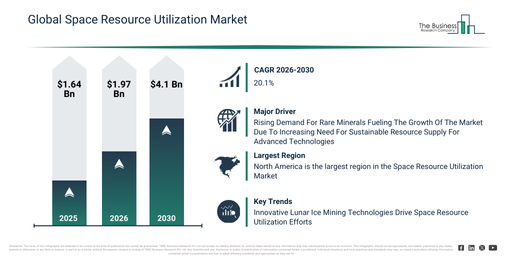
The space resource utilization market has experienced significant expansion recently. This market is projected to expand from $1.64 billion in 2025 to $1.97 billion by 2026, demonstrating a compound annual growth rate (CAGR) of 20.1%. Historically, this expansion has been driven by several factors, including pioneering research into the composition of lunar and asteroid materials for their extraction capabilities, the initial establishment of life support systems utilizing in-situ resources, fundamental experiments aimed at recycling orbital debris for material reuse, the rise of on-demand manufacturing technologies for assembly in space, and early pilot initiatives focused on employing extraterrestrial materials for fuel generation and construction purposes.
The space resource utilization market is expected to experience substantial growth in the near future. It is projected to reach $4.1 billion in 2030, demonstrating a compound annual growth rate (CAGR) of 20.1%. This expansion during the forecast period is driven by the scaling up of lunar and asteroid mining initiatives for sustainable resource provision, increased deployment of platforms for orbital recycling and material recovery, the evolution of advanced in-situ manufacturing and 3D printing technologies, rising investment in space-based power generation utilizing local resources, and growing commercial and governmental collaborations aimed at establishing self-sufficient off-Earth resource ecosystems. Key trends anticipated in the forecast period include the expansion of lunar and asteroid mining missions, advances in in-situ resource processing technologies, increasing demand for on-orbit manufacturing and repair capabilities, heightened investment in propellant production infrastructure, and improvements in closed-loop life support resource systems.
Free Space Resource Utilization Market Sample: Market Size, Growth Drivers And Competitive Landscape:
Space Resource Utilization Market Drivers Explained: What Is Supporting A 20.1% CAGR?
The escalating demand for rare minerals is expected to drive the future growth of the space resource utilization market. Rare minerals are naturally occurring materials that are infrequently found in the Earth’s crust and are highly valued for their unique characteristics utilized in electronics, renewable energy, and aerospace technologies. The necessity for rare minerals is increasing due to their crucial role in manufacturing batteries for electric vehicles. Space resource utilization assists in managing the use of rare minerals by enabling the extraction of scarce and valuable elements from asteroids and the lunar surface, thereby helping to meet industrial demand and lessen dependence on Earth’s diminishing reserves. For instance, in January 2025, the United States Geological Survey, a US-based government agency, reported that global rare earth production rose from 376,000 metric tons in 2022 to 390,000 metric tons in 2024, marking a 3.7% increase over the two-year period. This growing demand for rare minerals is a significant factor propelling the expansion of the space resource utilization market.
Space Resource Utilization Market Segment Guide: Main Divisions And Subsegments
The space resource utilization market covered in this report is segmented –
1) By Resource Type: Water, Metals, Minerals, Gases, Other Resource Types
2) By Application: Construction, Propellant Production, Life Support, Manufacturing, Other Applications
3) By End-User: Government, Commercial, Other End-Users
Subsegments:
1) By Water: Lunar Ice Deposits, Asteroid Water Extraction, In-Situ Water Production, Water For Life Support, Water For Propellant Production
2) By Metals: Iron, Nickel, Platinum Group Metals, Aluminum, Titanium, Rare Earth Metals
3) By Minerals: Regolith (Lunar Soil), Silicates, Basalt, Helium-3 Containing Minerals, Construction-Grade Aggregates
4) By Gases: Helium-3, Oxygen, Hydrogen, Carbon Dioxide, Nitrogen
5) By Other Resource Types: Solar Energy, Space-Based Rare Volatile Compounds, Organic Compounds, Exotic Isotopes, Radiation Shielding Materials
Space Resource Utilization Market Trends And Opportunities For 2026–2030
Leading firms within the space resource utilization market are concentrating on creating advanced solutions, including polar resources ice mining equipment, to advance technologies for obtaining and processing water ice found at lunar poles. This equipment, specifically, constitutes specialized instruments engineered to excavate soil at the lunar poles and examine it to ascertain the existence of water ice and other volatile substances. As an example, in February 2025, Space Exploration Technologies Corp., a US-based space technology enterprise, initiated the Intuitive Machines IM-2 mission, which transported PRIME-1 (Polar Resources Ice Mining Experiment-1). This payload from NASA is specifically designed to showcase essential technologies for pinpointing and extracting water ice situated on the Moon’s surface. The objective of PRIME-1 is to evaluate a drill and a mass spectrometer for the purpose of detecting and analyzing ice beneath the surface. This mission contributes to future lunar exploration endeavors by aiding in the establishment of techniques for in-situ resource utilization (ISRU), a crucial element for facilitating sustained human presence on the Moon and decreasing dependence on resources brought from Earth.
Which Major Players Are Active In The Space Resource Utilization Market?
Major companies operating in the space resource utilization market are Lockheed Martin Corporation, Northrop Grumman Corporation, Airbus Defence and Space SA, Blue Origin Enterprises L.P., Thales Alenia Space SAS, Sierra Nevada Company LLC, AMi Exploration, ispace Inc., Turion Space Corp., Wyvern, AstroForge Inc., Bradford Space Inc., Interlune Corporation, Astrobotic Technology Inc., Moon Express Inc., Orbit Fab Inc., Trans Astronautica Corporation, Astronika, Off-World Inc., Polimak Space, Lunasonde
Unlock The Complete Space Resource Utilization Market Report With Company Benchmarking:
Space Resource Utilization Market World Regions Compared: Which Leads In Revenue?
North America was the largest region in the space resource utilization market in 2025. The regions covered in the space resource utilization market report are Asia-Pacific, South East Asia, Western Europe, Eastern Europe, North America, South America, Middle East, Africa.
Reach Out To Our Team:
The Business Research Company: https://www.thebusinessresearchcompany.com/
Americas: +1 310-496-7795
Asia: +44 7882 955267 & +91 8897263534
Europe: +44 7882 955267
Email us at: marketing@tbrc.info
Follow us on:
LinkedIn: https://in.linkedin.com/company/the-business-research-company
YouTube: https://www.youtube.com/channel/UC24_fI0rV8cR5DxlCpgmyFQ
Global Market Model: https://www.thebusinessresearchcompany.com/global-market-model

Wasay has over a decade of experience in market research, data modelling, and analytics, with prior experience at GlobalData and Decision Tree Consulting Services. At The Business Research Company , he leads research operations across syndicated studies, customized consulting engagements, and the Global Market Model platform. His professional experience includes supporting organizations such as Boston Consulting Group, KPMG, and Ernst & Young. Wasay holds a degree in Electronics and Communications Engineering, postgraduate management qualifications from International Management Institute Belgium and Indian School of Business and Entrepreneurship, and completed the Integrated Program in Business Analytics from Indian Institute of Management Indore.