
Market attractiveness scoring, total addressable market sizing, company benchmarking matrices, interactive Excel dashboards, deeper supply chain intelligence, emerging startup tracking, and granular product-level insights are among the key offerings featured in The Business Research Company’s 2026 market reports, designed to deliver more actionable and strategically valuable research.
Space Situational Awareness Market Size Overview: From Historical Performance To The 2030 Forecast
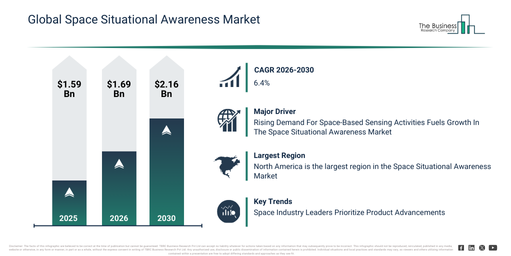
The space situational awareness market has experienced substantial growth in recent years. Its valuation is forecast to climb from $1.59 billion in 2025 to $1.69 billion in 2026, reflecting a compound annual growth rate (CAGR) of 6.4%. This past expansion can be attributed to several factors, including the increasing deployment of radar sensors and telescopes for tracking space objects, a rise in satellite launches driving demand for orbit determination and conjunction analysis, the early development of space data centers and event-generation tools for monitoring orbital environments, a heightened governmental focus on tracking space debris and predicting re-entry, and the expansion of mission support and navigation services for launch and early-orbit operations.
The market for space situational awareness is projected to experience substantial expansion in the coming years. This market is anticipated to reach $2.16 billion in 2030, exhibiting a compound annual growth rate (CAGR) of 6.4%. This growth during the forecast period stems from several factors, including the escalating requirement for advanced space-debris tracking due to the proliferation of satellite constellations, the increasing implementation of automated software for orbit determination and collision avoidance, the establishment of integrated space situational awareness networks that merge commercial and governmental data sources, the rising need for real-time space-weather predictions to safeguard spacecraft assets, and the broadening of international partnerships aimed at improving global space-traffic management capabilities. Key developments expected over this period encompass artificial intelligence and autonomous intelligence, digitalization, cloud computing, big data and cybersecurity, the Internet of Things (IoT), smart infrastructure and connected ecosystems, autonomous systems, robotics and smart mobility, alongside Industry 4.0 and intelligent manufacturing.
Get A Free Sample Of The Business Research Company’s Space Situational Awareness Market Report:
What Factor Is Increasing Demand In The Space Situational Awareness Market?
The increasing demand for space-based sensing activities is set to drive the growth of the space situational awareness market moving forward. These space-based sensing activities refer to remote sensing technology that provides profiles of the Earth’s atmosphere and ionosphere with high vertical resolution and global coverage, using GNSS (such as GPS) readings collected by low-Earth orbiting satellites. Most governments utilize space situational awareness to plan their space operations because it facilitates the prediction of orbital paths for cataloged objects and space trash. For instance, the UK Space Agency, a UK-based government agency, reported in August 2025 that in 2024, satellite services, including navigation, Earth observation, meteorology, and communications, contributed $527.30 billion (£454 billion) to the UK economy, making up 18% of the nation’s total GDP. Consequently, the rising demand for space-based sensing activities is a primary factor boosting the growth of the space situational awareness market.
Which Segments Make Up The Space Situational Awareness Market?
The space situational awareness market covered in this report is segmented –
1) By Solution: Service, Payload Systems, Software
2) By Capability: Detect, Track, And Identify (D/T/Id), Threat Warning And Assessment, Characterization
3) By Object: Mission-Related Debris, Rocket Bodies, Fragmentation Debris, Functional Spacecraft, Non-Functional Spacecraft, Other Objects
4) By Orbital Range: Near-Earth, Deep Space
5) By End Use: Commercial, Government And Military
Subsegments:
1) By Services: Collision Avoidance Services, Tracking and Monitoring Services, Data Analysis and Consulting Services, Debris Management Services
2) By Payload Systems: Surveillance Sensors, Radar Systems, Optical Sensors, Tracking Satellites
3) By Software: Space Object Tracking Software, Simulation and Predictive Analysis Tools, Data Visualization Software, Space Traffic Management Software
Space Situational Awareness Market Emerging Trends: What Are Industry Leaders Focusing On?
Leading enterprises in the space situational awareness market are prioritizing the deployment of space situational awareness (SSA) and space surveillance and tracking (SST) systems. These initiatives aim to boost the observation of space objects, refine collision prevention tactics, guarantee secure satellite operations, and facilitate adherence to regulations within the progressively crowded orbital environment. Such innovative systems represent sophisticated technology engineered for thorough surveillance of space objects, thereby safeguarding both space-based assets and ongoing operations. Their architecture, driven by APIs, permits seamless connectivity with diverse internal radars, telescopes, confidential systems, and onboard GPS units. Illustratively, in February 2024, Integrasys SA, a US-based company, introduced Orbisat. This platform is engineered to link with current proprietary or public subsystems, enabling automated tracking, collision avoidance, telemetry, and control capabilities. This interoperability is vital for sustaining effective operations within increasingly dense space environments. The solution leverages a comprehensive database assembled from public data sources such as Celestrack and Spacetrack, which receives continuous updates to guarantee real-time precision in observing objects in space.
Major Companies To Know In The Space Situational Awareness Market
Major companies operating in the space situational awareness market are Lockheed Martin Corporation, Kratos Defense & Security Solutions Inc., Polaris Alpha Advanced Systems Inc., Applied Defense Solutions, Schafer Industries, L3harris Technologies, General Dynamics Corporation, Vision Engineering Solutions, Norstar Space Data, SpaceNav LLC, Elecnor Deimos Group, ExoAnalytic Solutions Inc., Honeywell International Inc., DRS Technologies., BAE Systems, Northrop Grumman Corporation, RTX Corporation, Thales Group, ATOS SE, Elbit Systems Ltd., Leonardo S.p.A., Rheinmetall AG, Airbus SE, Boeing Co., Pratt & Whitney, Rolls-Royce Holdings plc, GE Aviation, Safran S.A., Israel Aerospace Industries, Spirit AeroSystems Inc., Triumph Group Inc., United Technologies Corporation, International Business Machines Corporation, Microsoft Corporation, Amazon Web Services Inc., Google LLC, Oracle Corporation, Cisco Systems Inc.
Read The In-Depth Space Situational Awareness Market Report:
Space Situational Awareness Market Regional Landscape: Largest Region In 2025
North America was the largest region in the space situational awareness market in 2025. North America is expected to be the fastest growing region in the space situational awareness market share during the forecast period. The regions covered in the space situational awareness market report are Asia-Pacific, South East Asia, Western Europe, Eastern Europe, North America, South America, Middle East, Africa.
Reach Out To Our Team:
The Business Research Company: https://www.thebusinessresearchcompany.com/
Americas: +1 310-496-7795
Asia: +44 7882 955267 & +91 8897263534
Europe: +44 7882 955267
Email us at: marketing@tbrc.info
Follow us on:
LinkedIn: https://in.linkedin.com/company/the-business-research-company
YouTube: https://www.youtube.com/channel/UC24_fI0rV8cR5DxlCpgmyFQ
Global Market Model: https://www.thebusinessresearchcompany.com/global-market-model

Wasay has over a decade of experience in market research, data modelling, and analytics, with prior experience at GlobalData and Decision Tree Consulting Services. At The Business Research Company , he leads research operations across syndicated studies, customized consulting engagements, and the Global Market Model platform. His professional experience includes supporting organizations such as Boston Consulting Group, KPMG, and Ernst & Young. Wasay holds a degree in Electronics and Communications Engineering, postgraduate management qualifications from International Management Institute Belgium and Indian School of Business and Entrepreneurship, and completed the Integrated Program in Business Analytics from Indian Institute of Management Indore.

