
Market attractiveness scoring, total addressable market sizing, company benchmarking matrices, interactive Excel dashboards, deeper supply chain intelligence, emerging startup tracking, and granular product-level insights are among the key offerings featured in The Business Research Company’s 2026 market reports, designed to deliver more actionable and strategically valuable research.
Space-Based Disaster Management Market On Course To Reach $5.66 Billion By 2030: Size And Growth Overview
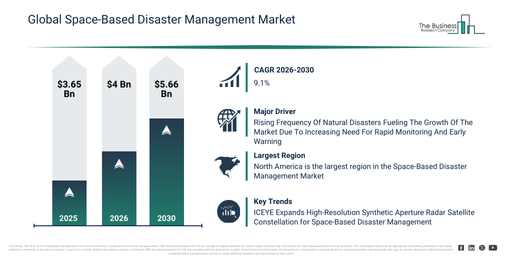
The space-based disaster management market size has experienced significant expansion in recent years. It is anticipated to grow from $3.65 billion in 2025 to $4 billion in 2026, demonstrating a compound annual growth rate (CAGR) of 9.6%. This historical development can be attributed to the early deployment of remote sensing satellites for disaster monitoring, the progression of geospatial mapping technologies for emergency response, government investments in space-enabled disaster management programs, the incorporation of mobile ground stations for rapid data acquisition, and the adoption of hyperspectral imaging for damage and resource assessment.
The space-based disaster management market is projected to witness significant growth in the coming years, with its size expected to reach $5.66 billion by 2030, demonstrating a compound annual growth rate (CAGR) of 9.1%. This anticipated expansion during the forecast period is driven by factors such as the increasing deployment of satellite constellations for comprehensive global disaster coverage, the growing utilization of real-time data transmission for critical emergency decision-making, the adoption of artificial intelligence and machine learning for predictive disaster analytics, a rise in partnerships between space agencies and disaster management organizations, and the development of sophisticated satellite navigation and communication systems for coordinated responses. Key trends for this period include the seamless integration of real-time satellite data, advanced geospatial analytics for improved disaster risk assessment, the creation of multi-sensor satellite payloads, the emergence of cloud-based disaster management platforms, and enhanced public-private collaboration in space-based disaster response.
Need Space-Based Disaster Management Market Forecasts? Get Your Free Sample Report Here:
Space-Based Disaster Management Market Growth Factors: What Is Strengthening Demand Worldwide?
The increasing frequency of natural calamities is projected to fuel the expansion of the space-based disaster management market in the future. These unexpected natural events result in substantial harm to human populations, infrastructure, and ecological systems. Their surge is attributed to climate change, fostering more severe and erratic weather patterns, thereby escalating the incidence and severity of phenomena like floods, hurricanes, and wildfires. This increase bolsters the need for space-based disaster management, which facilitates swift, extensive monitoring and timely alerts via satellite imagery, empowering authorities to react more efficiently and lessen destruction. As an illustration, in January 2024, data from the National Centers for Environmental Information (NCEI), a US-based federal agency, indicated that the United States experienced 28 separate weather and climate-related disasters in 2023, each incurring damages of at least $1 billion. Cumulatively, these occurrences resulted in estimated total losses amounting to $92.9 billion. Consequently, the escalating frequency of natural disasters is a key driver for the growth of the space-based disaster management market.
Space-Based Disaster Management Market By Segment: Complete Category And Subcategory Breakdown
The space-based disaster management market covered in this report is segmented –
1) By Solution: Satellite Communication, Satellite Navigation, Earth Observation, Other Solutions
2) By Application: Flood Monitoring, Earthquake Monitoring, Storm Tracking, Wildfire Management, Other Applications
3) By End-User: Government, Defense, Commercial, Other End-Users
Subsegments:
1) By Satellite Communication: Emergency Communication, Real-time Data Transmission, Broadcast Services, Telemedicine Support
2) By Satellite Navigation: Positioning Services, Timing Services, Navigation For Emergency Response Vehicles, Location-Based Alert Systems
3) By Earth Observation: Optical Imaging, Synthetic Aperture Radar (SAR) Imaging, Thermal Imaging, Multispectral And Hyperspectral Imaging
4) By Other Solutions: Data Analytics And Visualization, Disaster Risk Assessment Models, AI-Based Decision Support Systems, Integrated Ground Control Systems
Space-Based Disaster Management Market Trend Outlook: Developments Defining The Forecast Period
Leading entities within the space-based disaster management market are concentrating on creating sophisticated solutions, like resolution synthetic satellites, designed to record intricate surface features. These resolution synthetic satellites incorporate synthetic aperture radar (SAR) technology, which enables them to acquire accurate and elaborate images of the Earth’s topography, irrespective of dim lighting or the presence of clouds. An example of this is ICEYE, an Earth observation firm based in Finland, which deployed four new Synthetic Aperture Radar (SAR) satellites into orbit in August 2024. This deployment expands the world’s most extensive SAR satellite constellation, thereby empowering ICEYE to offer high-resolution, all-weather imaging functionalities. These new satellites provide imagery with a 25 cm resolution, serving both commercial and specific customer missions. Produced by ICEYE in Finland and the United States, these satellites were integrated through Exolaunch and launched as part of SpaceX’s Transporter-12 rideshare mission from Vandenberg Space Force Base in California.
Who Is Competing For Share In The Space-Based Disaster Management Market?
Major companies operating in the space-based disaster management market are Airbus SE, Maxar Technologies Holdings Inc., ICEYE Ltd., Planet Labs PBC, Spire Global Inc., BlackSky Technology Inc., EarthDaily Analytics, EOS Data Analytics Inc., Capella Space, Pixxel, Synspective Inc., SpaceKnow Inc., OroraTech GmbH, MDA Corporation, Satellogic, Astro Digital, Astraea Inc., Umbra Lab Inc., LiveEO GmbH, Blue Sky Analytics LLC.
Get The Full Picture With The Space-Based Disaster Management Market Report:
Space-Based Disaster Management Market Regional Snapshot: Leading Geography In 2025
North America was the largest region in the space-based disaster management market in 2025. Asia-Pacific is expected to be the fastest-growing region in the forecast period. The regions covered in the space-based disaster management market report are Asia-Pacific, South East Asia, Western Europe, Eastern Europe, North America, South America, Middle East, Africa.
Reach Out To Our Team:
The Business Research Company: https://www.thebusinessresearchcompany.com/
Americas: +1 310-496-7795
Asia: +44 7882 955267 & +91 8897263534
Europe: +44 7882 955267
Email us at: marketing@tbrc.info
Follow us on:
LinkedIn: https://in.linkedin.com/company/the-business-research-company
YouTube: https://www.youtube.com/channel/UC24_fI0rV8cR5DxlCpgmyFQ
Global Market Model: https://www.thebusinessresearchcompany.com/global-market-model

Wasay has over a decade of experience in market research, data modelling, and analytics, with prior experience at GlobalData and Decision Tree Consulting Services. At The Business Research Company , he leads research operations across syndicated studies, customized consulting engagements, and the Global Market Model platform. His professional experience includes supporting organizations such as Boston Consulting Group, KPMG, and Ernst & Young. Wasay holds a degree in Electronics and Communications Engineering, postgraduate management qualifications from International Management Institute Belgium and Indian School of Business and Entrepreneurship, and completed the Integrated Program in Business Analytics from Indian Institute of Management Indore.

