Designed to make market research more actionable and strategically valuable, The Business Research Company’s 2026 market reports feature market attractiveness scoring, total addressable market sizing, company benchmarking matrices, interactive Excel dashboards, deeper supply chain intelligence, emerging startup tracking, and granular product-level insights.
What Is The Projected CAGR Of The Synthetic Aperture Radar Market Through 2030?
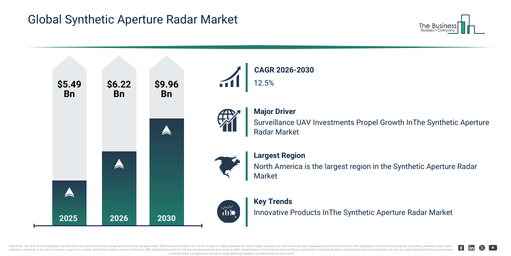
The synthetic aperture radar market has experienced rapid expansion in recent years. It is projected to increase from $5.49 billion in 2025 to $6.22 billion in 2026, demonstrating a compound annual growth rate (CAGR) of 13.4%. This historical growth can be attributed to various factors, including the rising demand for high-resolution earth observation, which propels the procurement of airborne and spaceborne SAR systems, augmented government investments in defense surveillance programs that utilize SAR capabilities, improvements in microwave signal processing leading to enhanced imaging accuracy, the expansion of commercial remote-sensing operators who adopt side-looking radar systems, and an increasing need for manufacturer-provided warranty-period maintenance and support services.
The synthetic aperture radar market is anticipated to experience significant expansion over the coming years, reaching $9.96 billion by 2030, driven by a compound annual growth rate (CAGR) of 12.5%. This projected growth stems from several factors, including the wider use of SAR for climate tracking and disaster response, the increasing launch of small satellites equipped with SAR for faster re-visits, higher investments in sophisticated digital SAR systems for better image clarity, the rising commercial need for imaging that works in all weather conditions and at any time, and an anticipated rise in comprehensive after-sales and lifecycle support services provided with new SAR systems. Key trends anticipated during this period involve the shrinking size of SAR systems for integration into small satellites, a greater uptake of spaceborne SAR for observing Earth, the creation of SAR systems capable of multiple frequencies and modes, the incorporation of SAR with unmanned aerial vehicles (UAVs), and progress in processing and analyzing SAR data in real-time.
Claim Your Free Synthetic Aperture Radar Market Sample Report With Key Data And Trends:
Synthetic Aperture Radar Market Demand Analysis: The Driving Force Behind Expansion
Greater investment in unmanned aerial vehicles (UAVs) for surveillance and attack operations is fueling the expansion of the synthetic aperture radar market. UAVs are extensively utilized in numerous scenarios due to their advancements in safety. With their remote control capabilities, drones monitor locations, communicate potential hazards, and provide alerts about threatening conditions at sites such as oil and gas refineries, pipelines, and flare stacks. Drone technology is also employed by the military during high-risk periods. MILSAR SAR/MTI Radar is specifically designed for use on airborne platforms for intelligence, surveillance, reconnaissance, deterrence, and attack operations. For instance, in February 2024, the UK Ministry of Defense launched a new drone strategy that includes at least 4.5 billion pounds ($5.7 billion) of investment in new unmanned aerial systems over the next decade. Consequently, the increase in investments in UAVs for surveillance will drive the growth of the synthetic aperture radar market.
Breaking Down The Synthetic Aperture Radar Market By Segment
The synthetic aperture radar market covered in this report is segmented –
1) By Component: Receiver, Transmitter, Antenna
2) By Platform: Airborne, Ground
3) By Mode: Single Mode, Multimode
4) By Frequency Band: X Band, L Band, C Band, S Band, K, Ku, Ka Band, UHF Or VHF Band
5) By Application: Military And Defense, Monitoring And Exploration
Subsegments:
1) By Receiver: Analog Receivers, Digital Receivers, Frequency-Selective Receivers
2) By Transmitter: Solid-State Transmitters, Magnetron Transmitters, Traveling Wave Tube (TWT) Transmitters
3) By Antenna: Phased Array Antennas, Parabolic Antennas, Aperture Antennas
Top Trend Influencing The Synthetic Aperture Radar Market Outlook
Leading firms in the synthetic aperture radar market are innovating sophisticated products, including drone-based synthetic aperture radar (SAR), to cater to broader clientele, boost sales, and grow income. Drone-based synthetic aperture radar (SAR) involves merging synthetic aperture radar capabilities with unmanned aerial vehicles (UAVs) or drones. As an example, in August 2023, GalaxEye Space, an India-based space technology startup, introduced an aerial drone-based synthetic aperture radar (SAR) system. This advanced system provides the capacity to deliver exceptionally detailed, high-resolution, all-weather imaging, even when faced with difficult atmospheric conditions. GalaxEye’s successful creation and display of this breakthrough position it as the first private company in India to accomplish this feat. The SAR system integrates exclusive data fusion technology, marking a notable step forward in space-derived intelligence. This distinctive characteristic allows satellite constellations to perform all-weather imaging without the atmospheric limitations faced by conventional single-sensor satellites. GalaxEye’s groundbreaking technology paves the way for producing highly detailed images via a compact satellite constellation, thereby transforming aerial drone-based synthetic aperture radar systems.
Synthetic Aperture Radar Market Competitive Landscape And Major Players
Major companies operating in the synthetic aperture radar market are Raytheon Technologies Corporation, Airbus Defence and Space S.A.S., Lockheed Martin Corporation, German Aerospace Center, Northrop Grumman Corporation, BAE Systems plc, Thales Group, L3Harris Technologies Inc., Leonardo S.p.A., General Atomics Aeronautical Systems Inc., Israel Aerospace Industries Ltd., Saab AB, SAR Aero Inc., Cobham plc, Aselsan A.S., OHB SE, MacDonald Dettwiler and Associates Ltd., ICEYE Oyj, Intellisense Systems Inc., Capella Space Corporation, IMSAR LLC, SRC Inc., MetaSensing B.V., MetaSensing Group
Read The Full Synthetic Aperture Radar Market Report By The Business Research Company:
Where Is The Synthetic Aperture Radar Market Largest? Key Regional Insights
North America was the largest region in the synthetic aperture radar market in 2025. Asia-Pacific is expected to be the fastest-growing region in the forecast period. The regions covered in the synthetic aperture radar market report are Asia-Pacific, South East Asia, Western Europe, Eastern Europe, North America, South America, Middle East, Africa.
Reach Out To Our Team:
The Business Research Company: https://www.thebusinessresearchcompany.com/
Americas: +1 310-496-7795
Asia: +44 7882 955267 & +91 8897263534
Europe: +44 7882 955267
Email us at: marketing@tbrc.info
Follow us on:
LinkedIn: https://in.linkedin.com/company/the-business-research-company
YouTube: https://www.youtube.com/channel/UC24_fI0rV8cR5DxlCpgmyFQ
Global Market Model: https://www.thebusinessresearchcompany.com/global-market-model

Wasay has over a decade of experience in market research, data modelling, and analytics, with prior experience at GlobalData and Decision Tree Consulting Services. At The Business Research Company , he leads research operations across syndicated studies, customized consulting engagements, and the Global Market Model platform. His professional experience includes supporting organizations such as Boston Consulting Group, KPMG, and Ernst & Young. Wasay holds a degree in Electronics and Communications Engineering, postgraduate management qualifications from International Management Institute Belgium and Indian School of Business and Entrepreneurship, and completed the Integrated Program in Business Analytics from Indian Institute of Management Indore.