The Business Research Company’s 2026 market reports are designed to deliver research that is more actionable and strategically valuable. Key offerings include market attractiveness scoring, total addressable market sizing, company benchmarking matrices, interactive Excel dashboards, deeper supply chain intelligence, emerging startup tracking, and granular product-level insights.
Electric-Driven Fixed Wing Unmanned Aerial Vehicles Market Size, Growth Rate And Key Forecast Highlights For 2026–2030
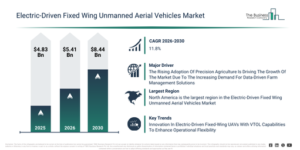
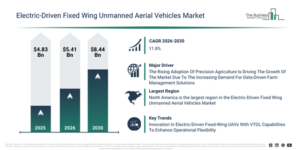
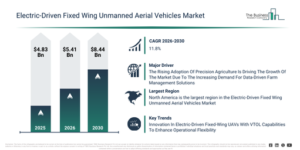
The market size for electric-driven fixed wing unmanned aerial vehicles has experienced rapid growth in recent years. It is projected to expand from $4.83 billion in 2025 to $5.41 billion in 2026, registering a compound annual growth rate (CAGR) of 12.0%. The historical growth of this market can be attributed to factors such as the increasing adoption of electric propulsion in UAVs, the expanded use of drones for mapping and inspection, a reliance on imported electronic components, the proliferation of agricultural drone applications, and the early development of long-endurance UAV platforms.
The market for electric-driven fixed wing unmanned aerial vehicles is anticipated to experience substantial expansion over the upcoming years. This market is projected to reach $8.44 billion by 2030, exhibiting a compound annual growth rate (CAGR) of 11.8%. This projected growth during the forecast period is due to factors such as an escalating demand for autonomous UAV operations, enhanced integration of sophisticated sensing technologies, the advancement of next-generation electric propulsion systems, the expanding commercial UAV service markets, and the increasing application of drones for monitoring critical infrastructure. Key developments expected during this timeframe encompass the incorporation of AI-driven flight control systems, a rise in autonomous long-endurance UAV operations, the embrace of sustainable electric propulsion technologies, the broadening of cloud-connected UAV analytics, and the execution of automated UAV manufacturing processes.
See What’s Inside The Electric-Driven Fixed Wing Unmanned Aerial Vehicles Market Report With A Free Sample:
Electric-Driven Fixed Wing Unmanned Aerial Vehicles Market Expansion: The Major Factor Driving Growth
The increasing integration of precision agriculture is anticipated to boost the electric-driven fixed-wing unmanned aerial vehicles market in the future. This farming management approach utilizes technologies such as GPS, sensors, and data analytics to optimize field-level management for crop cultivation. The growing embrace of precision agriculture stems mainly from the imperative to maximize crop yields and reduce resource consumption, utilizing data-driven tools including GPS-guided equipment, remote sensing, and variable rate application systems. Electric-driven fixed-wing unmanned aerial vehicles are employed in precision agriculture to provide efficient, high-resolution aerial surveillance for crop monitoring, soil analysis, and resource management over extensive farmlands. For instance, by 2025, the Australia-based Department of Agriculture, Fisheries, and Forestry predicts that approximately 6,600 companies will use controlled traffic farming on 6.7 million hectares, establishing it as the most widely adopted precision agriculture technique. Additionally, in January 2024, the US-based Government Accountability Office indicated that in 2023, 27% of farms and ranches across the United States implemented precision agriculture practices for managing their crops or livestock. Consequently, the expanding adoption of precision agriculture is propelling the growth of the electric-driven fixed-wing unmanned aerial vehicles market.
Understanding Electric-Driven Fixed Wing Unmanned Aerial Vehicles Market Segmentation For Strategic Planning
The electric-driven fixed wing unmanned aerial vehicles market covered in this report is segmented –
1) By Type: Small Unmanned Aerial Vehicles (UAV), Medium Unmanned Aerial Vehicles (UAV), Large Unmanned Aerial Vehicles (UAV)
2) By Technology: Fixed-Wing Electric Unmanned Aerial Vehicles (UAVs), Hybrid Electric Unmanned Aerial Vehicles (UAVs), Fully Autonomous Unmanned Aerial Vehicles (UAVs), Remotely Piloted Unmanned Aerial Vehicles (UAVs)
3) By Range: Beyond Line Of Sight, Visual Line Of Sight, Extended Visual Line Of Sight
4) By Application: Military, Government, Commercial
5) By End-User Industry: Agriculture, Military And Defense, Logistics And Transportation, Construction, Energy And Utilities, Environmental Monitoring
Subsegments:
1) By Small Unmanned Aerial Vehicles (UAVs): Mini Unmanned Aerial Vehicles, Micro Unmanned Aerial Vehicles, Nano Unmanned Aerial Vehicles
2) By Medium Unmanned Aerial Vehicles (UAVs): Tactical Unmanned Aerial Vehicles, Close-Range Unmanned Aerial Vehicles, Medium-Range Unmanned Aerial Vehicles
3) By Large Unmanned Aerial Vehicles (UAVs): Strategic Unmanned Aerial Vehicles, High-Altitude Long Endurance (HALE) Unmanned Aerial Vehicles, Medium-Altitude Long Endurance (MALE) Unmanned Aerial Vehicles
Key Electric-Driven Fixed Wing Unmanned Aerial Vehicles Market Trends To Watch In 2026
Leading companies within the electric-driven fixed-wing unmanned aerial vehicles market are focused on developing innovative offerings, such as vertical takeoff and landing drones, to boost operational flexibility and reduce reliance on runways. Vertical takeoff and landing (VTOL) drones are unmanned aerial vehicles (UAVs) that possess the ability to take off, hover, and land vertically without requiring a runway. For example, in September 2024, T-DRONES, a China-based aviation and aerospace component manufacturing firm, introduced the VA17, an all-electric tiltrotor VTOL drone engineered for rapid deployment and offering an extended flight endurance of up to 120 minutes. The VA17 merges vertical takeoff and landing functions with efficient fixed-wing flight, thereby eliminating the need for runways and making it perfectly suited for operations in restricted or distant zones. Fabricated with a lightweight carbon fiber and EPP foam structure, it delivers high stability and durability even in tough environmental circumstances. The drone is equipped with an advanced power management system and a dual redundant power supply for improved safety, and it is capable of carrying payloads up to 900 grams.
Key Companies Active In The Electric-Driven Fixed Wing Unmanned Aerial Vehicles Market
Major companies operating in the electric-driven fixed wing unmanned aerial vehicles market are The Boeing Company, Lockheed Martin Corporation, Northrop Grumman Corporation, General Atomics, Anduril Industries Inc., AeroVironment Inc., Quantum-Systems GmbH, Edge Autonomy Inc., Wingtra AG, Delair SAS, AgEagle Aerial Systems Inc., JOUAV Technology Co. Ltd., T-DRONES Co. Ltd., BlueBird Aero Systems Ltd., Survey Copter GmbH, Aeromao d.o.o., ElevonX Inc., Atmos UAV Ltd., DeltaQuad Inc., Ukrspecsystems
Explore Detailed Electric-Driven Fixed Wing Unmanned Aerial Vehicles Market Research And Forecasts:
Which Geography Dominates The Electric-Driven Fixed Wing Unmanned Aerial Vehicles Market?
North America was the largest region in the electric-driven fixed wing unmanned aerial vehicles market in 2025. Asia-Pacific is expected to be the fastest-growing region in the forecast period. The regions covered in the electric-driven fixed wing unmanned aerial vehicles market report are Asia-Pacific, South East Asia, Western Europe, Eastern Europe, North America, South America, Middle East, Africa.
Reach Out To Our Team:
The Business Research Company: https://www.thebusinessresearchcompany.com/
Americas: +1 310-496-7795
Asia: +44 7882 955267 & +91 8897263534
Europe: +44 7882 955267
Email us at: marketing@tbrc.info
Follow us on:
LinkedIn: https://in.linkedin.com/company/the-business-research-company
YouTube: https://www.youtube.com/channel/UC24_fI0rV8cR5DxlCpgmyFQ
Global Market Model: https://www.thebusinessresearchcompany.com/global-market-model

Wasay has over a decade of experience in market research, data modelling, and analytics, with prior experience at GlobalData and Decision Tree Consulting Services. At The Business Research Company , he leads research operations across syndicated studies, customized consulting engagements, and the Global Market Model platform. His professional experience includes supporting organizations such as Boston Consulting Group, KPMG, and Ernst & Young. Wasay holds a degree in Electronics and Communications Engineering, postgraduate management qualifications from International Management Institute Belgium and Indian School of Business and Entrepreneurship, and completed the Integrated Program in Business Analytics from Indian Institute of Management Indore.