The Business Research Company’s 2026 market reports are designed to deliver research that is more actionable and strategically valuable. Key offerings include market attractiveness scoring, total addressable market sizing, company benchmarking matrices, interactive Excel dashboards, deeper supply chain intelligence, emerging startup tracking, and granular product-level insights.
High Temperature Cement Market Size 2026: Valuation, Growth Rate And Forecast To 2030
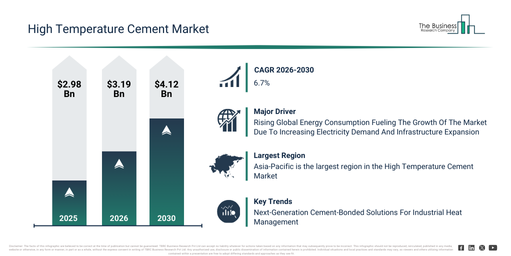
The high temperature cement market has experienced significant growth in recent years. It is forecast to expand from $2.98 billion in 2025 to $3.19 billion in 2026, demonstrating a compound annual growth rate (CAGR) of 6.9%. Historically, this market’s expansion can be attributed to factors such as an escalating demand for refractory cement in industrial applications, the growth of high-temperature processing industries, increased utilization within the aerospace and energy sectors, the broader adoption of heat-resistant cement in construction, and the ongoing development of thermal-stable cement formulations.
The high temperature cement market is anticipated to experience robust expansion in the coming years. By 2030, its valuation is set to reach $4.12 billion, demonstrating a compound annual growth rate (CAGR) of 6.7%. This projected growth is driven by several factors, including the increasing integration of AI for monitoring, the rise of robotics in cement handling, the broadening of connected cement manufacturing processes, the growing need for energy-efficient high-temperature cement, and the creation of sophisticated heat-resistant cement products. Key trends during this period encompass the use of specialized high-temperature resistant cement mixtures, the incorporation of AI-driven quality monitoring, the utilization of robots for cement handling tasks, the spread of connected manufacturing platforms for cement, and the implementation of energy-saving production methods for high-temperature cement.
Get A Free Sample Of The High Temperature Cement Market Report 2026:
What Is Driving The Growth Of The High Temperature Cement Market?
The increasing global energy consumption is projected to drive the expansion of the high temperature cement market in the future. This rise in energy use is fueled by growing electricity demand resulting from rapid industrialization and digitalization across both developing and developed economies. High temperature cement supports this growth by providing durable, thermally resistant materials essential for constructing boilers, furnaces, and reactors that operate under extreme heat conditions in power generation facilities. For instance, in January 2024, the International Energy Agency (IEA), a France-based intergovernmental organization, stated that global electricity demand grew by 2.2% in 2023 compared to 2022, indicating sustained growth in power generation capacity worldwide. Additionally, global electricity demand is expected to accelerate over the next three years, increasing by an average of 3.4% annually through 2026. Therefore, the escalating global energy consumption is a primary driver for the growth of the high temperature cement market.
How Is The High Temperature Cement Market Segmented?
The high temperature cement market covered in this report is segmented –
1) By Product Type: Alumina Cement, Magnesium Cement, Silicate Cement, Insulating Cement
2) By Property Characteristics: Thermal Stability, Mechanical Strength, Chemical Resistance, Durability, Heat Resistance
3) By Distribution Channel: Online Retail, Offline Retail, Direct Sales, Distributors Or Wholesalers
4) By Application: High-Temperature Insulation, Refractory Linings, Casting Material, Ceramic Coatings
5) By End-use Industry: Aerospace, Construction, Manufacturing, Energy And Power, Oil And Gas
Subsegments:
1) By Alumina Cement: Low Alumina Cement, Medium Alumina Cement, High Alumina Cement, Calcium Aluminate Cement (CAC), White Fused Alumina Cement
2) By Magnesium Cement: Magnesium Oxychloride Cement (MOC), Magnesium Oxysulfate Cement (MOS), Sorel Cement, Dead Burned Magnesia-Based Cement, Fused Magnesia-Based Cement
3) By Silicate Cement: Sodium Silicate Cement, Potassium Silicate Cement, Ethyl Silicate Cement, Lithium Silicate Cement, Water Glass-Based Silicate Cement
4) By Insulating Cement: Lightweight Insulating Cement, Fiber Reinforced Insulating Cement, Refractory Insulating Cement, Castable Insulating Cement, Foamed Or Cellular Insulating Cement
What Are The Latest Trends In The High Temperature Cement Market?
Major companies operating in the high temperature cement market are concentrating on technological advancements, such as cement-bonded refractory castables, to enhance thermal efficiency, reduce furnace downtime, and improve the durability and performance of materials within extreme industrial environments. Cement-bonded refractory castables refer to high-temperature-resistant materials composed of refractory aggregates and binders, typically calcium aluminate cement, which form resilient, heat-stable linings for furnaces, kilns, and other thermal processing equipment. For example, in February 2025, Calderys, a France-based provider of refractory solutions and services, introduced its expanded Fast Dry (CALDE FD) refractory solutions, specifically engineered to optimize dry-out processes in industrial furnaces. These new cement-bonded castables enable operators in sectors like utilities, waste incineration, and aluminum production to achieve faster heat-up times, decreasing furnace dry-out durations by up to 72 hours to reach 1,200°C, while maintaining superior performance and compatibility with existing installation systems. By improving operational efficiency, minimizing downtime, and enhancing energy utilization, CALDE FD strengthens Calderys’ commitment to reliability, cost efficiency, and sustainability in high-temperature industrial applications.
Who Are The Key Players In The High Temperature Cement Market?
Major companies operating in the high temperature cement market are Çimsa Çimento Sanayi ve Ticaret Anonim Şirketi, Almatis B.V., Kaifeng Datong Refractories Co. Ltd., Calucem d.o.o., Vitcas, Rongsheng Refractory Co. Ltd., Rondo Energy Inc., Refmon Industries, Zhengzhou Kerui Refractory, Mahakoshal Refractories Pvt. Ltd., Zibo Jucos Co. Ltd., Future Refractories, Kaiyuan Refractory, Skg Refractories Ltd, Janta Refractory Group, Oreworld Trade (Tangshan) Co. Ltd., Highland Refractory, Sarvottam Aluminates, Janta Overseas, Shardha Refractories.
Read The Complete High Temperature Cement Market Report 2026:
Which Region Is The Largest In The High Temperature Cement Market?
Asia-Pacific was the largest region in the high temperature cement market in 2025, and it is expected to be the fastest-growing region in the forecast period. The regions covered in the high temperature cement market report are Asia-Pacific, South East Asia, Western Europe, Eastern Europe, North America, South America, Middle East, Africa.
Reach Out To Our Team:
The Business Research Company: https://www.thebusinessresearchcompany.com/
Americas: +1 310-496-7795
Asia: +44 7882 955267 & +91 8897263534
Europe: +44 7882 955267
Email us at: marketing@tbrc.info
Follow us on:
LinkedIn: https://in.linkedin.com/company/the-business-research-company
YouTube: https://www.youtube.com/channel/UC24_fI0rV8cR5DxlCpgmyFQ
Global Market Model: https://www.thebusinessresearchcompany.com/global-market-model

Wasay has over a decade of experience in market research, data modelling, and analytics, with prior experience at GlobalData and Decision Tree Consulting Services. At The Business Research Company , he leads research operations across syndicated studies, customized consulting engagements, and the Global Market Model platform. His professional experience includes supporting organizations such as Boston Consulting Group, KPMG, and Ernst & Young. Wasay holds a degree in Electronics and Communications Engineering, postgraduate management qualifications from International Management Institute Belgium and Indian School of Business and Entrepreneurship, and completed the Integrated Program in Business Analytics from Indian Institute of Management Indore.