Market attractiveness scoring, total addressable market sizing, company benchmarking matrices, interactive Excel dashboards, deeper supply chain intelligence, emerging startup tracking, and granular product-level insights are among the key offerings featured in The Business Research Company’s 2026 market reports, designed to deliver more actionable and strategically valuable research.
#Commercial Building Insulation Market Growth Outlook: How Much Bigger Will The Market Be By 2030?#_x000D_
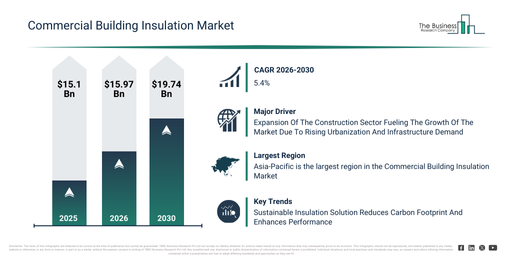
The commercial building insulation market has shown robust growth over recent years. Its valuation is anticipated to rise from $15.1 billion in 2025 to $15.97 billion in 2026, achieving a compound annual growth rate (CAGR) of 5.8%. This historical expansion can be attributed to several factors, including the rising use of insulation for commercial energy efficiency, the increasing adoption of thermal and acoustic control systems, a reliance on polymer- and mineral-based insulation materials, the expansion of commercial construction activities, and the growing need for moisture and fire-resistant insulation solutions._x000D_
_x000D_
The commercial building insulation market is anticipated to experience substantial growth in the upcoming years. Its valuation is projected to reach $19.74 billion by 2030, demonstrating a compound annual growth rate (CAGR) of 5.4%. This projected growth is driven by factors such as an escalating demand for sustainable insulation products, increased implementation of smart energy management systems, advancements in high-performance insulation technologies, the creation of sophisticated reflective and vacuum insulation panels, and the wider acceptance of more stringent building energy codes. Key trends anticipated during this period encompass the incorporation of AI for optimizing building energy, the emergence of low-carbon insulation solutions, improvements in automated insulation production processes, the utilization of networked sensors to monitor insulation efficiency, and the broader application of digital modeling and thermal simulation instruments._x000D_
_x000D_
#Request A Free Commercial Building Insulation Market Sample From The Business Research Company:#_x000D_
_x000D_
#How Is The Key Growth Driver Influencing The Commercial Building Insulation Market?#_x000D_
The anticipated growth of the commercial building insulation market is expected to be propelled by the expanding construction sector. This sector is defined as the industry focused on building, renovating, and maintaining infrastructure, residential, commercial, and industrial projects. The construction sector’s expansion is largely attributed to rapid urbanization, which leads to an increased demand for housing, transportation networks, and public infrastructure as more people relocate to cities. Commercial building insulation provides support to the construction sector by boosting energy efficiency, making it indispensable for sustainable and high-performance buildings. It works by reducing heating and cooling requirements, which in turn lowers operational costs and enhances occupant comfort. For example, the United States Census Bureau, a US-based government agency, stated in April 2025 that construction spending reached $2,156,495 million in 2024, showing an increase from $2,023,662 million in 2023. Thus, the expansion within the construction sector is a significant driver for the growth of the commercial building insulation market._x000D_
_x000D_
#Commercial Building Insulation Market Segmentation By Category: What Does The 2026 Report Cover?#_x000D_
The commercial building insulation market covered in this report is segmented – _x000D_
_x000D_
1) By Material Type: Fiberglass, Mineral Wool, Cellulose, Polyurethane Foam, Polystyrene, Other Material Types_x000D_
2) By Application: Walls, Roofs, Floors, Other Application_x000D_
3) By End-Use: Offices, Retail, Hospitality, Healthcare, Other End-Uses_x000D_
_x000D_
Subsegments:_x000D_
1) By Fiberglass: Blanket Insulation, Board Insulation, Loose Fill Insulation_x000D_
2) By Mineral Wool: Rock Wool, Slag Wool, Loose Fill, Boards And Batts_x000D_
3) By Cellulose: Dry Cellulose, Spray Applied Cellulose, Stabilized Cellulose_x000D_
4) By Polyurethane Foam: Open Cell Foam, Closed Cell Foam, Spray Foam_x000D_
5) By Polystyrene: Expanded Polystyrene, Extruded Polystyrene_x000D_
6) By Other Material Type: Cotton Insulation, Aerogel Insulation, Hemp Insulation, Vermiculite Insulation_x000D_
_x000D_
#How Are Industry Players Changing The Commercial Building Insulation Market Landscape?#_x000D_
Leading companies in the commercial building insulation market are focusing on developing sustainable products, such as bio-based insulation materials, to improve energy efficiency, reduce environmental impact, and meet stringent regulatory standards. Bio-based insulation materials refer to eco-friendly alternatives made from renewable resources like plant fibers, recycled materials, or other natural components, offering superior thermal performance while minimizing carbon footprint. For instance, in November 2023, Kingspan Group, an Ireland-based building materials company, launched Hemkor, a bio-based insulation product. Hemkor is a groundbreaking rigid insulation board made from responsibly sourced bio-based materials, offering excellent thermal efficiency and fire resistance. This innovative product aligns with circular economy principles, reducing reliance on fossil fuel-derived materials while maintaining high performance in commercial building applications. Hemkor exemplifies Kingspan’s commitment to sustainability, helping construction projects achieve lower embodied carbon and enhanced energy efficiency without compromising safety or durability._x000D_
_x000D_
#Commercial Building Insulation Market Global Key Players And Competitive Overview#_x000D_
Major companies operating in the commercial building insulation market are BASF SE, Dow Inc., Saint-Gobain S.A., Covestro AG, Knauf Insulation, Sika AG, Owens Corning, Kingspan Group plc, Huntsman Corporation, Etex Group, Rockwool International A/S, Alkegen, GAF Materials Corporation, CertainTeed Corporation, Johns Manville Corporation, Armacell International S.A, Atlas Roofing Corporation, Aspen Aerogels Inc., URSA Insulation S.A., Lloyd Insulations Limited, Brucha d.o.o., Bradford Insulation, Compagnie de Saint-Gobain S.A., Thermotec GmbH, Neo Thermal Insulation _x000D_
_x000D_
#Explore Comprehensive Commercial Building Insulation Market Coverage In The Full Report:#_x000D_
_x000D_
#Regional Analysis Of The Commercial Building Insulation Market: Where Is The Industry Concentrated?#_x000D_
Asia-Pacific was the largest region in the commercial building insulation market in 2025. The regions covered in the commercial building insulation market report are Asia-Pacific, South East Asia, Western Europe, Eastern Europe, North America, South America, Middle East, Africa._x000D_
_x000D_
#Reach Out To Our Team:#_x000D_
_x000D_
The Business Research Company: https://www.thebusinessresearchcompany.com/_x000D_
Americas: +1 310-496-7795_x000D_
Asia: +44 7882 955267 & +91 8897263534_x000D_
Europe: +44 7882 955267_x000D_
Email us at: marketing@tbrc.info_x000D_
_x000D_
#Follow us on:#_x000D_
_x000D_
LinkedIn: https://in.linkedin.com/company/the-business-research-company_x000D_
YouTube: https://www.youtube.com/channel/UC24_fI0rV8cR5DxlCpgmyFQ_x000D_
Global Market Model: https://www.thebusinessresearchcompany.com/global-market-model

Wasay has over a decade of experience in market research, data modelling, and analytics, with prior experience at GlobalData and Decision Tree Consulting Services. At The Business Research Company , he leads research operations across syndicated studies, customized consulting engagements, and the Global Market Model platform. His professional experience includes supporting organizations such as Boston Consulting Group, KPMG, and Ernst & Young. Wasay holds a degree in Electronics and Communications Engineering, postgraduate management qualifications from International Management Institute Belgium and Indian School of Business and Entrepreneurship, and completed the Integrated Program in Business Analytics from Indian Institute of Management Indore.