Market attractiveness scoring, total addressable market sizing, company benchmarking matrices, interactive Excel dashboards, deeper supply chain intelligence, emerging startup tracking, and granular product-level insights are among the key offerings featured in The Business Research Company’s 2026 market reports, designed to deliver more actionable and strategically valuable research.
Smart Building Acoustic Sensor Market Size Overview: From Historical Performance To The 2030 Forecast
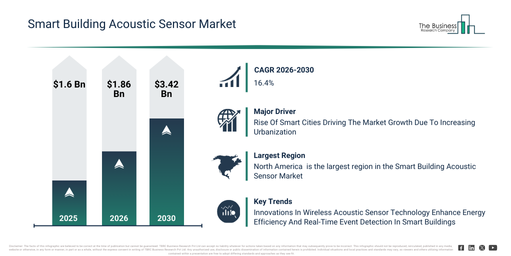
The smart building acoustic sensor market size has experienced rapid expansion in recent years. This market is forecasted to increase from $1.6 billion in 2025 to $1.86 billion in 2026, exhibiting a compound annual growth rate (CAGR) of 16.3%. The growth observed in the historic period can be attributed to the rising adoption of smart acoustic sensors, increasing use of IoT-enabled noise monitoring, growth in AI-based sound analysis, expansion of occupancy detection solutions, and integration with building automation systems.
The smart building acoustic sensor market size is anticipated to undergo significant expansion in the upcoming years. It is projected to grow to $3.42 billion in 2030 at a compound annual growth rate (CAGR) of 16.4%. The expansion foreseen during this period is driven by the increasing deployment of wireless and wired acoustic sensors, the adoption of AI-driven monitoring solutions, the broadening of real-time sound analytics, the creation of predictive noise management, and the rising integration with HVAC and security systems. Key trends for the forecast period include the implementation of AI-based acoustic monitoring systems, the integration of wireless and wired sensor networks, the adoption of IoT-enabled noise analysis platforms, the expansion of smart building occupancy detection, and the development of connected HVAC and security acoustic solutions.
Get A Free Sample Of The Business Research Company’s Smart Building Acoustic Sensor Market Report:
What Factor Is Increasing Demand In The Smart Building Acoustic Sensor Market?
The future expansion of the smart building acoustic sensor market is anticipated to be fueled by the emergence of smart cities. A smart city is defined as an urban environment employing various electronic techniques and sensors to gather data for effective management of assets, resources, and services. The increase in smart cities stems from growing global urbanization and governmental financial commitments to digital infrastructure, aimed at enhancing urban quality of life and operational effectiveness. Rapid urbanization significantly propels the development of smart cities, given that over half of the world’s population resides in urban settings, thus generating a need for intelligent infrastructure solutions. With the growth of smart cities, the demand for acoustic sensors escalates because these tools are crucial for monitoring noise, evaluating environmental quality, and fostering healthier urban living spaces via real-time sound level administration. For example, data from April 2025, provided by the International Institute for Management Development (IMD), a Switzerland-based business school, indicated that 146 cities were evaluated in the Smart City Index 2025, signifying a broader global scope for the study. Consequently, the proliferation of smart cities is a key factor boosting the growth of the smart building acoustic sensor market.
Which Segments Make Up The Smart Building Acoustic Sensor Market?
The smart building acoustic sensor market covered in this report is segmented –
1) By Product Type: Wired Acoustic Sensors, Wireless Acoustic Sensors
2) By Distribution Channel: Direct Sales, Distributors Or Wholesalers, Online Retail
3) By Application: Noise Monitoring, Security And Surveillance, Heating, Ventilation, And Air Conditioning (HVAC) System Monitoring, Occupancy Detection, Other Applications
4) By End-User: Commercial Buildings, Residential Buildings, Industrial Facilities, Educational Institutions, Healthcare Facilities, Other End-Users
Subsegments:
1) By Wired Acoustic Sensors: Analog Wired Sensors, Digital Wired Sensors, Networked (Ethernet Or PoE) Wired Sensors
2) By Wireless Acoustic Sensors: Wireless Fidelity (Wi-Fi) Enabled Sensors, Bluetooth-Enabled Sensors, Zigbee Or Z-Wave Sensors, Long Range Wide Area Network (LoRaWAN) Or Narrowband Internet of Things (NB-IoT) Sensors
Smart Building Acoustic Sensor Market Emerging Trends: What Are Industry Leaders Focusing On?
Major companies operating in the smart building acoustic sensor market are prioritizing the development of sophisticated solutions, such as wireless sensor systems, to facilitate seamless integration with building management platforms, enhance energy efficiency, and provide real-time acoustic event detection. These wireless sensor systems are networks of interconnected sensors that transmit data using wireless communication technologies, thereby eliminating the necessity for physical cabling for power or data transfer. For instance, in February 2025, PassiveLogic, a US-based autonomous building infrastructure company, introduced the Sense Nano. This device gathers energy from its environment, requiring no wires or batteries. Its truly wireless sensor design permits flexible placement within buildings, featuring a compact form factor (less than 2 in diameter) and architecturally sensitive housing made from CNC-machined aircraft-alloy aluminium. It also supports rapid deployment via a companion mobile app, Quantum Lens, which automatically recognizes the sensor’s location and streamlines its integration into a building’s digital twin.
Major Companies To Know In The Smart Building Acoustic Sensor Market
Major companies operating in the smart building acoustic sensor market are Robert Bosch GmbH, Siemens AG, Cisco Systems Inc, Schneider Electric SE, Honeywell International Inc, ABB Ltd, Johnson Controls International plc, Texas Instruments Incorporated, Infineon Technologies AG, STMicroelectronics N.V., Emerson Electric Co, Murata Manufacturing Co. Ltd, Analog Devices Inc, Delta Electronics Inc, Legrand SA, Omron Corporation, Beckhoff Automation GmbH, Axis Communications AB, Crestron Electronics Inc, Sound Intelligence B.V.
Read The In-Depth Smart Building Acoustic Sensor Market Report:
Smart Building Acoustic Sensor Market Regional Landscape: Largest Region In 2025
North America was the largest region in the smart building acoustic sensor market in 2025. Asia-Pacific is expected to be the fastest-growing region in the forecast period. The regions covered in the smart building acoustic sensor market report are Asia-Pacific, South East Asia, Western Europe, Eastern Europe, North America, South America, Middle East, Africa.
Reach Out To Our Team:
The Business Research Company: https://www.thebusinessresearchcompany.com/
Americas: +1 310-496-7795
Asia: +44 7882 955267 & +91 8897263534
Europe: +44 7882 955267
Email us at: marketing@tbrc.info
Follow us on:
LinkedIn: https://in.linkedin.com/company/the-business-research-company
YouTube: https://www.youtube.com/channel/UC24_fI0rV8cR5DxlCpgmyFQ
Global Market Model: https://www.thebusinessresearchcompany.com/global-market-model

Wasay has over a decade of experience in market research, data modelling, and analytics, with prior experience at GlobalData and Decision Tree Consulting Services. At The Business Research Company , he leads research operations across syndicated studies, customized consulting engagements, and the Global Market Model platform. His professional experience includes supporting organizations such as Boston Consulting Group, KPMG, and Ernst & Young. Wasay holds a degree in Electronics and Communications Engineering, postgraduate management qualifications from International Management Institute Belgium and Indian School of Business and Entrepreneurship, and completed the Integrated Program in Business Analytics from Indian Institute of Management Indore.