With a focus on actionable insights and strategic value, The Business Research Company’s 2026 market reports include market attractiveness scoring, total addressable market sizing, company benchmarking matrices, interactive Excel dashboards, deeper supply chain intelligence, emerging startup tracking, and granular product-level insights.
Hypergolic Propellant Systems Market Size Forecast Points To $2.32 Billion In Revenue By 2030
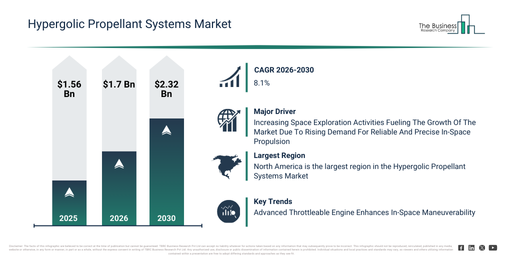
The hypergolic propellant systems market has experienced significant growth in recent years. It is anticipated to expand from $1.56 billion in 2025 to $1.7 billion in 2026, achieving a compound annual growth rate (CAGR) of 9.0%. This historical growth can be attributed to several factors, including an increased reliance on hypergolic thrusters for spacecraft maneuvering, the rising utilization of hydrazine derivatives, the expansion of commercial satellite launches, a dependence on imported aerospace chemicals, and the early adoption of restartable in-orbit engines.
The hypergolic propellant systems market is anticipated to demonstrate robust expansion over the coming years. Its size is projected to reach $2.32 billion by 2030, displaying a compound annual growth rate (CAGR) of 8.1%. This growth during the forecast period can be attributed to factors such as the increasing development of green hypergolic propellants, rising investment in advanced propulsion modules, the expansion of autonomous spacecraft maneuvering, the broadening of government space programs, and a growing demand for high-reliability orbital engines. Major trends foreseen in this period include the integration of AI-based propellant flow control, the expansion of automated hypergolic system manufacturing, the development of digital safety and monitoring platforms, the adoption of low-emission hypergolic alternatives, and the creation of autonomous in-orbit maneuvering thrusters.
Get A Free Hypergolic Propellant Systems Market Sample Covering Drivers, Trends And Key Players:
Hypergolic Propellant Systems Market Driver Analysis: Key Factor Supporting Revenue Growth
Future expansion of the hypergolic propellant systems market is anticipated to be driven by rising space exploration endeavors. These activities encompass missions, research, and space-based operations aimed at achieving scientific discoveries, technological progress, and commercial ventures beyond Earth. The surge in space exploration stems from a heightened need for sophisticated communication and Earth observation satellites, which facilitate worldwide connectivity, environmental oversight, and improved security. Hypergolic propellant systems bolster space exploration endeavors by offering dependable and immediate ignition, rendering them perfect for crucial in-space maneuvers. They also allow for precise thrust regulation and extended storage capabilities, thereby boosting mission safety and operational adaptability. For example, Novaspace, a French space consulting firm, reported in September 2023 that government expenditure on space exploration totaled $27 billion in 2024, with projections indicating an increase to almost $31 billion by 2034. Consequently, the expanding scope of space exploration activities is fueling the expansion of the hypergolic propellant systems market.
Hypergolic Propellant Systems Market Segmentation Framework: Major Segments At A Glance
The hypergolic propellant systems market covered in this report is segmented –
1) By Propellant Type: Monomethylhydrazine (MMH), Unsymmetrical Dimethylhydrazine (UDMH), Nitrogen Tetroxide (N2O4), Other Propellant Type
2) By Application: Spacecraft, Launch Vehicles, Satellites, Other Applications
3) By End-User: Commercial, Military, Government
Subsegments:
1) By Monomethylhydrazine (MMH): Aerospace-Grade Monomethylhydrazine (MMH), Commercial-Grade Monomethylhydrazine (MMH), Monomethylhydrazine (MMH) With Inhibitors, High-Purity Monomethylhydrazine (MMH)
2) By Unsymmetrical Dimethylhydrazine (UDMH): Aerospace-Grade Unsymmetrical Dimethylhydrazine (UDMH), Blended Unsymmetrical Dimethylhydrazine (UDMH) Formulations, Stabilized Unsymmetrical Dimethylhydrazine (UDMH), Technical-Grade Unsymmetrical Dimethylhydrazine (UDMH)
3) By Nitrogen Tetroxide (N2O4): Inhibited Red Fuming Nitric Acid (IRFNA), High-Density Nitrogen Tetroxide (N2O4), Mixed Oxides Of Nitrogen (MON), Cryogenic Nitrogen Tetroxide (N2O4) Derivatives
4) By Other Propellant: Hydrazine Derivatives, Green Hypergolic Propellants, Ionic Liquid Propellants, Triethylaluminum-Triethylborane (TEA-TEB) Systems
Latest Hypergolic Propellant Systems Market Developments And Emerging Trends
Leading companies operating in the hypergolic propellant systems market are prioritizing the development of advanced propulsion technologies, including throttleable rocket engines, to enhance mission flexibility, improve performance, and enable precise control in space operations. Throttleable rocket engines are propulsion systems that can smoothly and efficiently adjust their thrust levels during flight, which optimizes fuel consumption and increases maneuverability. For instance, in November 2023, Sierra Space Corporation, a US-based aerospace company, conducted tests on its new 5,500 pound-force (lbf) hypergolic rocket engine. This engine offers continuous throttling, providing exceptional control for in-space propulsion applications. The sophisticated hypergolic system ensures reliable ignition and stable performance across various thrust levels, making it ideal for orbital adjustments, docking maneuvers, and deep-space missions. The engine’s design also emphasizes reusability and operational efficiency, aligning with the growing demand for sustainable and adaptable space propulsion solutions.
Which Companies Are Shaping The Hypergolic Propellant Systems Market?
Major companies operating in the hypergolic propellant systems market are IHI Corporation, RTX Corporation, Airbus SE, The Boeing Company, Lockheed Martin Corporation, Northrop Grumman Corporation, Safran Aircraft Engines S.A.S., L3Harris Technologies Inc., Space Exploration Technologies Corp., Blue Origin LLC, ArianeGroup SAS, Thales Alenia Space S.A.S., The Aerospace Corporation, OHB System AG, Sierra Space Corporation, Rocket Lab USA Inc., Sitael S.p.A., Agile Space Industries Inc., InSpacePropulsion Technologies GmbH, Bradford Space Inc.
Dive Deeper Into The Hypergolic Propellant Systems Market With The Full Report:
Hypergolic Propellant Systems Market Regional Distribution: Where Is Revenue Concentrated?
North America was the largest region in the hypergolic propellant systems market in 2025. The regions covered in the hypergolic propellant systems market report are Asia-Pacific, South East Asia, Western Europe, Eastern Europe, North America, South America, Middle East, Africa.
Reach Out To Our Team:
The Business Research Company: https://www.thebusinessresearchcompany.com/
Americas: +1 310-496-7795
Asia: +44 7882 955267 & +91 8897263534
Europe: +44 7882 955267
Email us at: marketing@tbrc.info
Follow us on:
LinkedIn: https://in.linkedin.com/company/the-business-research-company
YouTube: https://www.youtube.com/channel/UC24_fI0rV8cR5DxlCpgmyFQ
Global Market Model: https://www.thebusinessresearchcompany.com/global-market-model

Wasay has over a decade of experience in market research, data modelling, and analytics, with prior experience at GlobalData and Decision Tree Consulting Services. At The Business Research Company , he leads research operations across syndicated studies, customized consulting engagements, and the Global Market Model platform. His professional experience includes supporting organizations such as Boston Consulting Group, KPMG, and Ernst & Young. Wasay holds a degree in Electronics and Communications Engineering, postgraduate management qualifications from International Management Institute Belgium and Indian School of Business and Entrepreneurship, and completed the Integrated Program in Business Analytics from Indian Institute of Management Indore.