Market attractiveness scoring, total addressable market sizing, company benchmarking matrices, interactive Excel dashboards, deeper supply chain intelligence, emerging startup tracking, and granular product-level insights are among the key offerings featured in The Business Research Company’s 2026 market reports, designed to deliver more actionable and strategically valuable research.
Sustainable Construction Materials Market Size Overview: From Historical Performance To The 2030 Forecast
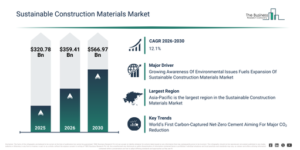
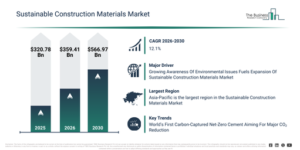
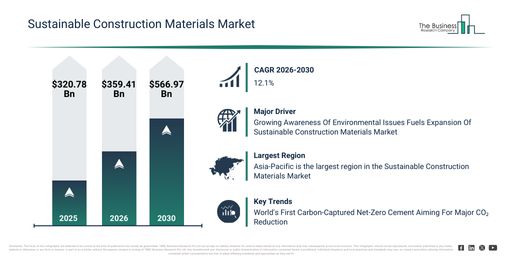
The sustainable construction materials market has observed substantial growth in recent years. Its value is expected to rise from $320.78 billion in 2025 to $359.41 billion in 2026, at a compound annual growth rate (CAGR) of 12.0%. This expansion in the past can be ascribed to factors like heightened environmental awareness, the initial integration of recycled building materials, a proliferation of green certification schemes, an increase in sustainable construction projects, and a surging demand for low-carbon products.
The sustainable construction materials market is expected to experience substantial expansion in the coming years. Its size is projected to reach $566.97 billion in 2030, advancing at a compound annual growth rate (CAGR) of 12.1%. This anticipated growth during the forecast period is driven by factors such as increased investment in circular material technologies, the expansion of renewable material production, a rising adoption of green building mandates, advancements in composite manufacturing, and broader integration of automated sustainable construction systems. Prominent trends expected in this period include the growing application of low-carbon construction materials, the expansion of automated material processing, increased implementation of smart material tracking, growth in sustainable prefabrication, and the rising utilization of recycled and renewable inputs.
Get A Free Sample Of The Business Research Company’s Sustainable Construction Materials Market Report:
What Factor Is Increasing Demand In The Sustainable Construction Materials Market?
The expanding understanding of environmental concerns is anticipated to fuel the future expansion of the sustainable construction materials market. This awareness involves comprehending how human actions affect the environment and recognizing the necessity for measures to resolve these challenges. This rising consciousness is a result of heightened media attention, educational efforts, and advocacy, which collectively boost public apprehension and insight. Sustainable construction materials tackle environmental problems by decreasing the ecological impact of building endeavors. This is achieved through the integration of environmentally friendly components that enhance energy efficiency, reduce waste generation, and decrease greenhouse gas outputs. Such materials are instrumental in fostering green buildings, thereby contributing to enduring environmental preservation and sustainability. As an illustration, figures from July 2023, provided by the Office for National Statistics, a UK-based government department, indicated that approximately 86.5% of adults in Great Britain had altered their lifestyles to address environmental concerns. Among these, 73.6% reported making some modifications, while 12.8% had implemented substantial adjustments. Consequently, the increasing recognition of environmental challenges is propelling the expansion of the sustainable construction materials market.
Which Segments Make Up The Sustainable Construction Materials Market?
The sustainable construction materials market covered in this report is segmented –
1) By Type: Bamboo, Reclaimed Wood, Green Insulation Materials, Structural Insulated Panels, Cross-Laminated Timber, Recycled Metal, Precast Concentrate, Recycled Plastic-Based Cement, Other Types
2) By Application: Exterior, Interior, Structural, Other Applications
3) By End-User: Residential, Commercial, Industrial
Subsegments:
1) By Bamboo: Solid Bamboo, Bamboo Laminates, Bamboo Composites
2) By Reclaimed Wood: Flooring, Beams And Timbers, Millwork And Paneling
3) By Green Insulation Materials: Cellulose Insulation, Wool Insulation, Cotton Insulation
4) By Structural Insulated Panels: SIPs With EPS, SIPs With XPS, SIPs With Polyurethane
5) By Cross-Laminated Timber: Standard CLT Panels, Prefabricated CLT Components
6) By Recycled Metal: Recycled Steel, Recycled Aluminum
7) By Precast Concentrate: Precast Wall Panels, Precast Flooring & Roofing Elements, Precast Structural Components
8) By Recycled Plastic-Based Cement: Plastic-Aggregate Concrete, Plastic-Modified Cement Composites, Polymer-Based Eco Concrete
9) By Other Types, Hempcrete, Ferrock, Mycelium-Based Materials, Fly Ash–Based Materials
Sustainable Construction Materials Market Emerging Trends: What Are Industry Leaders Focusing On?
Leading businesses within the sustainable construction materials market are concentrating on creating innovative solutions, like carbon-captured net-zero cement, to substantially cut carbon emissions and enhance the ecological impact of building endeavors. This type of cement, known as carbon-captured net-zero cement, seeks to reach a net-zero carbon footprint by capturing and either using or sequestering the carbon dioxide (CO2) emissions generated during its production process. An example is in November 2023, when Heidelberg Materials, a building material firm headquartered in Germany, launched evoZero, which is recognized as the world’s inaugural carbon-captured net-zero cement. This launch was intended to meet the pressing demand for sustainable construction materials and spearhead the cement industry’s efforts towards decarbonization. This pioneering product employs advanced carbon capture and storage (CCS) technology at the company’s Brevik plant in Norway, enabling it to achieve net-zero carbon emissions without depending on outside carbon offsets. Furthermore, it incorporates a transparent carbon accounting system that is validated using blockchain technology. This pivotal innovation represents a major advancement towards attaining carbon neutrality within the cement industry, fostering sustainable construction methods, and aiming for a reduction of 10 million metric tons of CO2 by 2030.
Major Companies To Know In The Sustainable Construction Materials Market
Major companies operating in the sustainable construction materials market are BASF SE, Compagnie de Saint-Gobain, Holcim Group Ltd., 3M Company, Novelis Inc., Knauf Gips KG, Skanska AB, CEMEX S.A.B. de C.V., DuPont de Nemours Inc., Sika AG, Owens Corning, Kingspan Group plc, Rockwool International A/S, Tarmac Ltd., Boral Limited, Forbo Holding AG, GAF Materials Corporation, Heidelberg Materials AG, The Alumasc Group plc, RedBuil LLC, Ecovative Design LLC
Read The In-Depth Sustainable Construction Materials Market Report:
Sustainable Construction Materials Market Regional Landscape: Largest Region In 2025
Asia-Pacific was the largest region in the sustainable construction materials market in 2025. The regions covered in the sustainable construction materials market report are Asia-Pacific, South East Asia, Western Europe, Eastern Europe, North America, South America, Middle East, Africa.
Reach Out To Our Team:
The Business Research Company: https://www.thebusinessresearchcompany.com/
Americas: +1 310-496-7795
Asia: +44 7882 955267 & +91 8897263534
Europe: +44 7882 955267
Email us at: marketing@tbrc.info
Follow us on:
LinkedIn: https://in.linkedin.com/company/the-business-research-company
YouTube: https://www.youtube.com/channel/UC24_fI0rV8cR5DxlCpgmyFQ
Global Market Model: https://www.thebusinessresearchcompany.com/global-market-model

Wasay has over a decade of experience in market research, data modelling, and analytics, with prior experience at GlobalData and Decision Tree Consulting Services. At The Business Research Company , he leads research operations across syndicated studies, customized consulting engagements, and the Global Market Model platform. His professional experience includes supporting organizations such as Boston Consulting Group, KPMG, and Ernst & Young. Wasay holds a degree in Electronics and Communications Engineering, postgraduate management qualifications from International Management Institute Belgium and Indian School of Business and Entrepreneurship, and completed the Integrated Program in Business Analytics from Indian Institute of Management Indore.