The Business Research Company’s 2026 market reports combine market attractiveness scoring, total addressable market sizing, company benchmarking matrices, interactive Excel dashboards, deeper supply chain intelligence, emerging startup tracking, and granular product-level insights to deliver research that is more actionable and strategically valuable.
Trenchless Pipe Rehabilitation Market Size Review: What Shaped Past Growth And What Will Drive Future Expansion?
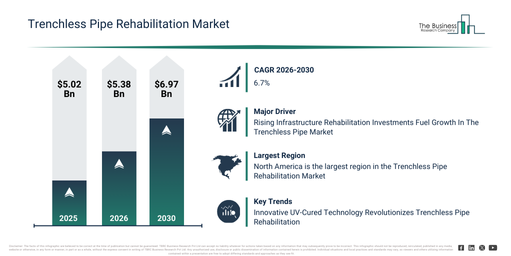
The trenchless pipe rehabilitation market size has experienced robust growth in recent years. It is projected to increase from $5.02 billion in 2025 to $5.38 billion in 2026, exhibiting a compound annual growth rate (CAGR) of 7.1%. The expansion observed during the historic period can be attributed to factors such as the rising aging underground pipeline infrastructure, an increase in municipal water and wastewater projects, the growing adoption of minimal excavation techniques, a strong reliance on trenchless repair technologies, and the broader expansion of industrial pipeline maintenance projects.
The trenchless pipe rehabilitation market is projected to experience substantial expansion over the coming years. Its size is forecast to reach $6.97 billion in 2030, exhibiting a compound annual growth rate (CAGR) of 6.7%. This anticipated growth during the forecast period is primarily driven by factors such as the rising application of AI and digital monitoring in rehabilitation processes, the uptake of automated pipe repair solutions, the creation of advanced high-performance liners, an increase in large-diameter pipe rehabilitation projects, and the broadening of hybrid and specialized rehabilitation techniques. Key trends anticipated within this period encompass the integration of AI-enabled monitoring for pipe rehabilitation, the deployment of smart CIPP and pipe bursting technologies, the spread of digital tunnel boring and auger systems, the connectivity of rehabilitation equipment, and the rise of autonomous pipe inspection and maintenance offerings.
Access Free Sample Pages From The Trenchless Pipe Rehabilitation Market Report 2026:
Understanding The Main Driver Of The Trenchless Pipe Rehabilitation Market
The trenchless pipe rehabilitation market is anticipated to grow in the coming period, propelled by the rising demand for infrastructure rehabilitation. Infrastructure rehabilitation involves repairing, restoring, and upgrading existing infrastructure systems to ensure their continuous functionality, safety, and efficiency. This demand stems from factors such as aging infrastructure, economic impact, environmental considerations, and sustainability goals. Trenchless pipe rehabilitation offers a minimally invasive, cost-effective, and environmentally friendly method for infrastructure rehabilitation. It efficiently tackles the challenges associated with aging underground pipelines, thereby contributing to the overall improvement and longevity of essential infrastructure systems. For instance, in August 2023, according to the American Road & Transportation Builders Association (ARTBA), a US-based government agency, more than 222,000 U.S. bridges require major repair work or should be replaced, which represents 36% of all U.S. structures. Consequently, the increasing demand for infrastructure rehabilitation acts as a key driver for the trenchless pipe rehabilitation market.
Trenchless Pipe Rehabilitation Market Segment Mapping For 2026 And Beyond
The trenchless pipe rehabilitation market covered in this report is segmented –
1) By Type: <18 Inch Pipes Line, 18-36 Inch Pipes, >36 Inch Pipes, Other Types
2) By Method Type: Cured-In-Place Pipe (CIPP), Pipe Bursting, Slip-Lining, Spray-In-Place Piping (SIPP), Other Method Types
3) By Application Type: Main Pipes, Wastewater Pipes, Other Application Types
4) By End User: Residential, Commercial, Industrial, Municipal
Subsegments:
1) By <18 Inch Pipes Line: Small Diameter Pipe Rehabilitation, CIPP (Cured-In-Place Pipe) For Small Diameter, Pipe Bursting For Small Diameter, Sliplining Techniques For Small Diameter Pipes
2) By 18-36 Inch Pipes: CIPP for Medium Diameter Pipes, Pipe Bursting For Medium Diameter, Sliplining Techniques For Medium Diameter Pipes, Internal Coating Solutions For Medium Diameter Pipes
3) By >36 Inch Pipes: CIPP For Large Diameter Pipes, Pipe Bursting For Large Diameter, Sliplining Techniques For Large Diameter Pipes, Advanced Rehabilitation Techniques
4) By Other Types: Pressure Pipe Rehabilitation, Gravity Pipe Rehabilitation, Hybrid Rehabilitation Techniques, Specialized Rehabilitation For Specific Materials
What Key Trend Is Expected To Shape The Trenchless Pipe Rehabilitation Market Over The Forecast Period?
Major companies operating in the trenchless pipe rehabilitation market are prioritizing the development of technologies like UV-cured solutions to improve efficiency, decrease curing durations, and enhance the durability of pipe linings. This UV-cured technology facilitates quicker project completion, minimizes environmental impact, and is particularly effective for rehabilitating pipes in challenging areas, such as urban environments where reducing disruption is critical. For example, in June 2024, United Felts LLC, a US-based provider of trenchless pipe rehabilitation, unveiled a new UV-cured-in-place pipe (CIPP) portfolio specifically for trenchless sewer rehabilitation. This portfolio incorporates advanced UV curing technology, representing a significant innovation in the trenchless pipeline repair industry. It is engineered to suit various pipe sizes and conditions, offering a versatile solution for municipalities and contractors seeking to restore aging or damaged sewer systems without requiring extensive excavation.
Trenchless Pipe Rehabilitation Market Major Players And Industry Competition Overview
Major companies operating in the trenchless pipe rehabilitation market are Granite Construction Inc., Trelleborgs Gummifabriks AB, Michels Corporation, Roto-Rooter Group Inc., Insituform Technologies Inc., Ashimori Industry Co. Ltd., Vortex Companies LLC, Sewer Equipment Company, SPML Infra Ltd., Waterline Renewal Technologies Inc., NuFlow Technologies Inc., SAK Construction LLC, Spinello Companies, Hobas Pipe USA Inc., HK Solutions Group, AquaPipe, Impreg Group LLC, NordiTube Technologies SE, Amex Sanivar, Saertex Multicom GmbH, Pipe Restoration Technologies LLC
Full Trenchless Pipe Rehabilitation Market Report: Market Size, Trends, Segments And Key Players:
Trenchless Pipe Rehabilitation Market Geographic Segmentation: Regions Covered In The Report
North America was the largest region in the trenchless pipe rehabilitation market in 2025. Asia-Pacific is expected to be the fastest-growing region in the forecast period. The regions covered in the trenchless pipe rehabilitation market report are Asia-Pacific, South East Asia, Western Europe, Eastern Europe, North America, South America, Middle East, Africa.
Reach Out To Our Team:
The Business Research Company: https://www.thebusinessresearchcompany.com/
Americas: +1 310-496-7795
Asia: +44 7882 955267 & +91 8897263534
Europe: +44 7882 955267
Email us at: marketing@tbrc.info
Follow us on:
LinkedIn: https://in.linkedin.com/company/the-business-research-company
YouTube: https://www.youtube.com/channel/UC24_fI0rV8cR5DxlCpgmyFQ
Global Market Model: https://www.thebusinessresearchcompany.com/global-market-model

Wasay has over a decade of experience in market research, data modelling, and analytics, with prior experience at GlobalData and Decision Tree Consulting Services. At The Business Research Company , he leads research operations across syndicated studies, customized consulting engagements, and the Global Market Model platform. His professional experience includes supporting organizations such as Boston Consulting Group, KPMG, and Ernst & Young. Wasay holds a degree in Electronics and Communications Engineering, postgraduate management qualifications from International Management Institute Belgium and Indian School of Business and Entrepreneurship, and completed the Integrated Program in Business Analytics from Indian Institute of Management Indore.