The Business Research Company’s 2026 market reports combine market attractiveness scoring, total addressable market sizing, company benchmarking matrices, interactive Excel dashboards, deeper supply chain intelligence, emerging startup tracking, and granular product-level insights to deliver research that is more actionable and strategically valuable.
Is The Underwater Concrete Market Expanding? Latest Size Estimates And 2030 Projections
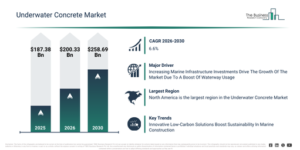
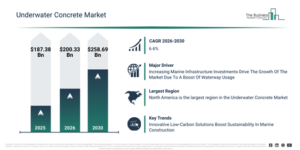
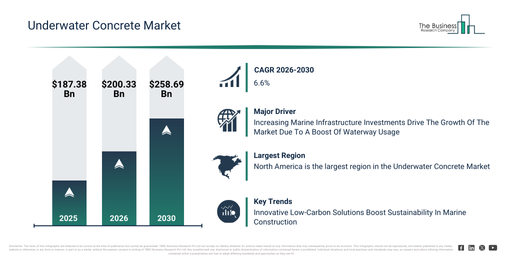
The underwater concrete market has demonstrated significant growth in recent years. It is projected to expand from $187.38 billion in 2025 to $200.33 billion in 2026, achieving a compound annual growth rate (CAGR) of 6.9%. This historical expansion can be credited to factors like the rise in underwater construction activities, increased application of anti-washout admixtures, the reliance on high-strength marine-grade cement, the proliferation of hydropower and port developments, and the surging need for underwater repair materials.
The underwater concrete market is projected to experience substantial expansion in the coming years. It is anticipated to reach $258.69 billion by 2030, exhibiting a compound annual growth rate (CAGR) of 6.6%. This growth over the forecast period is attributable to factors such as the increasing use of sustainable marine concretes, greater investment in offshore infrastructure, the expansion of tunnel and submerged transit systems, advancements in underwater curing technologies, and the proliferation of automated underwater construction equipment. Key trends expected during this period involve the integration of AI-based mix design optimization, the uptake of low-carbon underwater concrete formulations, the scaling of automated underwater construction systems, the application of smart sensors for submerged concrete monitoring, and the creation of digital quality-control platforms.
Free Underwater Concrete Market Sample: Market Size, Growth Drivers And Competitive Landscape:
Underwater Concrete Market Drivers Explained: What Is Supporting A 6.6% CAGR?
The growth of the underwater concrete market is anticipated to be propelled by increasing marine infrastructure investments. These investments focus on allocating funds for the development and maintenance of structures like ports, harbors, and offshore facilities. The rising global trade, which boosts the demand for efficient maritime transport, is contributing to the increase in marine infrastructure investments. Underwater concrete provides crucial support to marine infrastructure by offering durable, water-resistant foundations for constructing structures below the waterline. For example, UN Trade and Development, a Switzerland-based intergovernmental organization, reported in June 2025 that global ocean trade in 2023 reached $2.2 trillion, comprising $1.3 trillion in services and $900 billion in goods, accounting for roughly 7% of total world trade. Consequently, the expanding marine infrastructure investments are fueling the growth of the underwater concrete market.
Underwater Concrete Market Segment Guide: Main Divisions And Subsegments
The underwater concrete market covered in this report is segmented –
1) By Material Type: Aggregates, Admixtures, Cement, Other Types
2) By Product Type: Fly Ash Based, Slag Based, Geopolymer, Other Product Types
3) By Laying Technique: Tremie Method, Bucket Placing, Pump Method, Other Laying Techniques
4) By Application: Hydropower, Tunnels, Marine, Shore Protection, Swimming Pools, Underwater Repairs
Subsegments:
1) By Aggregates: Sand, Gravel, Crushed Stone, Slag
2) By Admixtures: Water-Reducing Admixtures, Retarding Admixtures, Anti-Washout Admixtures, Air-Entraining Admixtures
3) By Cement: Portland Cement, High Alumina Cement, Blast Furnace Cement, Rapid Hardening Cement
4) By Other Types: Silica Fume Concrete, Polymer Concrete, Lightweight Concrete, High-Performance Concrete
Underwater Concrete Market Trends And Opportunities For 2026–2030
Leading firms in the underwater concrete market are concentrating on creating novel solutions, including low-carbon cement and concrete, to lessen environmental harm and boost sustainability in marine construction projects. These low-carbon materials are building products engineered to release considerably less carbon dioxide during manufacturing through the use of alternative binding agents, recycled components, or energy-saving techniques. As an illustration, Cementos Molins, S.A., a Spain-based cement enterprise, introduced DRAGON BM-PL (CEM II/B-M (P-L) 42.5R) and DRAGON IV-SR (CEM IV/A (P) 42.5 R-SR), both low-carbon emission cement and concretes, in February 2024. The novel, low-carbon footprint cement DRAGON BM-PL is suitable for general concrete and mortar manufacturing, while DRAGON IV-SR is specifically formulated for underwater structures and sulfate-rich soils. By incorporating more than 55% alternative fuels and additives, these offerings minimize CO2 emissions, thereby supporting circular economy ideals. These products are projected to make up over 41% of the company’s Portland cement output in Spain. Promsa, the firm’s concrete division, utilizes this cement to create concrete with as much as 25% reduced emissions and includes recycled aggregates. Cementos Molins targets carbon-neutral concrete by 2050, stressing sustainable building practices and ecological certifications, and advocating for extensive societal cooperation to attain carbon neutrality.
Which Major Players Are Active In The Underwater Concrete Market?
Major companies operating in the underwater concrete market are Heidelberg Materials AG, Cemex S.A.B. de C.V., Sika AG, Buzzi S.p.A., Tarmac Trading Limited, GCP Applied Technologies Inc., Fosroc International Ltd, Unibeton Ready Mix L.L.C., J.F. Brennan Company Inc, Normet Group Oy, The Euclid Chemical Company, Conmix Ltd., CHRYSO SAS, Don Construction Products Ltd, CICO Technologies Ltd, Wieser Concrete Products Inc, Xypex Chemical Corporation, MUHU Construction Materials Co. Ltd., Mapei S.p.A., Rockbond SCP Ltd
Unlock The Complete Underwater Concrete Market Report With Company Benchmarking:
Underwater Concrete Market World Regions Compared: Which Leads In Revenue?
North America was the largest region in the underwater concrete market in 2025. Asia-Pacific is expected to be the fastest-growing region in the forecast period. The regions covered in the underwater concrete market report are Asia-Pacific, South East Asia, Western Europe, Eastern Europe, North America, South America, Middle East, Africa.
Reach Out To Our Team:
The Business Research Company: https://www.thebusinessresearchcompany.com/
Americas: +1 310-496-7795
Asia: +44 7882 955267 & +91 8897263534
Europe: +44 7882 955267
Email us at: marketing@tbrc.info
Follow us on:
LinkedIn: https://in.linkedin.com/company/the-business-research-company
YouTube: https://www.youtube.com/channel/UC24_fI0rV8cR5DxlCpgmyFQ
Global Market Model: https://www.thebusinessresearchcompany.com/global-market-model

Wasay has over a decade of experience in market research, data modelling, and analytics, with prior experience at GlobalData and Decision Tree Consulting Services. At The Business Research Company , he leads research operations across syndicated studies, customized consulting engagements, and the Global Market Model platform. His professional experience includes supporting organizations such as Boston Consulting Group, KPMG, and Ernst & Young. Wasay holds a degree in Electronics and Communications Engineering, postgraduate management qualifications from International Management Institute Belgium and Indian School of Business and Entrepreneurship, and completed the Integrated Program in Business Analytics from Indian Institute of Management Indore.