With a focus on actionable insights and strategic value, The Business Research Company’s 2026 market reports include market attractiveness scoring, total addressable market sizing, company benchmarking matrices, interactive Excel dashboards, deeper supply chain intelligence, emerging startup tracking, and granular product-level insights.
How Much Will The 3-Dimensional NAND–XPoint Hybrid Display Market Be Worth By 2030?
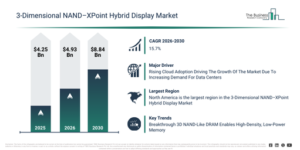
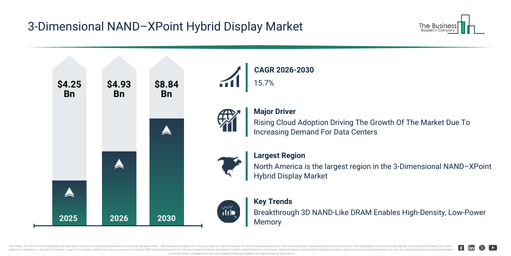
The 3-dimensional nand–xpoint hybrid display market has experienced rapid expansion recently. Forecasts indicate that it will increase from $4.25 billion in 2025 to $4.93 billion in 2026, achieving a compound annual growth rate (CAGR) of 16.0%. Historically, this market’s expansion has stemmed from progress in 3d nand fabrication, a growing need for high-capacity storage, the widespread adoption of data center memory solutions by enterprises, the proliferation of consumer electronics demanding quicker storage, and enhancements in memory endurance.
The 3-dimensional nand–xpoint hybrid display market size is projected to experience swift expansion in the coming years. This market is anticipated to reach $8.84 billion in 2030, exhibiting a compound annual growth rate (CAGR) of 15.7%. Key factors contributing to this anticipated growth include the increasing integration of hybrid memory solutions, the need for ultra-fast data processing in artificial intelligence applications, the expanding scale of cloud and edge computing infrastructure, a heightened emphasis on energy-efficient memory, and the escalating demand for high-endurance storage across industrial sectors. Significant trends expected during this period encompass high-performance memory integration, solutions for low-latency data access, implementation of tiered storage architectures, the development of energy-efficient memory systems, and advancements in enhanced endurance memory technologies.
Get Access To A Free 3-Dimensional NAND–XPoint Hybrid Display Market Report Sample:
The Key Driver Behind The 3-Dimensional NAND–XPoint Hybrid Display Market’s 15.7% CAGR
The market for 3-dimensional NAND-XPoint hybrid displays is anticipated to expand due to the escalating need for data centers. Data centers are facilities housing servers, storage, networking, and power systems, utilized by organizations to store, manage, and process substantial amounts of data. The need for these centers is consistently climbing as more businesses embrace cloud computing to improve scalability, guarantee secure data handling, and support the expanding requirement for smooth digital services across various sectors. A 3-dimensional NAND–XPoint hybrid display offers advantages to data centers by combining extensive storage capacity with quick, low-latency access, thereby boosting performance and efficiency for operations that are data-intensive. For example, in September 2024, data from the National Telecommunications and Information Administration, a US-based government department, indicated that the United States possesses more than 5,000 data centers, with their demand projected to increase at an annual rate of 9% until 2030. Consequently, the growing requirement for data centers is a primary factor propelling the growth of the 3-dimensional NAND-XPoint hybrid display market.
3-Dimensional NAND–XPoint Hybrid Display Market Classification: Main Segments And Detailed Subsegments
The 3-dimensional nand–xpoint hybrid display market covered in this report is segmented –
1) By Technology: 3-Dimensional NAND, Cross Point (XPoint), Hybrid
2) By Application: Consumer Electronics, Data Centers, Automotive, Industrial, Healthcare, Other Applications
3) By End-User: Enterprises, Individuals, Government, Other End-Users
Subsegments:
1) By 3-Dimensional NAND: Triple Level Cell, Quad Level Cell, Penta Level Cell
2) By Cross Point (XPoint): Phase Change Memory, Resistive Random Access Memory
3) By Hybrid: Dynamic Random Access Memory With Flash, Phase Change Memory With Flash, Magnetoresistive Random Access Memory With Flash
3-Dimensional NAND–XPoint Hybrid Display Market Strategic Shifts: What Leading Players Are Prioritizing
Leading companies in the 3-dimensional NAND-XPoint hybrid display market are concentrating on developing advanced solutions, such as 3-dimensional NAND-like DRAM cell arrays, to boost memory density, accelerate read/write speeds, and decrease power consumption. This type of memory architecture vertically arranges memory cells, akin to 3D NAND, while preserving DRAM’s rapid read/write performance, thereby combining high density with low-latency operation. For instance, in May 2023, NEO Semiconductor, a US-based technology company, introduced its pioneering 3D X-DRAM technology, which features the world’s first 3D NAND-like DRAM cell array designed to substantially overcome traditional DRAM capacity limits. This novel memory utilizes innovative 1T1C (one transistor, one capacitor) and 3T0C (three transistor, zero capacitor) cell designs, built on a 3D NAND-compatible process, and integrates IGZO (Indium Gallium Zinc Oxide) material to improve data retention and minimize power consumption. The technology achieves a density of up to 512 Gb, approximately 8 to 10 times greater than current DRAM, while maintaining DRAM-level performance, including rapid read/write speeds and extended data retention. Manufacturing is more affordable and simpler as it leverages existing 3D NAND fabrication lines with minimal changes, ensuring scalability and cost-efficiency.
3-Dimensional NAND–XPoint Hybrid Display Market Company Analysis: Major Industry Participants
Major companies operating in the 3-dimensional nand–xpoint hybrid display market are Samsung Electronics Co. Ltd., Intel Corporation, SK hynix Inc., Toshiba Corporation, Micron Technology Inc., Kingston Technology Company Inc., Western Digital Corporation, Kioxia Holdings Corporation, SanDisk Corporation, Corsair Memory Inc., SMART Modular Technologies Inc., ADATA Technology Co. Ltd., Transcend Information Inc., PNY Technologies Inc., Apacer Technology Inc., Viking Technology Inc., TEAMGROUP Inc., Mushkin Enhanced MFG Inc., Crossbar Inc., Adesto Technologies Corporation, Sidense Corporation.
Get Full Access To The 3-Dimensional NAND–XPoint Hybrid Display Market Report 2026:
3-Dimensional NAND–XPoint Hybrid Display Market Global Regional Breakdown: Key Regions Analyzed
North America was the largest region in the 3-dimensional NAND–XPoint hybrid display market in 2025. Asia-Pacific is expected to be the fastest-growing region in the forecast period. The regions covered in the 3-dimensional nand–xpoint hybrid display market report are Asia-Pacific, South East Asia, Western Europe, Eastern Europe, North America, South America, Middle East, Africa.
Reach Out To Our Team:
The Business Research Company: https://www.thebusinessresearchcompany.com/
Americas: +1 310-496-7795
Asia: +44 7882 955267 & +91 8897263534
Europe: +44 7882 955267
Email us at: marketing@tbrc.info
Follow us on:
LinkedIn: https://in.linkedin.com/company/the-business-research-company
YouTube: https://www.youtube.com/channel/UC24_fI0rV8cR5DxlCpgmyFQ
Global Market Model: https://www.thebusinessresearchcompany.com/global-market-model

Wasay has over a decade of experience in market research, data modelling, and analytics, with prior experience at GlobalData and Decision Tree Consulting Services. At The Business Research Company , he leads research operations across syndicated studies, customized consulting engagements, and the Global Market Model platform. His professional experience includes supporting organizations such as Boston Consulting Group, KPMG, and Ernst & Young. Wasay holds a degree in Electronics and Communications Engineering, postgraduate management qualifications from International Management Institute Belgium and Indian School of Business and Entrepreneurship, and completed the Integrated Program in Business Analytics from Indian Institute of Management Indore.