With a focus on actionable insights and strategic value, The Business Research Company’s 2026 market reports include market attractiveness scoring, total addressable market sizing, company benchmarking matrices, interactive Excel dashboards, deeper supply chain intelligence, emerging startup tracking, and granular product-level insights.
Prefabricated Buildings Market Size Forecast Points To $251.9 Billion In Revenue By 2030
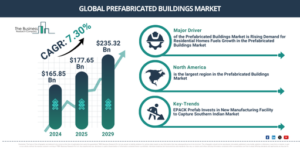
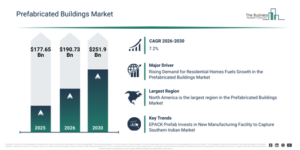
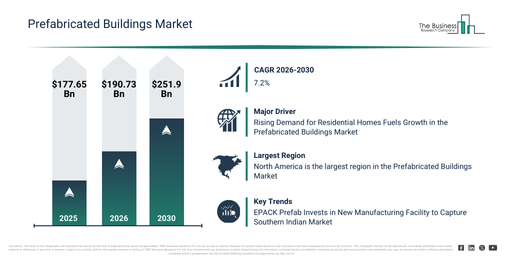
The prefabricated buildings market size has expanded significantly in recent years. It is projected to grow from $177.65 billion in 2025 to $190.73 billion in 2026, at a compound annual growth rate (CAGR) of 7.4%. This historic growth can be attributed to the rising adoption of standardized prefab systems, the early expansion of industrial and commercial modular projects, an increasing demand for cost-efficient building delivery, the growing acceptance of panelized construction, and a steady increase in modular retrofitting solutions.
The prefabricated buildings market is projected for substantial expansion over the coming years. This market is set to reach a value of $251.9 billion by 2030, demonstrating a compound annual growth rate (CAGR) of 7.2%. Driving this growth during the forecast period are factors such as the increasing incorporation of robotics in prefab factories, the expanding use of sustainable prefab materials, the wider embrace of digital twin technology in prefab design, the rising integration of smart monitoring systems within modular structures, and the advancement of high-performance composite prefab components. Key trends observed for the forecast period encompass enhanced standardization in panel assembly, an uptick in multi-module manufacturing, the evolution of high-end prefab structural systems, improved efficiency in large-scale prefab projects, and the broader application of composite prefab solutions.
Get A Free Prefabricated Buildings Market Sample Covering Drivers, Trends And Key Players:
Prefabricated Buildings Market Driver Analysis: Key Factor Supporting Revenue Growth
The anticipated expansion of the prefabricated buildings market is set to be driven by the increasing demand for residential homes. This rising demand for residential homes is attributed to elements such as population growth, intensified urbanization, and an elevated desire for home ownership and bespoke living spaces. Prefabricated buildings offer advantages for residential properties by allowing for more rapid and cost-effective construction with reliable quality, as their components are pre-manufactured in a regulated setting and then swiftly assembled on-site. As an illustration, in July 2023, the Australian Bureau of Statistics, an Australia-based government agency that collects and analyses statistics, reported that the number of dwellings under construction climbed by 1.3% to 240,813 in the March quarter of 2023, compared to previous year. Thus, the requirement for residential homes is propelling the growth of the prefabricated buildings market.
Prefabricated Buildings Market Segmentation Framework: Major Segments At A Glance
The prefabricated buildings market covered in this report is segmented –
1) By Product: Skeleton System, Panel System, Cellular System, Combined System
2) By Material: Concrete, Glass, Metal, Timber, Other Materials
3) By Module Type: Bathroom Pods, Kitchenette, Other Module Types
4) By Application: Industrial, Commercial, Residential
Subsegments:
1) By Skeleton System: Steel Frame Systems, Concrete Frame Systems, Timber Frame Systems, Hybrid Frame Systems, Modular Skeleton Systems
2) By Panel System: Concrete Panel Systems, Steel Panel Systems, Timber Panel Systems, Sandwich Panel Systems, Glass Panel Systems, Prefabricated Wall Panel Systems
3) By Cellular System: Concrete Cellular Systems, Steel Cellular Systems, Modular Cellular Systems, Insulated Cellular Systems, Prefabricated Room Modules
4) By Combined System: Hybrid Structural Systems, Modular Prefabricated Units with Integrated Structural Elements, Mixed-Use Combined Systems, Combined Prefabricated Walls And Floors Systems
Latest Prefabricated Buildings Market Developments And Emerging Trends
Leading companies in the prefabricated buildings market are prioritizing strategic investments to enhance their technological capabilities, expand product offerings, and increase operational efficiency. These strategic investments improve prefabricated buildings by advancing manufacturing technology, boosting efficiency, and diversifying product lines, resulting in faster construction, reduced costs, and more innovative and sustainable solutions. For example, in February 2023, EPACK Prefab, an India-based manufacturer of pre-engineered building solutions, invested $23.62 million (?198 crore) to establish a new manufacturing facility in Andhra Pradesh. This plant will be situated in the Mambattu Industrial area of Sullurpeta constituency, spanning approximately 25 acres. The investment seeks to secure a greater market share in the southern region of India, a market experiencing increased demand for prefabricated building solutions. Moreover, its close proximity to the southern market is expected to help reduce transportation costs, which currently inflate prices by approximately 20%.
Which Companies Are Shaping The Prefabricated Buildings Market?
Major companies operating in the prefabricated buildings market are Daiwa House Industry Co. Ltd., Sekisui House Real Estate Holdings Ltd., Skanska AB, Clayton Homes Inc., Bellway plc, Willscot Holdings Corp., Cavco Industries Inc., McGrath RentCorp Inc., Fleetwood Homes Inc., Astron Buildings S.A., Everest Industries Ltd, Veev, Alfa PEB Limited, Palomar Modular Buildings, Plant Prefab Inc., Lindal Cedar Homes Inc., Epack Polymers Pvt. Ltd., Lloyd Insulations Limited, Ramtech Building Systems Inc., Champion Prefabs, Blu Homes Inc., BOXX Modular Inc., Mighty Buildings Inc., Modular Building Systems LLC, TopHat
Dive Deeper Into The Prefabricated Buildings Market With The Full Report:
Prefabricated Buildings Market Regional Distribution: Where Is Revenue Concentrated?
North America was the largest region in the prefabricated buildings market in 2025. Asia-Pacific is expected to be the fastest-growing region in the forecast period. The regions covered in the prefabricated buildings market report are Asia-Pacific, South East Asia, Western Europe, Eastern Europe, North America, South America, Middle East, Africa.
Reach Out To Our Team:
The Business Research Company: https://www.thebusinessresearchcompany.com/
Americas: +1 310-496-7795
Asia: +44 7882 955267 & +91 8897263534
Europe: +44 7882 955267
Email us at: marketing@tbrc.info
Follow us on:
LinkedIn: https://in.linkedin.com/company/the-business-research-company
YouTube: https://www.youtube.com/channel/UC24_fI0rV8cR5DxlCpgmyFQ
Global Market Model: https://www.thebusinessresearchcompany.com/global-market-model

Wasay has over a decade of experience in market research, data modelling, and analytics, with prior experience at GlobalData and Decision Tree Consulting Services. At The Business Research Company , he leads research operations across syndicated studies, customized consulting engagements, and the Global Market Model platform. His professional experience includes supporting organizations such as Boston Consulting Group, KPMG, and Ernst & Young. Wasay holds a degree in Electronics and Communications Engineering, postgraduate management qualifications from International Management Institute Belgium and Indian School of Business and Entrepreneurship, and completed the Integrated Program in Business Analytics from Indian Institute of Management Indore.