The Business Research Company’s 2026 market reports combine market attractiveness scoring, total addressable market sizing, company benchmarking matrices, interactive Excel dashboards, deeper supply chain intelligence, emerging startup tracking, and granular product-level insights to deliver research that is more actionable and strategically valuable.
#Is The Single-Family Housing Green Buildings Market Expanding? Latest Size Estimates And 2030 Projections#_x000D_
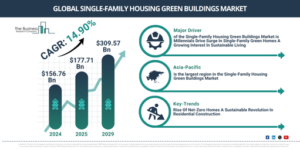
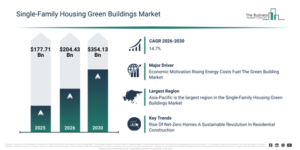
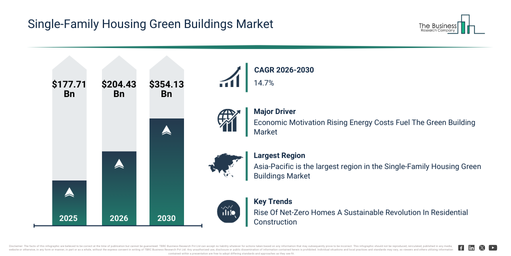
The single-family housing green buildings market has experienced rapid growth in recent years. This market is projected to expand from $177.71 billion in 2025 to $204.43 billion in 2026, demonstrating a compound annual growth rate (CAGR) of 15.0%. Historically, this growth can be ascribed to several factors, including the increasing embrace of green residential designs, a rising demand for energy-efficient retrofits, the wider use of eco-friendly building materials, the initial expansion of smart home installations, and increasing governmental backing for sustainable housing._x000D_
_x000D_
The single-family housing green buildings market is projected to experience substantial expansion over the coming years. This market is anticipated to reach $354.13 billion in 2030, demonstrating a compound annual growth rate (CAGR) of 14.7%. This projected growth during the forecast period stems from factors such as an increasing move towards net-zero home construction, a rise in the deployment of residential renewable energy systems, greater adoption of automated home energy management, the expansion of comprehensive green residential developments, and a growing inclination for low-carbon residential building materials. Key trends identified for the forecast period encompass a heightened demand for environmentally friendly home constructions, increased uptake of high-performance insulation systems, a developing preference for energy-efficient building designs, an increase in green home renovation projects, and a broadening market transition towards low-carbon housing options._x000D_
_x000D_
#Free Single-Family Housing Green Buildings Market Sample: Market Size, Growth Drivers And Competitive Landscape:#_x000D_
_x000D_
#Single-Family Housing Green Buildings Market Drivers Explained: What Is Supporting A 14.7% CAGR?#_x000D_
The escalating costs and consumption of energy are anticipated to stimulate the growth of the single-family housing green buildings market in the coming years. Energy cost is defined as the expense of the energy needed to heat a home, apartment, or rental property, while energy consumption refers to the quantity of energy used to perform an action, create something, or occupy a facility. Reducing both energy consumption and cost represents a primary objective for single-family dwelling green buildings. Through the adoption of energy-efficient features and practices, builders and homeowners can diminish their ecological footprint and achieve financial savings over time. For instance, in April 2024, the Energy Information Administration, a US-based principal government information system entity, reported that the average U.S. residential electricity price increased from 15.04 cents/kWh in 2022 to 15.98 cents/kWh in 2023, marking a 6.2% rise. Therefore, the upward trend in energy costs and consumption is a key driver for the single-family housing green building market._x000D_
_x000D_
#Single-Family Housing Green Buildings Market Segment Guide: Main Divisions And Subsegments#_x000D_
The single-family housing green buildings market covered in this report is segmented – _x000D_
_x000D_
1) By Type: New Constructions, Remodeling Projects_x000D_
2) By Product: Interior Products, Exterior Products_x000D_
3) By Construction Type: Full Green, Semi Green_x000D_
_x000D_
Subsegments:_x000D_
1) By New Constructions: Energy-efficient Homes, Sustainable Homes, Eco-friendly Homes _x000D_
2) By Remodeling Projects: Green Home Renovations, Energy-efficient Upgrades, Sustainable Retrofitting, Eco-friendly Home Improvements_x000D_
_x000D_
#Single-Family Housing Green Buildings Market Trends And Opportunities For 2026–2030#_x000D_
Consumers and builders are increasingly focusing on developing self-sustainable residences, termed Net-zero homes, to achieve more sustainable living and minimize their carbon footprint. A net-zero home generates its own energy locally, aiming to produce at least as much as it consumes. For example, in April 2024, Mahindra Lifespace Developers Ltd., an India-based real estate and infrastructure development company, launched Mahindra Zen, its first Net Zero Waste + Energy residential project. This project saw remarkable demand, with over 150 homes (around 65% of the units) sold within two days, accumulating sales over ?350 crore ($0.041 billion). This rapid success highlights significant interest in sustainable living and strengthens Mahindra Lifespaces’ standing in the eco-friendly real estate market._x000D_
_x000D_
#Which Major Players Are Active In The Single-Family Housing Green Buildings Market?#_x000D_
Major companies operating in the single-family housing green buildings market are Turner Construction Co., Clark Group, AECOM, Hensel Phelps, Holder Construction, The Whiting-Turner Contracting Co., Gilbane Building Co., Skanska USA, Structure Tone, Webcor Builders, Lendlease, Clayco, Suffolk Construction, DPR Construction, PCL Construction Enterprises, Walsh Group, Balfour Beatty US, BL Harbert, Level 10 Construction, Austin Commercial, James G. Davis Construction, JE Dunn Construction, Power Construction, Consigli Building Group, McCarthy Holdings, Hoffman Construction, Brasfield & Gorrie, Mortenson Construction, Sundt Construction, HITT Contracting, Hathway Dinwiddie Construction, The Beck Group, The Weitz Company, The Boldt Company, The Opus Group, The Korte Company, Ryan Companies US Inc., The Haskell Company _x000D_
_x000D_
#Unlock The Complete Single-Family Housing Green Buildings Market Report With Company Benchmarking:#_x000D_
_x000D_
#Single-Family Housing Green Buildings Market World Regions Compared: Which Leads In Revenue?#_x000D_
Asia-Pacific was the largest region in the single-family housing green buildings market in 2025. Africa is expected to be the fastest-growing region in the single-family housing green buildings market during the forecast period. The regions covered in the single-family housing green buildings market report are Asia-Pacific, South East Asia, Western Europe, Eastern Europe, North America, South America, Middle East, Africa._x000D_
_x000D_
#Reach Out To Our Team:#_x000D_
_x000D_
The Business Research Company: https://www.thebusinessresearchcompany.com/_x000D_
Americas: +1 310-496-7795_x000D_
Asia: +44 7882 955267 & +91 8897263534_x000D_
Europe: +44 7882 955267_x000D_
Email us at: marketing@tbrc.info_x000D_
_x000D_
#Follow us on:#_x000D_
_x000D_
LinkedIn: https://in.linkedin.com/company/the-business-research-company_x000D_
YouTube: https://www.youtube.com/channel/UC24_fI0rV8cR5DxlCpgmyFQ_x000D_
Global Market Model: https://www.thebusinessresearchcompany.com/global-market-model

Wasay has over a decade of experience in market research, data modelling, and analytics, with prior experience at GlobalData and Decision Tree Consulting Services. At The Business Research Company , he leads research operations across syndicated studies, customized consulting engagements, and the Global Market Model platform. His professional experience includes supporting organizations such as Boston Consulting Group, KPMG, and Ernst & Young. Wasay holds a degree in Electronics and Communications Engineering, postgraduate management qualifications from International Management Institute Belgium and Indian School of Business and Entrepreneurship, and completed the Integrated Program in Business Analytics from Indian Institute of Management Indore.