The Business Research Company’s 2026 market reports combine market attractiveness scoring, total addressable market sizing, company benchmarking matrices, interactive Excel dashboards, deeper supply chain intelligence, emerging startup tracking, and granular product-level insights to deliver research that is more actionable and strategically valuable.
Fiber Optic Transceivers Market Size Trajectory: Key Numbers Every Industry Stakeholder Should Know
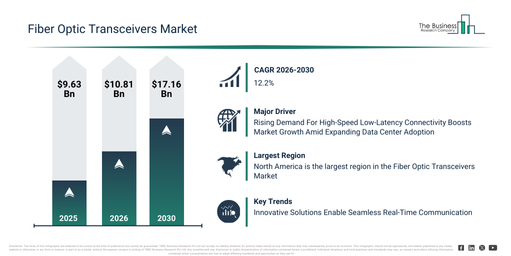
The fiber optic transceivers market has seen rapid expansion in recent years. It is forecast to rise from $9.63 billion in 2025 to $10.81 billion in 2026, achieving a compound annual growth rate (CAGR) of 12.3%. This past growth can be attributed to factors such as the increasing need for high-speed internet, the ongoing expansion of telecommunication networks, the early adoption of fiber optic technology, rising internet penetration, and the requirement for long-distance communication.
The fiber optic transceivers market is projected to experience substantial expansion over the coming years. This market is predicted to reach a valuation of $17.16 billion by 2030, exhibiting a compound annual growth rate (CAGR) of 12.2%. Factors driving this growth during the forecast period include the proliferation of 5G networks, an increase in cloud computing and data center usage, the need for high-bandwidth applications, the development of smart cities and IoT infrastructure, and increased investment in telecommunication infrastructure. Key trends anticipated during this period encompass the adoption of high-speed data transmission, the increasing presence of cloud data centers, further development of telecommunication infrastructure, the miniaturization of network components, and advancements in energy-efficient optical networking.
Looking For Reliable Fiber Optic Transceivers Market Data? Request A Free Sample:
What Is Behind The Rising Demand In The Fiber Optic Transceivers Market?
The increasing deployment of data centers is anticipated to fuel the expansion of the fiber optic transceivers market moving forward. A data center is a physical facility dedicated to housing computer systems, servers, and networking equipment essential for the storage, management, and processing of substantial data volumes. The proliferation of data centers is attributed to factors like the escalating demand for cloud services, the rise of big data and analytics, the broadening of 5G networks, the imperative for enhanced data storage and security, and the swift uptake of Internet of Things (IoT) devices. Fiber optic transceivers assist data centers by enabling high-speed, long-distance data transmission with minimal latency and high bandwidth, thereby ensuring efficient connectivity among servers, switches, and storage devices. For instance, in January 2025, according to CBRE, a US-based commercial real estate services and investment firm, data center availability in Latin America experienced a moderate rise, primarily driven by expanded capacity in São Paulo, where availability increased from 52.3 MW in 2023 to 62.1 MW in 2024. Thus, the growing adoption of data centers is a key driver for the fiber optic transceivers market’s growth.
Fiber Optic Transceivers Market Segment Coverage And Subsegment Analysis
The fiber optic transceivers market covered in this report is segmented –
1) By Type: Short-Reach Transceivers, Medium-Reach Transceivers, Long-Reach Transceivers, Very-Long-Reach Transceivers, Ultra-Long-Reach Transceivers, Parallel Transceivers
2) By Form Factor: Small Form-Factor Pluggable (SFP), Quad Small Form-Factor Pluggable (QSFP), Compact Form-Factor Pluggable (CFP), Mini-Connectorized Transceiver (MCX), Dual In-Line Memory Module (DIMM), Other Form Factors
3) By Fiber Type: Single-Mode, Multimode
4) By Data Rate: Less Than 10 Gbps, 10 Gbps to 40 Gbps, 41 Gbps to 100 Gbps, More Than 100 Gbps
5) By Application: Data Center Networks, Telecommunication Networks, High-Performance Computing (HPC), Consumer Electronics, Industrial Automation, Aerospace And Defense, Medical Imaging, Other Applications
Subsegments:
1) By Short-Reach Transceivers: Short-Range (SR), Short-Range 4-Lane (SR4), Multi-Mode Fiber (MMF) Transceivers
2) By Medium-Reach Transceivers: Long-Range (LR), Long-Range 4-Lane (LR4), Single-Mode Fiber (SMF) Transceivers
3) By Long-Reach Transceivers: Extended-Range (ER), Extended-Range 4-Lane (ER4), CWDM Transceivers
4) By Very-Long-Reach Transceivers: Ultra-Long-Range (ZR), Extended (ZR+), DWDM Transceivers
5) By Ultra-Long-Reach Transceivers: Coherent Optical Transceivers, 400G ZR Or ZR+ Transceivers, Submarine Network Transceivers
6) By Parallel Transceivers: Quad Small Form-factor Pluggable (QSFP), C Form-Factor Pluggable (CFP), 100G Parallel Optics (CXP)
Fiber Optic Transceivers Market Future Trends: Where Is The Industry Heading?
Major companies operating in the fiber optic transceivers market are developing innovative products that incorporate advanced technologies, such as latency adjustment technology, to enhance network performance, reduce data transmission delays, and support high-speed, real-time applications across industries like telecommunications, data centers, and cloud computing. Latency adjustment technology refers to methods used to minimize or compensate for delays in data transmission, ensuring faster and more efficient network performance. For instance, in May 2024, Fujitsu Limited, a Japan-based information and communications technology company, launched 1FINITY T250, a disaggregation-type optical transmission device, to achieve the innovative optical and wireless network (IOWN) initiative. The 1FINITY T250 enables an all-photonics network (APN) by utilizing latency adjustment technology to optimize data transmission, reduce delays, and ensure seamless, high-speed communication across long-distance optical networks.
Fiber Optic Transceivers Market Top Players List For 2026
Major companies operating in the fiber optic transceivers market are Hon HAI Precision Industry Co. Ltd., Huawei Technologies Co. Ltd., Cisco Systems Inc., Broadcom Inc., Sumitomo Electric Industries Ltd., Fujitsu Limited, NVIDIA Corporation, Texas Instruments Incorporated, Infineon Technologies AG, Fujikura Ltd., Juniper Networks Inc., Arista Networks Inc., Ciena Corporation, Coherent Corp., Belden Inc., Samtec Inc., Lumentum Operations LLC, Accelink Technologies Corporation, Source Photonics Inc., Allied Telesis Inc., FS.COM Inc., New H3C Technologies Co. Ltd., InnoLight Technology Corporation, Hisense Broadband Inc., Finisar Corporation, Optoway Technology Inc., Gigalight, QSFPTEK Technology Co. Ltd, ZTE Corporation, Perle Systems
Order Your Copy Of The Fiber Optic Transceivers Market Report 2026:
How Does The Fiber Optic Transceivers Market Vary By Region?
North America was the largest region in the fiber optic transceivers market in 2025. Asia-Pacific is expected to be the fastest-growing region in the forecast period. The regions covered in the fiber optic transceivers market report are Asia-Pacific, South East Asia, Western Europe, Eastern Europe, North America, South America, Middle East, Africa.
Reach Out To Our Team:
The Business Research Company: https://www.thebusinessresearchcompany.com/
Americas: +1 310-496-7795
Asia: +44 7882 955267 & +91 8897263534
Europe: +44 7882 955267
Email us at: marketing@tbrc.info
Follow us on:
LinkedIn: https://in.linkedin.com/company/the-business-research-company
YouTube: https://www.youtube.com/channel/UC24_fI0rV8cR5DxlCpgmyFQ
Global Market Model: https://www.thebusinessresearchcompany.com/global-market-model

Wasay has over a decade of experience in market research, data modelling, and analytics, with prior experience at GlobalData and Decision Tree Consulting Services. At The Business Research Company , he leads research operations across syndicated studies, customized consulting engagements, and the Global Market Model platform. His professional experience includes supporting organizations such as Boston Consulting Group, KPMG, and Ernst & Young. Wasay holds a degree in Electronics and Communications Engineering, postgraduate management qualifications from International Management Institute Belgium and Indian School of Business and Entrepreneurship, and completed the Integrated Program in Business Analytics from Indian Institute of Management Indore.