With a focus on actionable insights and strategic value, The Business Research Company’s 2026 market reports include market attractiveness scoring, total addressable market sizing, company benchmarking matrices, interactive Excel dashboards, deeper supply chain intelligence, emerging startup tracking, and granular product-level insights.
How Large Could The Flexible Hybrid Electronics Market Become By 2030 At A 11.8% CAGR?
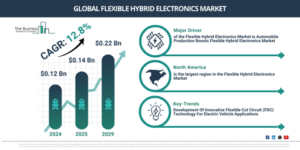
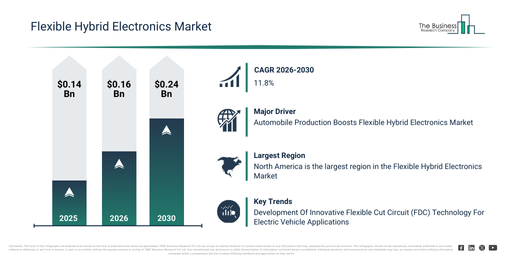
The flexible hybrid electronics market size has experienced rapid expansion in recent years. This market is projected to expand from $0.14 billion in 2025 to $0.16 billion in 2026, demonstrating a compound annual growth rate (CAGR) of 13.8%. The historical growth of this market can be attributed to several factors, including developments in flexible substrate materials, the rise of wearable electronics, increased research in printed electronics, the escalating demand for miniaturized devices, and the incorporation of flexible circuits into consumer electronics.
The flexible hybrid electronics market is expected to experience rapid expansion over the next few years. It is projected to grow to $0.24 billion in 2030, at a compound annual growth rate (CAGR) of 11.8%. This anticipated growth throughout the forecast period can be attributed to the rise of IoT-enabled sensors, the increasing application of flexible electronics in healthcare, the broadening scope of electronics in electric and autonomous vehicles, escalating investments in smart manufacturing, and continuous advancements in stretchable and hybrid electronics. Furthermore, major trends anticipated in this period encompass the growing adoption of flexible electronics in wearable devices, a rising demand for lightweight and conformable electronic systems, greater integration of printed sensors and flexible circuits, the expansion of hybrid rigid-flex and stretchable electronics, and a heightened focus on durable and high-reliability flexible substrates.
Get A Free Flexible Hybrid Electronics Market Sample With 2030 Forecast Insights:
Flexible Hybrid Electronics Market Outlook: Key Driver Supporting Long-Term Growth
Anticipated expansion in the production of vehicles is projected to stimulate the growth of the flexible hybrid electronics market. These four-wheeled, self-operating vehicles, powered by either electric motors or internal combustion engines and intended for use on public roads, are seeing increased production primarily due to heightened global consumer demand, significant technological breakthroughs, and successful penetration into new and emerging markets. When integrated into automobiles, flexible hybrid electronics offer enhanced design adaptability and facilitate the incorporation of light, pliable electronic systems, thereby improving both functionality and overall performance. For example, data from January 2024, provided by the European Automobile Manufacturers’ Association (ACEA), a Belgium-based automotive industry organization, indicated a substantial 13.9% growth in the EU car market during 2023. This resulted in sales of 867,052 units more than in 2022, bringing the total annual sales volume to 10.5 million units. Most markets within the EU recorded double-digit increases, particularly the major ones: Italy (+18.9%), Spain (+16.7%), and France (+16.1%). Conversely, Germany recorded a comparatively lower year-on-year increase of 7.3%. Consequently, the increasing output of automobiles is a key factor fueling the expansion of the flexible hybrid electronics market.
Segmentation Of The Flexible Hybrid Electronics Market: Key Categories Explained
The flexible hybrid electronics market covered in this report is segmented –
1) By Structure Type: Rigid Flex Circuit, Multilayer Flex Circuit, Double Sided Flex Circuit, Single Sided Flex Circuit, Other Structure Types
2) By Application: Displays, Batteries, Thin- Film Photovoltaics, Printed Sensors, Organic Light Emitting Diode Lighting, Other Applications
3) By Vertical: Industrial, Consumer Electronics, Automobile Industry, Military And Defense, Aerospace, Other Verticals
Subsegments:
1) By Rigid Flex Circuit: Rigid Flex PCB (Printed Circuit Board), Hybrid Rigid-Flex PCB
2) By Multilayer Flex Circuit: 3-Layer Flex Circuit, 4-Layer Flex Circuit, 5-Layer Flex Circuit, 6-Layer Flex Circuit, Multi-Layer Flex Circuit
3) By Double Sided Flex Circuit: 2-Layer Flex Circuit, Double Sided Polyimide Flex Circuit, Double Sided PET Flex Circuit
4) By Single Sided Flex Circuit: Single Sided Polyimide Flex Circuit, Single Sided PET Flex Circuit
5) By Other Structure Types: Flexible Hybrid Circuit (FHC), Flex-on-Flex Circuit, Stretchable Circuits, Integrated Flexible Circuits, 3D Flexible Electronics
Flexible Hybrid Electronics Market Evolving Trends: What Businesses Should Know
Leading companies operating in the flexible electronics and circuit market are prioritizing the creation of advanced flexible circuit production processes to boost revenue growth. These advanced processes refer to manufacturing techniques that yield flexible printed circuit boards (PCBs) featuring complex designs, high reliability, and superior performance characteristics. As an illustration, in April 2024, Ennovi, a Singapore-based provider of mobility electrification solutions, introduced its Flexible Cut Circuit (FDC) technology. This innovation is designed for manufacturing flexible circuits utilized in low-voltage signal applications for electric vehicle (EV) battery cell contact systems. This groundbreaking method offers a more economical and environmentally sustainable option compared to traditional flexible printed circuits (FPCs). The FDC technology also streamlines the manufacturing process, enabling faster continuous production and immediate copper recycling, which enhances its eco-friendliness and overall efficiency.
Who Competes In The Flexible Hybrid Electronics Market? Major Companies Listed
Major companies operating in the flexible hybrid electronics market are Samsung Electronics Co Ltd., Panasonic Corporation, Jabil Inc., Flex Ltd., LG Display Co Ltd, Du Pont De Nemours and Company, AU Optronics Corporation, E Ink Holdings Inc., Royole Corporation, Pragmatic Semiconductor, Brewer Science Inc., NovaCentrix, Blue Spark Technologies Inc., Plastic Logic Limited, XENON Corporation, Ynvisible Interactive Inc., BeBop Sensors Inc., C3Nano Inc., Ares Materials Inc., MC10 Inc., Powercast Corporation, Canatu Oy, Polyera Corporation, American Semiconductor Inc., Imprint Energy Inc
Read The Complete Flexible Hybrid Electronics Market Forecast Report Through 2030:
Flexible Hybrid Electronics Market Regional Ranking: Which Geography Comes First?
North America was the largest region in the flexible hybrid electronics market in 2025. Asia-Pacific is expected to be the fastest-growing region in the forecast period. The regions covered in the flexible hybrid electronics market report are Asia-Pacific, South East Asia, Western Europe, Eastern Europe, North America, South America, Middle East, Africa.
Reach Out To Our Team:
The Business Research Company: https://www.thebusinessresearchcompany.com/
Americas: +1 310-496-7795
Asia: +44 7882 955267 & +91 8897263534
Europe: +44 7882 955267
Email us at: marketing@tbrc.info
Follow us on:
LinkedIn: https://in.linkedin.com/company/the-business-research-company
YouTube: https://www.youtube.com/channel/UC24_fI0rV8cR5DxlCpgmyFQ
Global Market Model: https://www.thebusinessresearchcompany.com/global-market-model

Wasay has over a decade of experience in market research, data modelling, and analytics, with prior experience at GlobalData and Decision Tree Consulting Services. At The Business Research Company , he leads research operations across syndicated studies, customized consulting engagements, and the Global Market Model platform. His professional experience includes supporting organizations such as Boston Consulting Group, KPMG, and Ernst & Young. Wasay holds a degree in Electronics and Communications Engineering, postgraduate management qualifications from International Management Institute Belgium and Indian School of Business and Entrepreneurship, and completed the Integrated Program in Business Analytics from Indian Institute of Management Indore.