Designed to make market research more actionable and strategically valuable, The Business Research Company’s 2026 market reports feature market attractiveness scoring, total addressable market sizing, company benchmarking matrices, interactive Excel dashboards, deeper supply chain intelligence, emerging startup tracking, and granular product-level insights.
Gallium Arsenide Germanium Solar Cell (Gaas) Market Revenue Expansion Outlook For The 2026–2030 Forecast Period
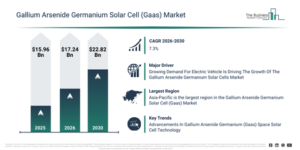
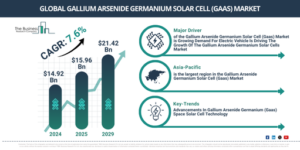
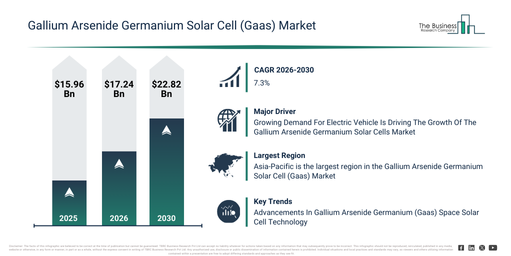
The gallium arsenide germanium solar cell (gaas) market has experienced substantial growth in recent years. It is anticipated to expand from $15.96 billion in 2025 to $17.24 billion in 2026, reflecting a compound annual growth rate (CAGR) of 8.0%. The market’s growth in the past can be attributed to the early adoption of gaas in space applications, the increasing demand for high efficiency solar cells, advancements in III-V semiconductor fabrication, the proliferation of satellite and aerospace programs, and the inherent efficiency limitations of silicon solar cells.
The market for gallium arsenide germanium solar cells (gaas) is projected to experience robust expansion over the coming years. It is anticipated to reach $22.82 billion in 2030, exhibiting a compound annual growth rate (CAGR) of 7.3%. This growth during the forecast period is driven by several factors, including increasing investments in space solar power, a rising need for high-performance photovoltaics, improvements in epitaxial growth techniques, expanded application in wireless and optoelectronic systems, and an emphasis on highly efficient renewable energy solutions. Key trends anticipated for the forecast period encompass the adoption of high-efficiency III-V solar cells, the integration of advanced semiconductor materials, the development of high-temperature and radiation-resistant solar solutions, the broadening of space-grade photovoltaic technologies, and a greater incorporation of compound semiconductors into energy systems.
Download A Free Sample For In-Depth Gallium Arsenide Germanium Solar Cell (Gaas) Market Intelligence:
Gallium Arsenide Germanium Solar Cell (Gaas) Market Demand Driver: How It Is Shaping Industry Growth
The increasing adoption of renewable energy sources is projected to fuel the expansion of the gallium arsenide germanium solar cell (Gaas) market in the coming years. Renewable energy refers to power sources that are naturally restored within a human timeframe and originate from continuously regenerating natural processes. The heightened need for renewable energy is primarily influenced by factors like climate change concerns and sustainability objectives. Gallium arsenide solar cells, known for their high efficiency and dependability, are crucial for meeting this rising demand for renewable energy. Their distinct characteristics render them especially beneficial for niche uses, thereby fostering a more robust and sustainable energy framework. For example, in January 2024, the International Energy Agency (IEA), a France-based intergovernmental organization, reported that in 2023, the worldwide increase in renewable energy capacity soared by 50%, totaling approximately 510 gigawatts more than in 2022. Consequently, the rising preference for renewable sources is propelling the growth of the gallium arsenide germanium solar cell (Gaas) market.
Gallium Arsenide Germanium Solar Cell (Gaas) Market Segmentation Overview: Detailed Category Analysis
The gallium arsenide germanium solar cell (gaas) market covered in this report is segmented –
1) By Type: Liquid Encapsulated Czochralski (LEC) Grown Gallium Arsenide (GaAs), VGF (Vertical Gradient Freeze) Grown Gallium Arsenide (GaAs)
2) By Channel: Direct Sales, Other Distribution Channel
3) By Application: Spacecraft Power Systems, High-Altitude Long-Endurance (HALE) Unmanned Aerial Vehicles, Concentrated Photovoltaic (CPV) Systems, Research And Development Or Experimental Solar Technologies, Military And Defense Solar Power Applications
Subsegments:
1) By Liquid Encapsulated Czochralski (LEC) Grown GaAs: Liquid Encapsulated Czochralski (LEC) Grown GaAs, Semi-Insulating LEC GaAs Wafers, Semi-Conducting LEC GaAs Wafers, N-Type LEC GaAs Substrates, P-Type LEC GaAs Substrates, Large-Diameter LEC GaAs Wafers (=4-inch)
2) By VGF (Vertical Gradient Freeze) Grown GaAs: High-Purity VGF GaAs Wafers, Low-Dislocation-Density VGF GaAs, N-Type VGF GaAs Substrates, P-Type VGF GaAs Substrates, Space-Grade VGF GaAs Wafers
Top Gallium Arsenide Germanium Solar Cell (Gaas) Market Trends And Recent Industry Developments
Leading companies in the gallium arsenide germanium solar cell (Gaas) market are advancing innovative space solar cell technology to enhance energy efficiency and reliability for satellite and spacecraft applications. This space solar cell technology, based on gallium arsenide and germanium (GaAs/Ge), uses semiconductor materials like gallium arsenide (GaAs) and germanium (Ge) to convert sunlight into electricity. For example, in March 2023, US-based aerospace and defense company Rocket Lab USA Inc. unveiled a new space solar cell known as IMM-ß. This new cell represents the highest-efficiency space solar cell technology currently in high-volume production. The high efficiencies of IMM-ß solar cells are achieved through the use of gallium arsenide germanium solar cells (GaAs) and other materials such as indium gallium phosphide (InGaP). The IMM-ß solar cells exhibit an average beginning of life (BOL) efficiency of 33.3%, which exceeds the 32% efficiency of the IMM-a cell currently being produced.
Gallium Arsenide Germanium Solar Cell (Gaas) Market Company Landscape: Key Players To Watch
Major companies operating in the gallium arsenide germanium solar cell (gaas) market are Spectrolab, Inc., SolAero Technologies Corp., Azur Space Solar Power GmbH, Emcore Corporation, MicroLink Devices, Inc., Alta Devices, Inc., Solar Junction Corporation, AXT, Inc., Freiberger Compound Materials GmbH, Xiamen Powerway Advanced Material Co., Ltd., DOWA Electronics Materials Co., Ltd., Vital Materials Co., Ltd., Semiconductor Wafer, Inc., IQE plc, WIN Semiconductors Corp., China Crystal Technologies Co., Ltd., Umicore NV, Veeco Instruments Inc., Aixtron SE, Advanced Micro-Fabrication Equipment Inc. (AMEC), Sumitomo Electric Industries, Ltd., Sumika Electronic Materials, Inc., JDS Uniphase Corporation, Kopin Corporation, Anadigics, Inc.
Explore The Gallium Arsenide Germanium Solar Cell (Gaas) Global Market Report For Full Insights:
Gallium Arsenide Germanium Solar Cell (Gaas) Market Region-Wise Analysis: Largest Regional Market Identified
Asia-Pacific was the largest region in the gallium arsenide germanium solar cell (Gaas) market in 2025. North America is expected to be the fastest-growing region in the forecast period. The regions covered in the gallium arsenide germanium solar cell (gaas) market report are Asia-Pacific, South East Asia, Western Europe, Eastern Europe, North America, South America, Middle East, Africa.
Reach Out To Our Team:
The Business Research Company: https://www.thebusinessresearchcompany.com/
Americas: +1 310-496-7795
Asia: +44 7882 955267 & +91 8897263534
Europe: +44 7882 955267
Email us at: marketing@tbrc.info
Follow us on:
LinkedIn: https://in.linkedin.com/company/the-business-research-company
YouTube: https://www.youtube.com/channel/UC24_fI0rV8cR5DxlCpgmyFQ
Global Market Model: https://www.thebusinessresearchcompany.com/global-market-model

Wasay has over a decade of experience in market research, data modelling, and analytics, with prior experience at GlobalData and Decision Tree Consulting Services. At The Business Research Company , he leads research operations across syndicated studies, customized consulting engagements, and the Global Market Model platform. His professional experience includes supporting organizations such as Boston Consulting Group, KPMG, and Ernst & Young. Wasay holds a degree in Electronics and Communications Engineering, postgraduate management qualifications from International Management Institute Belgium and Indian School of Business and Entrepreneurship, and completed the Integrated Program in Business Analytics from Indian Institute of Management Indore.