With a focus on actionable insights and strategic value, The Business Research Company’s 2026 market reports include market attractiveness scoring, total addressable market sizing, company benchmarking matrices, interactive Excel dashboards, deeper supply chain intelligence, emerging startup tracking, and granular product-level insights.
How Much Will The Hydrogen Fuel Cells Market Be Worth By 2030?
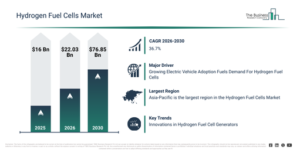
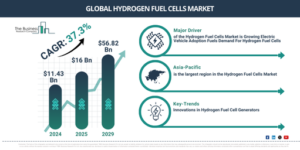
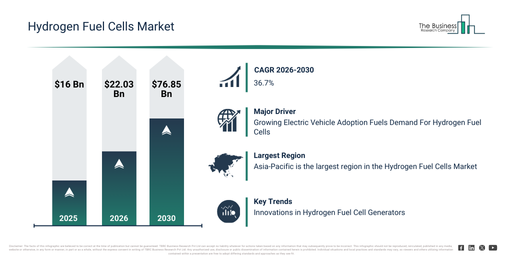
The hydrogen fuel cells market has shown substantial growth in recent years. It is anticipated to expand from $16 billion in 2025 to $22.03 billion in 2026, exhibiting a compound annual growth rate (CAGR) of 37.7%. This historical progression can be linked to factors such as the increasing need for clean energy solutions, the rising acceptance of fuel cell vehicles, the development of stationary power generation uses, augmented research funding for hydrogen technologies, and the expansion of microgrid and backup power installations.
The hydrogen fuel cells market size is projected to experience substantial expansion in the coming years, reaching $76.85 billion by 2030, with a compound annual growth rate (CAGR) of 36.7%. This growth over the forecast period is driven by increased investment in hydrogen infrastructure, higher production of green hydrogen, expanded adoption of fuel cells in heavy-duty transport, a rising demand for long-duration energy storage solutions, and an enhanced focus on decentralized clean energy systems. Key trends anticipated during this period include a surge in the adoption of hydrogen fuel cells for electric mobility, greater use of smart monitoring and IoT-integrated fuel cell systems, advancements in automated manufacturing of fuel cell components, an increasing emphasis on low-carbon and sustainable energy technologies, and a heightened implementation of digital platforms for fuel cell optimization.
Get Access To A Free Hydrogen Fuel Cells Market Report Sample:
The Key Driver Behind The Hydrogen Fuel Cells Market’s 36.7% CAGR
The increasing need for electric vehicles is expected to foster expansion in the hydrogen fuel cells market. Electric vehicles have become widely favored owing to their ecological advantages and lessened reliance on fossil fuels. Fuel-cell electric vehicles operate by utilizing fuel cell stacks to transform gaseous hydrogen stored on board into electricity, subsequently stored in a battery to energize the vehicle’s electric motor. The majority of fuel cell electric vehicles (FCEVs) run on hydrogen (H2) and qualify as zero-emission vehicles (ZEVs). As an illustration, a report released by Kelley Blue Book, a US-based Cox Automotive company, in January 2024, indicated that in 2023, an unprecedented 1.2 million car purchasers in the United States opted for electric vehicles. This figure represented 7.6% of the overall U.S. vehicle market, a rise from 5.9% recorded in 2022. Consequently, the growing demand for electric vehicles is set to propel the hydrogen fuel cells market.
Hydrogen Fuel Cells Market Classification: Main Segments And Detailed Subsegments
The hydrogen fuel cells market covered in this report is segmented –
1) By Type: Proton Exchange Membrane, Direct Methanol, Solid Oxide, Alkaline Membrane, Phosphoric Acid, Molten Carbonate
2) By End-User: Fuel Cell Vehicles, Utilities, Defense
3) By Application: Transportation, Stationary Power Generation, Portable
Subsegments:
1) By Proton Exchange Membrane: Automotive PEM Fuel Cells, Portable PEM Fuel Cells
2) By Direct Methanol: Small-scale DMFCs, Portable DMFCs
3) By Solid Oxide: Planar SOFCs, Tubular SOFCs
4) By Alkaline Membrane: Low-Temperature AFCs, High-Temperature AFCs
5) By Phosphoric Acid: Stationary PAFCs, Mobile PAFCs
6) Molten Carbonate: Large-Scale MCFCs, Distributed Generation MCFCs
Hydrogen Fuel Cells Market Strategic Shifts: What Leading Players Are Prioritizing
Leading firms within the hydrogen fuel cells market are concentrating on creating innovative offerings, such as the hydrogen fuel cell generator, to enhance their market standing. This generator is a device that transforms hydrogen fuel into electrical energy via a chemical process involving hydrogen and oxygen, yielding only water and heat, thus serving as an eco-conscious power solution. For example, in April 2024, the Japan-based company Panasonic introduced H2 KIBOU. H2 KIBOU, a Panasonic-developed demonstration facility, highlights renewable energy solutions, sourcing 100% of its electricity from pure hydrogen fuel cell generators and photovoltaic systems. The facility’s objective is to advance the utilization of renewably sourced hydrogen, thereby assisting Panasonic in its ambition to attain RE100 status and foster a decarbonized society.
Hydrogen Fuel Cells Market Company Analysis: Major Industry Participants
Major companies operating in the hydrogen fuel cells market are Plug Power, Toshiba Corporation, Doosan Fuel Cell, Bloom Energy, Ballard Power, SFC Energy AG, Cummins Inc, FuelCell Energy, Panasonic Holdings Corporation, Horizon Fuel Cell Technologies, Reliance Industries, GAIL, National Thermal Power Corporation Limited (NTPC), Indian Oil Corporation, Larsen and Toubro, Adani Green Energy, Tianneng, Corun, Narada, Sinohytec-U, Furuise, Huachang Chemical, Zhongding Group, ITM Power, Ceres Power Holdings, AFC Energy, Proton Motor Power Systems, Hydrogenone Capital Growth, Clean Power Hydrogen, TMH-Energy Solutions, APT spol. s r.o., Grupa Lotos SA, Gdansk-based refiner, Gazprom, Rosatom, Capital Power Corporation, ENMAX (Shepard Energy Centre), Federated Co-operatives Limited (FCL), Strathcona Resources Ltd, Lafarge Canada Inc, ArcelorMittal Mining Canada G.P, Suncor ATCO Heartland Hydrogen Hub, Alberta Power (2000) Ltd. (Heartland Generation), Stelco Inc., Dow Chemical Canada ULC, Bravo Motor, Great Wall Motor, HyundAI Motor Company, Cummins Brazil, Fortescue Rio Negro Hydrogen Complex, H2Pro, Masdar, NEOM Green Hydrogen Company, Car4future, HyPlat, Chem Energy SA, HySA Systems, Mitsubishi Power Egypt.
Get Full Access To The Hydrogen Fuel Cells Market Report 2026:
Hydrogen Fuel Cells Market Global Regional Breakdown: Key Regions Analyzed
Asia-Pacific was the largest region in the hydrogen fuel cell market in 2025. North America was the second-largest market in the hydrogen fuel cell market. The regions covered in the hydrogen fuel cells market report are Asia-Pacific, South East Asia, Western Europe, Eastern Europe, North America, South America, Middle East, Africa.
Reach Out To Our Team:
The Business Research Company: https://www.thebusinessresearchcompany.com/
Americas: +1 310-496-7795
Asia: +44 7882 955267 & +91 8897263534
Europe: +44 7882 955267
Email us at: marketing@tbrc.info
Follow us on:
LinkedIn: https://in.linkedin.com/company/the-business-research-company
YouTube: https://www.youtube.com/channel/UC24_fI0rV8cR5DxlCpgmyFQ
Global Market Model: https://www.thebusinessresearchcompany.com/global-market-model

Wasay has over a decade of experience in market research, data modelling, and analytics, with prior experience at GlobalData and Decision Tree Consulting Services. At The Business Research Company , he leads research operations across syndicated studies, customized consulting engagements, and the Global Market Model platform. His professional experience includes supporting organizations such as Boston Consulting Group, KPMG, and Ernst & Young. Wasay holds a degree in Electronics and Communications Engineering, postgraduate management qualifications from International Management Institute Belgium and Indian School of Business and Entrepreneurship, and completed the Integrated Program in Business Analytics from Indian Institute of Management Indore.