The Business Research Company’s 2026 market reports are designed to deliver research that is more actionable and strategically valuable. Key offerings include market attractiveness scoring, total addressable market sizing, company benchmarking matrices, interactive Excel dashboards, deeper supply chain intelligence, emerging startup tracking, and granular product-level insights.
Dense Wavelength Division Multiplexing (DWDM) Transceiver Market Size, Growth Rate And Key Forecast Highlights For 2026–2030
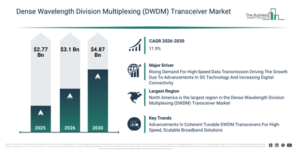
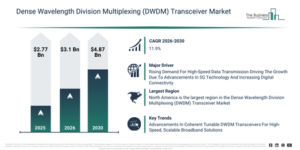
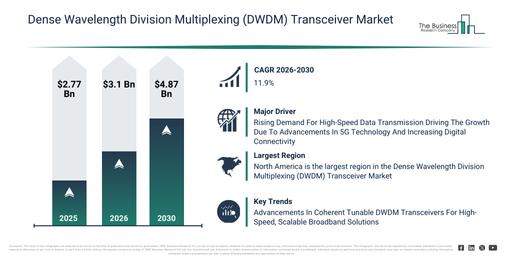
The dense wavelength division multiplexing (dwdm) transceiver market size has demonstrated rapid expansion in recent years. It is anticipated to increase from $2.77 billion in 2025 to $3.1 billion in 2026, exhibiting a compound annual growth rate (CAGR) of 12.0%. The historical growth of this market can be attributed to several factors including the adoption of high-speed fiber networks, the expansion of telecommunication infrastructure, increasing internet traffic, rising demand for enterprise data centers, and continuous advancements in optical module technology.
The dense wavelength division multiplexing (dwdm) transceiver market size is projected to experience swift expansion over the coming years. It is expected to reach $4.87 billion by 2030, with a compound annual growth rate (CAGR) of 11.9%. This growth during the forecast period is driven by the deployment of 5G networks, the increasing adoption of cloud computing and hyperscale data centers, the expansion of global internet infrastructure, the demand for energy-efficient networking solutions, and the integration of AI and automation in optical networks. Notable trends for the forecast period include high-capacity optical transmission, advanced fiber network expansion, tunable dwdm transceivers, energy-efficient optical modules, and scalable data center connectivity.
See What’s Inside The Dense Wavelength Division Multiplexing (DWDM) Transceiver Market Report With A Free Sample:
Dense Wavelength Division Multiplexing (DWDM) Transceiver Market Expansion: The Major Factor Driving Growth
The future expansion of the dense wavelength division multiplexing (DWDM) transceiver market is anticipated to be driven by the escalating demand for high-speed data transmission. High-speed data transmission refers to the rapid transfer of large volumes of data across communication networks within a short period. This increasing need for high-speed data transmission is fueled by factors such as data-intensive applications, 5G expansion, IoT growth, big data and AI adoption, alongside remote work and digital transformation. The rising demand for high-speed data transmission prompts the adoption of DWDM transceivers, enabling multiple data streams to be transmitted over a single fiber using different wavelengths. This enhances network scalability, minimizes latency, and supports the development of broadband and 5G networks. For instance, in December 2023, Ookla, a US-based web service, reported that in 2023, Speedtest users experiencing the top 10% of 5G download speeds globally saw a 9% increase, rising from 525.54 Mbps in Q3 2022 to 573.12 Mbps in Q3 2023. Therefore, the increasing demand for high-speed data transmission is propelling the growth of the dense wavelength division multiplexing (DWDM) transceiver market.
Understanding Dense Wavelength Division Multiplexing (DWDM) Transceiver Market Segmentation For Strategic Planning
The dense wavelength division multiplexing (dwdm) transceiver market covered in this report is segmented –
1) By Form Factor: Small Form-Factor Pluggable (SFP), Enhanced Small Form-Factor Pluggable (SFP+), 10-Gigabit Small Form-Factor Pluggable (XFP), 100G Form-Factor Pluggable (CFP), Other Form Factors
2) By Data Rate: Less Than 10 Gigabits Per Second (Gbps), 10 Gigabits Per Second (Gbps) To 40 Gigabits Per Second (Gbps), 40 Gigabits Per Second (Gbps) To 100 Gigabits Per Second (Gbps), More Than 100 Gigabits Per Second (Gbps)
3) By Application: Telecommunications, Data Centers, Enterprise, Other Applications
Subsegments:
1) By Small Form-Factor Pluggable (SFP): SFP DWDM 1G, SFP DWDM 2.5G
2) By Enhanced Small Form-Factor Pluggable (SFP+): SFP+ DWDM 10G, SFP+ Tunable DWDM
3) By 10-Gigabit Small Form-Factor Pluggable (XFP): XFP DWDM 10G, XFP DWDM 40km/80km
4) By 100G Form-Factor Pluggable (CFP): CFP DWDM 100G, CFP2 And CFP4 DWDM
5) By Other Form Factors: Quad Small Form-Factor Pluggable (QSFP), Coherent Optical Modules, Custom And Proprietary Modules
Key Dense Wavelength Division Multiplexing (DWDM) Transceiver Market Trends To Watch In 2026
Leading companies within the dense wavelength division multiplexing (DWDM) transceiver market are concentrating on developing advanced coherent tunable DWDM transceivers to address the increasing need for high-speed, scalable broadband solutions. These coherent tunable DWDM transceivers are sophisticated optical instruments that employ coherent detection for efficient signal processing and facilitate dynamic wavelength adjustment. For example, in November 2024, Precision Optical Technologies, a US-based telecommunications company, announced the general availability of its QSFP28 100ZR. These cutting-edge transceivers are engineered to offer high-performance, scalable, and cost-effective solutions for long-haul and metro optical networks. By leveraging dense wavelength division multiplexing (DWDM) technology, these transceivers empower data centers, telecommunications providers, and cloud service providers to maximize their optical network capacity and effectively manage the ever-growing demand for high-speed data transmission. The QSFP28 100ZR is particularly suitable for supporting 5G networks, cloud infrastructure, and data center interconnections.
Key Companies Active In The Dense Wavelength Division Multiplexing (DWDM) Transceiver Market
Major companies operating in the dense wavelength division multiplexing (dwdm) transceiver market are Huawei Technologies Co. Ltd., Cisco Systems Inc., Broadcom Inc., Sumitomo Electric Industries Ltd., NEC Corporation, ZTE Corporation, Molex LLC, Juniper Networks Inc., Arista Networks Inc., Ciena Corporation, Coherent Corp., II-VI Incorporated, Lumentum Holdings Inc., Infinera Corporation, Accelink Technologies, Eoptolink Technology Inc., Oclaro Inc., PacketLight Networks Ltd., Atop Technology, Finisar Corporation, Fujitsu Optical Components Limited, Hisense Broadband.
Explore Detailed Dense Wavelength Division Multiplexing (DWDM) Transceiver Market Research And Forecasts:
Which Geography Dominates The Dense Wavelength Division Multiplexing (DWDM) Transceiver Market?
North America was the largest region in the dense wavelength division multiplexing (DWDM) transceiver market in 2025. Asia-Pacific is expected to be the fastest-growing region in the forecast period. The regions covered in the dense wavelength division multiplexing (dwdm) transceiver market report are Asia-Pacific, South East Asia, Western Europe, Eastern Europe, North America, South America, Middle East, Africa.
Reach Out To Our Team:
The Business Research Company: https://www.thebusinessresearchcompany.com/
Americas: +1 310-496-7795
Asia: +44 7882 955267 & +91 8897263534
Europe: +44 7882 955267
Email us at: marketing@tbrc.info
Follow us on:
LinkedIn: https://in.linkedin.com/company/the-business-research-company
YouTube: https://www.youtube.com/channel/UC24_fI0rV8cR5DxlCpgmyFQ
Global Market Model: https://www.thebusinessresearchcompany.com/global-market-model

Wasay has over a decade of experience in market research, data modelling, and analytics, with prior experience at GlobalData and Decision Tree Consulting Services. At The Business Research Company , he leads research operations across syndicated studies, customized consulting engagements, and the Global Market Model platform. His professional experience includes supporting organizations such as Boston Consulting Group, KPMG, and Ernst & Young. Wasay holds a degree in Electronics and Communications Engineering, postgraduate management qualifications from International Management Institute Belgium and Indian School of Business and Entrepreneurship, and completed the Integrated Program in Business Analytics from Indian Institute of Management Indore.