The Business Research Company’s 2026 market reports combine market attractiveness scoring, total addressable market sizing, company benchmarking matrices, interactive Excel dashboards, deeper supply chain intelligence, emerging startup tracking, and granular product-level insights to deliver research that is more actionable and strategically valuable.
Dual Interface Integrated Circuit Card Market Value Projected To Grow At A 12.1% Compound Annual Growth Rate Through 2030
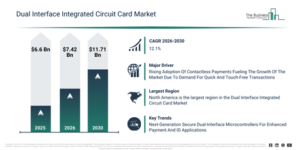
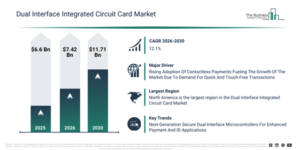
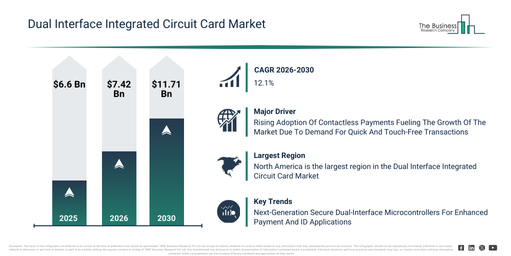
The dual interface integrated circuit card market has experienced substantial expansion recently. Forecasts indicate this market will increase from $6.6 billion in 2025 to $7.42 billion in 2026, exhibiting a compound annual growth rate (CAGR) of 12.4%. Historically, this growth has been driven by factors such as the increased uptake of banking and financial services cards, broader government ID program implementation, advancements in telecom networks, a surge in demand for transit and loyalty cards, and the progress in microcontroller-based smart card development.
The dual interface integrated circuit card market is projected to experience swift expansion in the upcoming years. This market is predicted to reach $11.71 billion in 2030, exhibiting a compound annual growth rate (CAGR) of 12.1%. Key drivers for this expansion during the forecast period include greater integration with biometric systems, a surge in demand for dual interface cards within the healthcare sector, the proliferation of contactless payment options, the uptake of cloud-based card management platforms, and the broadened application of smart cards in retail and logistics. Noteworthy trends anticipated in the same period encompass secure multi-application smart cards, the widespread adoption of contactless payments, cards with integrated biometric features, the incorporation of smart cards into wearable technology, and cloud-based card management solutions.
Evaluate The Dual Interface Integrated Circuit Card Market Report Before You Buy With A Free Sample:
Dual Interface Integrated Circuit Card Market Growth Driver Analysis For The 2026–2030 Forecast Period
The increasing use of contactless payments is anticipated to fuel the expansion of the dual interface integrated circuit (IC) card market in the coming years. Contactless payment systems enable swift and secure transactions through tapping a card or device near a compatible terminal, leveraging near field communication (NFC) or radio frequency identification (RFID) technologies. The surge in contactless payment adoption stems from growing consumer desire for rapid, convenient transactions that require no physical touch or PIN. Dual interface integrated circuit (IC) cards are crucial for intelligent payment systems, offering both contact and contactless transaction capabilities, thereby making them adaptable across diverse payment settings. These cards enhance user experience by facilitating quick, secure, and touch-free payments, simplifying daily financial activities. For example, UK Finance, a financial services company based in the UK, reported in July 2024 that 18.3 billion contactless payments were conducted in the UK during 2023, representing a 7% rise from 17 billion in 2022. Consequently, the expanding adoption of contactless payments is propelling the growth of the dual interface integrated circuit (IC) card market.
Dual Interface Integrated Circuit Card Market Segmentation Breakdown: Primary And Secondary Categories
The dual interface integrated circuit card market covered in this report is segmented –
1) By Type: Contact Interface Cards, Contactless Interface Cards, Dual Interface Smart Cards, Hybrid Cards
2) By Component: Microcontroller, Memory, Other Components
3) By Technology: Radio Frequency Identification, Near Field Communication, Magnetic Stripe Technology, Smart Card Technology
4) By Application: Banking And Financial Services, Telecommunications, Transportation And Logistics, Government And Identification, Healthcare And Medical Services, Retail
Subsegments:
1) By Contact Interface Cards: Consumer Grade, Commercial Grade, Access Control Systems
2) By Contactless Interface Cards: Banking Cards, Transit Cards, Retail And Loyalty Cards
3) By Dual Interface Smart Cards: Payment Cards, Identification Cards, Healthcare Cards
4) By Hybrid Cards: Telecom Cards, Multi Application Cards, Secure Government Cards
Dual Interface Integrated Circuit Card Market Industry Trends: New Developments From Leading Companies
Leading companies in the dual interface integrated circuit (IC) card market are concentrating on developing innovative solutions, such as secure dual interface microcontrollers for contact + contactless smart cards, to enhance payment convenience, security, and multi-application functionality. These secure dual-interface microcontrollers for contact + contactless smart cards are chips designed to enable a single card to communicate via both physical contact and contactless methods, while incorporating built-in security features like encryption and authentication. This technology facilitates faster, more convenient transactions, supports multiple applications on one card, and protects sensitive data from fraud or unauthorized access. For instance, in June 2024, STMicroelectronics International N.V., a manufacturing company based in Switzerland, launched the ST31N600 secure dual-interface microcontroller, engineered to support biometric system-on-card (BSoC) and dynamic CVV (dCVV) payment cards. The ST31N600 is equipped with an Arm SecurCore SC000 32-bit core, up to 608 kB flash memory, an RF-harvesting contactless interface (ISO 14443 type A/B, type F) supporting up to 6.8 Mbps, and enables simultaneous contact/contactless operation. It also integrates advanced cryptographic accelerators, including AES and 3-key DES, and supports on-card biometric template matching without requiring an external battery. Its applications span banking cards with biometric authentication, multi-application cards combining payment and transit, and secure ID cards for governments.
Who Are The Top Competitors In The Dual Interface Integrated Circuit Card Market?
Major companies operating in the dual interface integrated circuit card market are IDEMIA Group, Thales Group S.A., Infineon Technologies AG, NXP Semiconductors N.V., Giesecke & Devrient GmbH, CPI Card Group Inc., Austriacard Holdings AG, Eastcompeace Technology Co. Ltd., Goldpac Group Limited, dz card (International) Co. Ltd., Paragon Identification SAS, Arroweye Solutions Inc., Silone Cardtech Co. Ltd., CardLogix Corporation, MoreRFID Co. Ltd., Variuscard GmbH, IC Payments LLC, Toppan Printing Co. Ltd., SmartTech Production Co. Ltd., Beijing Watchdata System Co. Ltd.
Access The Dual Interface Integrated Circuit Card Market Report For Complete Segment-Level Analysis:
Which Region Leads The Dual Interface Integrated Circuit Card Market, And Which Regions Are Covered?
North America was the largest region in the dual interface integrated circuit (IC) card market in 2025. Asia-Pacific is expected to be the fastest-growing region in the forecast period. The regions covered in the dual interface integrated circuit card market report are Asia-Pacific, South East Asia, Western Europe, Eastern Europe, North America, South America, Middle East, Africa.
Reach Out To Our Team:
The Business Research Company: https://www.thebusinessresearchcompany.com/
Americas: +1 310-496-7795
Asia: +44 7882 955267 & +91 8897263534
Europe: +44 7882 955267
Email us at: marketing@tbrc.info
Follow us on:
LinkedIn: https://in.linkedin.com/company/the-business-research-company
YouTube: https://www.youtube.com/channel/UC24_fI0rV8cR5DxlCpgmyFQ
Global Market Model: https://www.thebusinessresearchcompany.com/global-market-model

Wasay has over a decade of experience in market research, data modelling, and analytics, with prior experience at GlobalData and Decision Tree Consulting Services. At The Business Research Company , he leads research operations across syndicated studies, customized consulting engagements, and the Global Market Model platform. His professional experience includes supporting organizations such as Boston Consulting Group, KPMG, and Ernst & Young. Wasay holds a degree in Electronics and Communications Engineering, postgraduate management qualifications from International Management Institute Belgium and Indian School of Business and Entrepreneurship, and completed the Integrated Program in Business Analytics from Indian Institute of Management Indore.