
Delivering more actionable and strategically valuable research, The Business Research Company’s 2026 market reports feature market attractiveness analysis, total addressable market evaluation, company benchmarking matrices, interactive Excel dashboards, expanded supply chain intelligence, emerging startup coverage, and detailed product insights.
Hygroscopic Building Material Market Value Expansion And Long-Term Growth Outlook
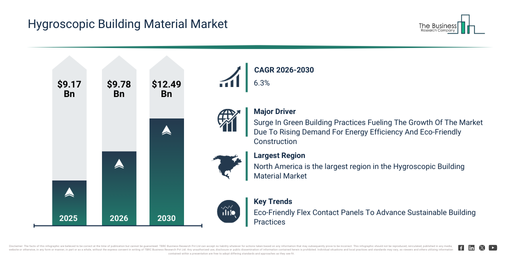
The hygroscopic building material market has shown significant growth in recent years. It is projected to expand from $9.17 billion in 2025 to $9.78 billion in 2026, achieving a compound annual growth rate (CAGR) of 6.6%. This historical increase can be attributed to several factors, including the rising adoption of natural hygroscopic materials, an increase in renovation and restoration projects, growing requirements for improved indoor air quality, the broader use of bio-sourced materials, and the reliance on moisture-regulating panels.
The hygroscopic building material market is projected to experience substantial expansion over the upcoming years. Its valuation is anticipated to reach $12.49 billion by 2030, demonstrating a compound annual growth rate (CAGR) of 6.3%. This anticipated growth during the forecast period stems from factors such as the heightened development of synthetic hygroscopic substances, the growing implementation of automated production methods, an increase in sustainable construction initiatives, the proliferation of intelligent indoor climate management systems, and the expanding application of composite hygroscopic panels. Key trends for the same period encompass the incorporation of AI-powered systems for humidity control, the embrace of environmentally friendly bio-sourced construction materials, further expansion of automated production techniques, the creation of interconnected platforms for monitoring indoor climates, and the utilization of smart materials designed for moisture regulation.
Download A Free Sample Report For Comprehensive Market Insights:
Hygroscopic Building Material Market Opportunity Drivers: What Is Creating New Revenue Potential?
The expanding embrace of green building techniques is projected to fuel the advancement of the hygroscopic building material market in the future. These practices involve methods for designing and erecting structures that ensure occupant safety, minimize energy and water consumption, and demonstrate environmental responsibility. The increasing prevalence of green building is spurred by the imperative to cut down energy expenses, enabling individuals and corporations to economize on electricity and heating costs over extended periods. Hygroscopic construction materials contribute to green building principles by inherently moderating internal humidity levels, thereby lessening the need for mechanical ventilation and air conditioning, boosting energy efficiency, and concurrently elevating indoor air quality and user comfort. As an illustration, in February 2024, data from the US Green Building Council, a non-profit entity based in the US, revealed a 9% rise in Leadership in Energy and Environmental Design (LEED) certifications during 2023 compared to the prior year, alongside an additional 21 certifications awarded to single-family residences. Furthermore, the count of newly registered LEED projects saw a significant ascent, increasing by 51%, which points to considerable expansion. Consequently, the growing adoption of green building approaches propels the development of the hygroscopic building material market.
Hygroscopic Building Material Market Segment Performance And Strategic Opportunities
The hygroscopic building material market covered in this report is segmented –
1) By Type: Natural Hygroscopic Materials, Synthetic Hygroscopic Materials
2) By Functionality: Moisture Control, Temperature Regulation, Sound Insulation
3) By Material Form: Solid Hygroscopic Materials, Foam-Based Hygroscopic Materials, Composite Hygroscopic Materials
4) By Application: Residential Buildings, Commercial Buildings, Industrial Buildings
5) By End-Use: Construction, Renovation, Restoration
Subsegments:
1) By Natural Hygroscopic Materials: Wood, Wool, Clay, Hemp, Cork
2) By Synthetic Hygroscopic Materials: Polymer-based Foams, Modified Cellulose Materials, Synthetic Fiber Insulations, Composite Panels, Aerogels
Hygroscopic Building Material Market Innovation Trends Driving Future Development
Leading companies in the hygroscopic building material market are concentrating on creating sophisticated solutions, such as bio-sourced wood-fiber insulation panels, with the goal of enhancing indoor air quality and managing moisture. These bio-sourced wood-fiber insulation panels are natural construction materials, made from renewable wood fibers, that passively absorb and release indoor moisture, thereby assisting in balancing humidity levels while also offering thermal and acoustic insulation. For example, in February 2023, Isonat, a France-based building materials manufacturing company, unveiled its Flex Contact range, comprising bio-sourced wood-fiber insulation panels. The Flex Contact panels are flexible, environmentally friendly insulation boards crafted from natural wood fibers, providing excellent moisture regulation, breathability, and simple installation. They elevate indoor comfort by sustaining stable humidity, support green building certifications, and cut down on energy usage in heating and cooling systems.
Hygroscopic Building Material Market Key Players: Which Companies Shape Industry Competition?
Major companies operating in the hygroscopic building material market are BASF SE, Compagnie de Saint-Gobain S.A., Arkema S.A., Owens Corning Inc., Clariant AG, Johns Manville Corporation, Soprema S.A.S., W. R. Grace & Co., Steico SE, ParexGroup S.A., Porocel Industries LLC, Knauf Gips KG, Fuji Silysia Chemical Ltd., Hengye Inc., Havelock Wool LLC, Claytec GmbH & Co. KG, IsoHemp S.A., Dessica S.A.S., Zibo Jalon New Materials Co. Ltd., Baubiologie Dämmstoffe Naturbau GmbH
Access The Complete Hygroscopic Building Material Market Report:
Hygroscopic Building Material Market Regional Analysis And Leading Geography
North America was the largest region in the hygroscopic building material market in 2025. Asia-Pacific is expected to be the fastest-growing region in the forecast period. The regions covered in the hygroscopic building material market report are Asia-Pacific, South East Asia, Western Europe, Eastern Europe, North America, South America, Middle East, Africa.
Get in touch with us:
The Business Research Company: https://www.thebusinessresearchcompany.com/
Americas: +1 310-496-7795
Asia: +44 7882 955267 & +91 8897263534
Europe: +44 7882 955267
Email us at: marketing@tbrc.info
Follow us on:
LinkedIn: https://in.linkedin.com/company/the-business-research-company
YouTube: https://www.youtube.com/channel/UC24_fI0rV8cR5DxlCpgmyFQ
Global Market Model: https://www.thebusinessresearchcompany.com/global-market-model

Wasay has over a decade of experience in market research, data modelling, and analytics, with prior experience at GlobalData and Decision Tree Consulting Services. At The Business Research Company , he leads research operations across syndicated studies, customized consulting engagements, and the Global Market Model platform. His professional experience includes supporting organizations such as Boston Consulting Group, KPMG, and Ernst & Young. Wasay holds a degree in Electronics and Communications Engineering, postgraduate management qualifications from International Management Institute Belgium and Indian School of Business and Entrepreneurship, and completed the Integrated Program in Business Analytics from Indian Institute of Management Indore.
