Enhanced with market attractiveness analysis, total addressable market evaluation, company benchmarking matrices, interactive Excel dashboards, expanded supply chain intelligence, emerging startup coverage, and detailed product insights, The Business Research Company’s 2026 market reports deliver more actionable and strategically valuable research.
Industrial Building Insulation Market Size, Value And Growth Trends Through 2030
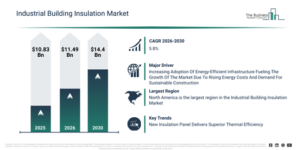
The industrial building insulation market has shown significant growth in recent years. It is expected to expand from $10.83 billion in 2025 to $11.49 billion in 2026, reflecting a compound annual growth rate (CAGR) of 6.1%. This historical growth can be attributed to factors such as the increasing use of industrial insulation for energy efficiency, a growing need for acoustic and thermal management, the expanding requirements for fireproofing insulation, its rising application in new industrial facilities, and the increased implementation of insulation for pipes and equipment.
The industrial building insulation market size is anticipated to demonstrate robust expansion over the next few years. It is predicted to reach $14.4 billion by 2030, exhibiting a compound annual growth rate (CAGR) of 5.8%. This projected growth during the forecast period stems from factors such as the increasing creation of eco-friendly insulation solutions, enhanced automation in insulation installation processes, the broadening of energy management systems, advancements in high-performance thermal and acoustic materials, and the rising integration of connected building monitoring platforms. Noteworthy trends expected in this period involve the utilization of AI-optimized thermal insulation design, the increasing adoption of sustainable industrial insulation materials, the expansion of automated insulation installation systems, the integration of intelligent energy and environmental monitoring, and the deployment of networked industrial building management platforms.
Download A Free Sample Report For Comprehensive Market Insights:
Industrial Building Insulation Market Growth Drivers: What Factors Are Accelerating Expansion?
The expanding integration of energy-efficient infrastructure is projected to fuel the expansion of the industrial building insulation market moving ahead. This infrastructure encompasses structures and systems engineered to consume less energy, uphold operational performance, and lessen their environmental footprint. The growing embrace of such infrastructure stems from escalating energy expenses, prompting businesses to reduce long-term operating costs and enhance energy efficiency. Industrial building insulation plays a crucial role in promoting energy-efficient infrastructure by curbing heat loss, rendering it vital for manufacturing plants and extensive facilities. It significantly improves energy efficiency, lowers running expenditures, and aids in achieving environmental sustainability. As an illustration, in February 2024, the US Green Building Council Inc., a US-based non-profit organization, reported a 9% rise in leadership in energy and environmental design (LEED) certifications in 2023 compared to 2022, alongside 21 further certifications for single-family homes. Furthermore, registrations for new projects saw a substantial increase of 51%, underscoring robust progress in sustainable construction. Consequently, the rising uptake of energy-efficient infrastructure is propelling the expansion of the industrial building insulation market.
Industrial Building Insulation Market Segment Analysis: What Are The Major Market Categories?
The industrial building insulation market covered in this report is segmented –
1) By Material Types: Fiberglass, Mineral Wool, Cellulose, Polyurethane Foam, Polystyrene, Other Material Types
2) By Thickness: Less Than 1 inch, 1 Inch To 2 Inches, 2 Inches To 4 Inches, More Than 4 Inches
3) By Installation Method: New Construction, Retrofit, Pre-Insulated Panels, Insulated Roof Systems, Structural Insulated Panels (SIPs)
4) By Application: Roof Insulation, Wall Insulation, Floor Insulation, Other Applications
5) By End-User Industry: Pharmaceuticals, Food And Beverage, Aerospace, Automotive, Electronics
Subsegments:
1) By Fiberglass: Blanket, Loose-Fill, Rigid Board, Duct Insulation, Pipe Insulation
2) By Mineral Wool: Rock Wool, Slag Wool, Blanket, Board, Loose-Fill
3) By Cellulose: Loose-Fill, Dense-Pack, Spray-Applied, Stabilized Cellulose, Low-dust Cellulose
4) By Polyurethane Foam: Spray Foam, Rigid Foam Board, Pre-Insulated Panels, Pipe Insulation
5) By Polystyrene: Expanded Polystyrene (EPS), Extruded Polystyrene (XPS), Foam Board, Structural Insulated Panels (SIPs)
6) By Other Material Types: Aerogel Insulation, Vacuum Insulated Panels (VIPs), Phenolic Foam, Natural Fiber Insulation
Industrial Building Insulation Market Trends: What Is Shaping Future Industry Growth?
Leading firms within the industrial building insulation market are prioritizing the creation of sophisticated offerings, like high-performance insulation panels, to improve energy efficiency, fire safety, and sustainability in industrial structures. These high-performance insulation panels are cutting-edge insulating materials engineered to deliver exceptional thermal resistance, energy efficiency, fire safety, and moisture management. As an example, in March 2025, Kingspan Group, an Ireland-based building materials firm, introduced Therma TA41, a high-performance polyisocyanurate (PIR) insulation panel. This product is designed for outstanding thermal efficiency, providing a thermal conductivity of merely 0.022 W/mK, making it perfectly suited for flat roofs and other rigorous industrial uses where strong energy performance and moisture resistance are essential. Furthermore, it provides improved fire resistance, maintains dimensional stability, and ensures long-term durability, positioning it as a dependable choice for building initiatives focused on energy efficiency and safety.
Industrial Building Insulation Market Leading Companies Driving Competitive Growth
Major companies operating in the industrial building insulation market are BASF SE, Dow Inc., Compagnie de Saint-Gobain S.A., 3M Company, Covestro AG, Owens Corning, Kingspan Group plc, Huntsman Corporation, Cabot Corporation, Johns Manville Corporation, Rockwool A/S, Knauf Insulation Inc., GAF Materials LLC, Armacell International S.A., Atlas Roofing Corporation, Paroc Group Oy, Dongsung Finetec Co. Ltd., Aspen Aerogels Inc., URSA Insulation S.A., Recticel Insulation NV, Lloyd Insulations Limited.
Access The Complete Industrial Building Insulation Market Report:
Industrial Building Insulation Market Geographic Landscape: Which Region Dominates Industry Growth?
North America was the largest region in the industrial building insulation market in 2025. Asia-Pacific is expected to be the fastest-growing region in the forecast period. The regions covered in the industrial building insulation market report are Asia-Pacific, South East Asia, Western Europe, Eastern Europe, North America, South America, Middle East, Africa.
Get in touch with us:
The Business Research Company: https://www.thebusinessresearchcompany.com/
Americas: +1 310-496-7795
Asia: +44 7882 955267 & +91 8897263534
Europe: +44 7882 955267
Email us at: marketing@tbrc.info
Follow us on:
LinkedIn: https://in.linkedin.com/company/the-business-research-company
YouTube: https://www.youtube.com/channel/UC24_fI0rV8cR5DxlCpgmyFQ
Global Market Model: https://www.thebusinessresearchcompany.com/global-market-model

Wasay has over a decade of experience in market research, data modelling, and analytics, with prior experience at GlobalData and Decision Tree Consulting Services. At The Business Research Company , he leads research operations across syndicated studies, customized consulting engagements, and the Global Market Model platform. His professional experience includes supporting organizations such as Boston Consulting Group, KPMG, and Ernst & Young. Wasay holds a degree in Electronics and Communications Engineering, postgraduate management qualifications from International Management Institute Belgium and Indian School of Business and Entrepreneurship, and completed the Integrated Program in Business Analytics from Indian Institute of Management Indore.