Designed to make market research more actionable and strategically valuable, The Business Research Company’s 2026 market reports feature market attractiveness scoring, total addressable market sizing, company benchmarking matrices, interactive Excel dashboards, deeper supply chain intelligence, emerging startup tracking, and granular product-level insights.
#How Big Is The Chemical Sensors Market In 2026, And How Fast Will It Grow?#_x000D_
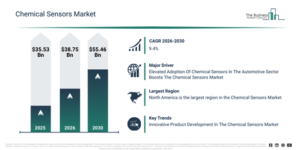
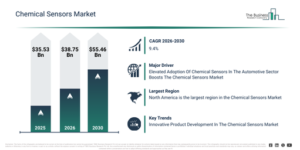
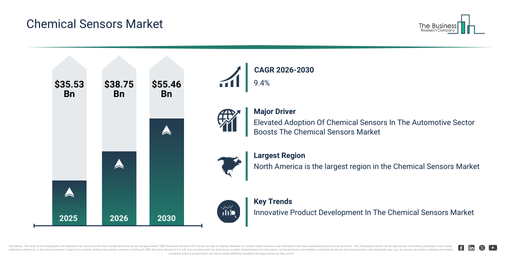
The chemical sensors market size has experienced significant expansion recently. It is projected to expand from $35.53 billion in 2025 to $38.75 billion in 2026, exhibiting a compound annual growth rate (CAGR) of 9.1%. Historically, this growth has been driven by increased utilization of optical and pellistor sensors, greater uptake in automotive and medical sectors, implementation in industrial surveillance, incorporation into environmental oversight, and their application in detecting gases and liquids._x000D_
_x000D_
The chemical sensors market is projected to experience significant growth over the next few years, reaching a size of $55.46 billion by 2030 with a compound annual growth rate (CAGR) of 9.4%. This expansion during the forecast period can be attributed to factors such as the increasing use of AI-driven sensor analytics, the growing adoption of IoT-enabled monitoring, the broader application of high-precision chemical detection, advancements in real-time environmental sensing, and a rise in smart analytical sensor applications. Key trends anticipated during this period include the integration of AI-powered chemical sensors, the deployment of IoT-enabled sensor networks, the adoption of advanced bio-sensors, the implementation of real-time data monitoring, and the expansion of digitalized analytical solutions._x000D_
_x000D_
#Download A Free Chemical Sensors Market Sample Report With Size And Forecast Data:#_x000D_
_x000D_
#Chemical Sensors Market Growth Driver: The Key Factor Behind Rising Demand#_x000D_
The chemical sensors market is anticipated to grow throughout the forecast period, driven by their increasing integration into the automotive industry. Automobile traffic serves as the main origin of exhaust gases. These chemical sensors, along with measurement technologies, play a crucial role in enhancing engine performance, boosting energy efficiency, and diminishing pollutant emissions. As an illustration, Bosch, a German technology and services provider, unveiled new BME690 air quality sensors in January 2023 for vehicle integration. These sensors are designed to monitor pollutants such as carbon monoxide and nitrogen dioxide, thereby improving cabin air quality and furnishing data for optimizing vehicle emissions. The company is also currently developing a variation of its air quality sensor technology with an autonomous vehicle manufacturer to introduce the first smoke detector capable of detecting smoke and vape within the vehicle environment. Therefore, the expanding application of chemical sensors in the automotive sector is propelling the growth of the chemical sensors market._x000D_
_x000D_
#Chemical Sensors Market Segmentation: Key Segments And Subsegments Covered#_x000D_
The chemical sensors market covered in this report is segmented – _x000D_
_x000D_
1) By Product Type: Optical, Pallister Or Catalytic Bead, Other Product Types_x000D_
2) By Particulate Type: Liquid, Gas_x000D_
3) By Detection Method: pH Sensors, Humidity Sensors, Bio Sensors_x000D_
4) By End-User: Automotive, Medical, Environmental Monitoring, Industrial, Other End-Users_x000D_
_x000D_
Subsegments:_x000D_
1) By Optical: Fluorescence-Based Sensors, Infrared (IR) Sensors, Raman Spectroscopy Sensors _x000D_
2) By Pellistor or Catalytic Bead: Combustible Gas Sensors, Methane Sensors _x000D_
3) By Other Product Types: Electrochemical Sensors, Semiconductor Sensors, Piezoelectric Sensors_x000D_
_x000D_
#Chemical Sensors Market Trends: Key Developments Shaping 2026 And Beyond#_x000D_
Leading companies in the chemical distribution market are developing new offerings, such as hydrogen pressure sensors, to cater to larger customer bases, boost sales, and increase revenue. A hydrogen pressure sensor is a device specifically designed to measure the pressure of hydrogen gas. For example, in September 2023, Baker Hughes, a US-based energy technology company, introduced its Druck hydrogen-rated pressure sensors. These hydrogen pressure sensors are built for extended stability and resilience in challenging conditions, making them suitable for a diverse array of applications. These applications include gas turbines, hydrogen production via electrolysis, and hydrogen filling stations. The launch of this advanced hydrogen technology allows customers to utilize a pressure sensor that not only withstands demanding hydrogen environments for long periods but also offers enhanced precision and dependability. Baker Hughes has integrated advanced barrier coating technology into its latest Druck hydrogen pressure sensors. This technology protects the sensor element from the harmful effects of hydrogen, assuring customers an exceptional minimum operational life of five years, covering a broad pressure range._x000D_
_x000D_
#Leading Companies Operating In The Chemical Sensors Market#_x000D_
Major companies operating in the chemical sensors market are Honeywell International Inc., Siemens AG, Halma plc, Denso Corporation, Emerson Electric Co., General Electric Company, Intelligent Optical Systems Inc., SICK AG, Alpha MOS SA, Robert Bosch GmbH, Hans Turck GmbH & Co. KG, Owlstone Medical Ltd., SPEC Sensors LLC, Nemoto & Co. Ltd., SenseAir AB, Freescale Semiconductor Inc., JLM Innovation GmbH, ABB Group, BorgWarner Inc., Smiths Detection Inc., MSA Safety Incorporated, Pepperl+Fuchs Group, AirTest Technologies Inc., Yokogawa Electric Corporation, Thermo Fisher Scientific Inc., Pendar Technologies Inc., Intellisense Systems Inc., Lyten Inc., Physical Sciences Inc., Aerodyne Research Inc., Sensirion AG, City Technology Ltd., Figaro Engineering Inc. _x000D_
_x000D_
#Access The Full Chemical Sensors Market Research Report:#_x000D_
_x000D_
#Chemical Sensors Market Regional Analysis: Largest Region And Key Geographies Covered#_x000D_
North America was the largest region in the chemical sensors market in 2025. Asia-Pacific is expected to be the fastest-growing region in the forecast period. The regions covered in the chemical sensors market report are Asia-Pacific, South East Asia, Western Europe, Eastern Europe, North America, South America, Middle East, Africa._x000D_
_x000D_
#Reach Out To Our Team:#_x000D_
_x000D_
The Business Research Company: https://www.thebusinessresearchcompany.com/_x000D_
Americas: +1 310-496-7795_x000D_
Asia: +44 7882 955267 & +91 8897263534_x000D_
Europe: +44 7882 955267_x000D_
Email us at: marketing@tbrc.info_x000D_
_x000D_
#Follow us on:#_x000D_
_x000D_
LinkedIn: https://in.linkedin.com/company/the-business-research-company_x000D_
YouTube: https://www.youtube.com/channel/UC24_fI0rV8cR5DxlCpgmyFQ_x000D_
Global Market Model: https://www.thebusinessresearchcompany.com/global-market-model

Wasay has over a decade of experience in market research, data modelling, and analytics, with prior experience at GlobalData and Decision Tree Consulting Services. At The Business Research Company , he leads research operations across syndicated studies, customized consulting engagements, and the Global Market Model platform. His professional experience includes supporting organizations such as Boston Consulting Group, KPMG, and Ernst & Young. Wasay holds a degree in Electronics and Communications Engineering, postgraduate management qualifications from International Management Institute Belgium and Indian School of Business and Entrepreneurship, and completed the Integrated Program in Business Analytics from Indian Institute of Management Indore.