Market attractiveness scoring, total addressable market sizing, company benchmarking matrices, interactive Excel dashboards, deeper supply chain intelligence, emerging startup tracking, and granular product-level insights are among the key offerings featured in The Business Research Company’s 2026 market reports, designed to deliver more actionable and strategically valuable research.
Educational Robot Market Valued At $2.75 Billion In 2026, Projected To Reach $5.44 Billion By 2030
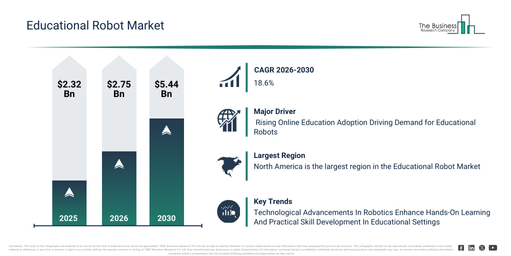
The educational robot market size has witnessed swift expansion in recent years. It is projected to expand from $2.32 billion in 2025 to $2.75 billion in 2026, achieving a compound annual growth rate (CAGR) of 18.6%. The historical growth of this market can be attributed to the increasing integration of robotics in classrooms, a rising emphasis on STEM education, the prior use of basic programmable kits, a growing demand for interactive learning tools, and widespread adoption in robotics competitions.
The educational robot market is poised for significant expansion in the next few years. It is projected to reach $5.44 billion in 2030, with a compound annual growth rate (CAGR) of 18.6%. This anticipated growth during the forecast period stems from the increasing integration of AI-driven tutoring, the growing popularity of personalized learning robots, the expansion of modular robotic kits, a heightened demand for coding-integrated educational tools, and the shift towards cloud-connected learning platforms. Key trends for this period include AI-driven learning robots, AR/VR-compatible educational robots, IoT-enabled collaborative learning robots, autonomous classroom assistive robots, and smart manufacturing approaches for educational robot hardware.
Request A Complimentary Educational Robot Market Research Sample:
Key Factor Propelling The Educational Robot Market Forward
The growing acceptance of online learning is anticipated to fuel the expansion of the educational robot market in the forthcoming years. Online learning, often referred to as e-learning, is a method for acquiring information or competencies through electronic materials and the Internet. When integrated into online learning, educational robots enhance the learning experience by providing hands-on and stimulating techniques for studying various courses, particularly in the STEM and technology sectors. For instance, in January 2024, a report from Eurostat, a Luxembourg-based government agency, stated that 30% of EU internet users aged 16 to 74 reported engaging in online courses or using online learning materials in the previous three months of 2023. This figure represented a 2% increase from 2022, when participation stood at 28%. Consequently, the increasing adoption of online learning is a key driver for the educational robot market.
Educational Robot Market Segments And Subsegments Explained
The educational robot market covered in this report is segmented –
1) By Type: Service Robot, Educational Industrial Robot
2) By Component: Hardware, Software
3) By Application: Primary Education, Secondary Education, Higher Education, Other Applications
Subsegments:
1) By Service Robot: Social Robots, Companion Robots, Teaching Assistants, Research And Development Robots
2) By Educational Industrial Robot: Robotic Arm Kits, Simulation And Programming Robots
Emerging Trends Transforming The Educational Robot Market
Leading companies in the educational robot market are concentrating on developing advanced and accessible robotic solutions to enhance interactive learning, support skill development, and provide students with practical programming experience. These innovations prioritize affordability, ease of use, and compatibility with classroom environments to broaden their adoption across schools and training institutions. For instance, in August 2024, Kawasaki Robotics, a Japan-based robotics and heavy industries manufacturer, introduced Astorino, its newest education-focused robot. Astorino is a 6-axis robot with a 1 kg payload, priced at approximately $5,000 to make robotics education more accessible. The robot features a lightweight 12 kg structure and operates on a standard 110 V power supply, making it suitable for classroom integration. Students can also 3D-print replacement parts for nearly the entire robot using the provided STL files. Designed to mirror the programming and structure of Kawasaki’s industrial robots, Astorino offers a realistic hands-on learning experience that prepares learners for real-world industrial robotics applications.
Educational Robot Market Key Players: Major Companies In The 2026 Report
Major companies operating in the educational robot market are SoftBank Robotics Group Corp, ROBOTIS Co Ltd., Aisoy Robotics, Blue Frog Robotics & Buddy, LEGO System A/S, Wonder Workshop Inc., Makeblock, Modular Robotics, Robolink, BrainCo, CoderZ, Cubic Robotics, Dobot Robots, EdTech Robotics, EZ-Robot, Fable, Gakken Classroom Global, Hexbug, Kano, KUBO Robotics, Learning Resources
Explore The Full Educational Robot Market Report With Forecasts To 2030:
Educational Robot Market By Region: Where Is Demand Strongest?
North America was the largest region in the educational robot market in 2025. Asia Pacific is expected to be the fastest-growing region in the educational robot market report forecast period. The regions covered in the educational robot market report are Asia-Pacific, South East Asia, Western Europe, Eastern Europe, North America, South America, Middle East, Africa.
Reach Out To Our Team:
The Business Research Company: https://www.thebusinessresearchcompany.com/
Americas: +1 310-496-7795
Asia: +44 7882 955267 & +91 8897263534
Europe: +44 7882 955267
Email us at: marketing@tbrc.info
Follow us on:
LinkedIn: https://in.linkedin.com/company/the-business-research-company
YouTube: https://www.youtube.com/channel/UC24_fI0rV8cR5DxlCpgmyFQ
Global Market Model: https://www.thebusinessresearchcompany.com/global-market-model

Wasay has over a decade of experience in market research, data modelling, and analytics, with prior experience at GlobalData and Decision Tree Consulting Services. At The Business Research Company , he leads research operations across syndicated studies, customized consulting engagements, and the Global Market Model platform. His professional experience includes supporting organizations such as Boston Consulting Group, KPMG, and Ernst & Young. Wasay holds a degree in Electronics and Communications Engineering, postgraduate management qualifications from International Management Institute Belgium and Indian School of Business and Entrepreneurship, and completed the Integrated Program in Business Analytics from Indian Institute of Management Indore.