Market attractiveness scoring, total addressable market sizing, company benchmarking matrices, interactive Excel dashboards, deeper supply chain intelligence, emerging startup tracking, and granular product-level insights are among the key offerings featured in The Business Research Company’s 2026 market reports, designed to deliver more actionable and strategically valuable research.
Organic Electronics Market Size Estimate For 2026 And Revenue Forecast Through 2030
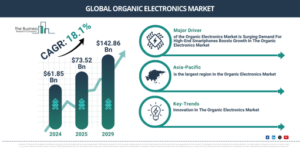
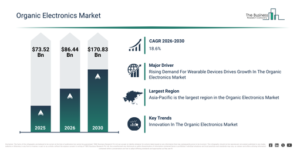
Recent years have witnessed rapid growth in the organic electronics market size. It is anticipated to expand from $73.52 billion in 2025 to $86.44 billion in 2026, exhibiting a compound annual growth rate (CAGR) of 17.6%. Historically, this expansion is attributable to several key factors, including early research into conductive polymers, the advancement of OLED technology, a rising demand for lightweight electronics, the proliferation of flexible display applications, and initial adoption in low power devices.
The organic electronics market is projected to experience substantial expansion in the coming years. This market is forecast to reach $170.83 billion by 2030, exhibiting a compound annual growth rate (CAGR) of 18.6%. Factors contributing to this growth during the forecast period include the expanding application of wearable electronics, the increased deployment of organic photovoltaics for energy harvesting, a heightened emphasis on sustainable materials, progress in printed electronic circuits, and the proliferation of flexible sensor applications. Key trends expected over the forecast period encompass innovations in organic semiconductor materials, wider adoption of flexible substrates, an increase in the use of organic photovoltaics, ongoing advancements in printed electronics, and the broader integration of organic conductive materials within wearable devices.
Free Organic Electronics Market Report Sample Available For Download:
Why Is Demand In The Organic Electronics Market Expected To Keep Rising?
The organic electronics market is anticipated to expand as a result of the increasing need for consumer electronics. These refer to electronic devices intended for personal and daily use, encompassing items like smartphones, tablets, laptops, and home entertainment systems. The growing adoption of smart devices and connected technologies in daily life is fueling this increased demand for consumer electronics. Within these devices, organic electronics are utilized to produce lightweight, flexible, and energy-efficient components such as OLED displays, flexible screens, sensors, and organic solar cells, which are integral to products like smartphones, TVs, and wearables. For instance, in February 2024, the Japan Electronics and Information Technology Industries Association, a Japan-based trade organization, reported that consumer electronic equipment production reached $201.91 million (¥31,685 million), marking an increase from $149.27 million (¥23,425 million) in January 2023. Consequently, the rising demand for consumer electronics is a primary driver for the growth of the organic electronics market.
How Is The Organic Electronics Market Divided Across Segments And Subsegments?
The organic electronics market covered in this report is segmented –
1) By Material: Semiconductor, Conductive, Dielectric, Substrate
2) By Application: Display, Lighting, Battery, Conductive Ink, Other Applications
3) By End User: Consumer Electronics, Healthcare, Automotive, Energy, Aerospace And Defense, Other End Users
Subsegments:
1) By Semiconductor: Organic Thin-Film Transistors (OTFTs), Organic Light-Emitting Diodes (OLEDs), Organic Photovoltaics (OPVs)
2) By Conductive: Conductive Polymers, Carbon Nanotubes, Graphene-Based Conductors
3) By Dielectric: Polymer Dielectrics, Organic Insulating Materials
4) By Substrate: Flexible Substrates, Rigid Substrates
Organic Electronics Market Trends Reshaping Customer Demand And Business Strategies
Leading companies within the organic electronics market are concentrating on developing advanced technological products, such as flexible OLEDs, to broaden their market presence. Flexible organic light-emitting diode (OLED) technology utilizes a pliable substrate, typically constructed from polyimide. For example, in May 2023, Merck KGaA, a Germany-based science and technology firm, unveiled new barrier materials that, in contrast to current options, provide flexible OLED (organic light-emitting diode) devices with enhanced flexibility, reliability, and longevity. These innovative materials are processed using low-temperature plasma-enhanced atomic layer deposition (PE-ALD) technology, which allows for improved thin film encapsulation. This development extends the OLED device’s operational life and satisfies increasingly stringent automotive criteria. Moreover, it boosts barrier performance, cuts costs, and presents numerous benefits over existing solutions, all of which are expected to contribute to the growth of the organic electronics market.
Organic Electronics Market Major Players: Companies At The Forefront Of The Industry
Major companies operating in the organic electronics market are Sony Group Corporation, Panasonic Corporation, Samsung Display, LG Display Co. Ltd., BOE Technology Group Co. Ltd., Toshiba Corporation, AUO Corporation, Universal Display Corporation, OLEDWorks LLC, Novaled GmbH, Heliatek GmbH, ISORG, FlexEnable, Kateeva Inc., BASF SE, Sumitomo Corporation, Heraeus Holding GmbH, Henkel AG & Co. KGaA, Merck KGaA, Fujifilm Corporation, Evonik Industries AG, Covestro AG, AGC Inc., PolyIC GmbH & Co. KG, Sigma-Aldrich Corporation
Read More About The Organic Electronics Market In The Full Report:
Organic Electronics Market Regional Share Analysis For 2025
Asia-Pacific was the largest region in the organic electronics market in 2025. The regions covered in the organic electronics market report are Asia-Pacific, South East Asia, Western Europe, Eastern Europe, North America, South America, Middle East, Africa.
Reach Out To Our Team:
The Business Research Company: https://www.thebusinessresearchcompany.com/
Americas: +1 310-496-7795
Asia: +44 7882 955267 & +91 8897263534
Europe: +44 7882 955267
Email us at: marketing@tbrc.info
Follow us on:
LinkedIn: https://in.linkedin.com/company/the-business-research-company
YouTube: https://www.youtube.com/channel/UC24_fI0rV8cR5DxlCpgmyFQ
Global Market Model: https://www.thebusinessresearchcompany.com/global-market-model

Wasay has over a decade of experience in market research, data modelling, and analytics, with prior experience at GlobalData and Decision Tree Consulting Services. At The Business Research Company , he leads research operations across syndicated studies, customized consulting engagements, and the Global Market Model platform. His professional experience includes supporting organizations such as Boston Consulting Group, KPMG, and Ernst & Young. Wasay holds a degree in Electronics and Communications Engineering, postgraduate management qualifications from International Management Institute Belgium and Indian School of Business and Entrepreneurship, and completed the Integrated Program in Business Analytics from Indian Institute of Management Indore.