With a focus on actionable insights and strategic value, The Business Research Company’s 2026 market reports include market attractiveness scoring, total addressable market sizing, company benchmarking matrices, interactive Excel dashboards, deeper supply chain intelligence, emerging startup tracking, and granular product-level insights.
How Large Could The Plastic Transistors Market Become By 2030 At A 6.4% CAGR?
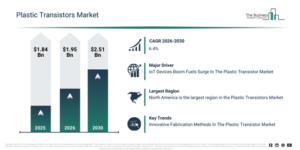
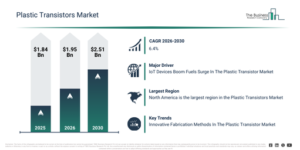
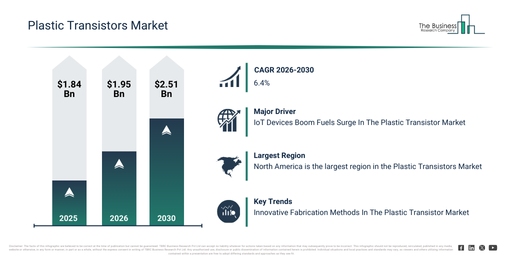
The market size for plastic transistors has demonstrated strong growth in recent years. It will grow from $1.84 billion in 2025 to $1.95 billion in 2026 at a compound annual growth rate (CAGR) of 6.3%. This historical expansion can be attributed to factors such as early research in organic semiconductors, a rise in lightweight electronic components, the increasing demand for flexible circuits, initial adoption in OLED panels, and the growing use in consumer electronics.
The market for plastic transistors is projected to experience substantial growth over the coming years. It is anticipated to reach $2.51 billion by 2030, exhibiting a compound annual growth rate (CAGR) of 6.4%. This expansion during the forecast period can be attributed to factors such as the growth of wearable electronics, the increasing use of bendable sensors, a greater emphasis on low-cost manufacturing, progress in printed circuit technologies, and the proliferation of plastic displays. Key trends expected during this period involve advancements in organic semiconductor materials, a surge in the application of flexible electronics, wider integration of plastic transistors in wearable devices, the development of bendable and printable sensors, and the creation of affordable electronic components.
Get A Free Plastic Transistors Market Sample With 2030 Forecast Insights:
Plastic Transistors Market Outlook: Key Driver Supporting Long-Term Growth
The increasing integration of Internet of Things (IoT) devices is projected to stimulate the future expansion of the plastic transistor market. These IoT devices consist of non-conventional computing hardware capable of wireless network connectivity and data transmission. Plastic transistors find application in IoT devices, enabling their use in equipment requiring flexibility, such as bending, twisting, or adapting to various forms. For example, Forbes, a US-based business magazine, reported that in 2023, cellular IoT connections reached 3.5 billion. It is also estimated that a user of these devices would engage in more than 5,000 data transactions daily, leading to the generation of a significant 90 zettabytes of data. Consequently, the swift uptake of IoT devices is fueling the expansion of the plastic transistor market.
Segmentation Of The Plastic Transistors Market: Key Categories Explained
The plastic transistors market covered in this report is segmented –
1) By Type: 3-alkythiophene Semiconducting Layer, Polyimide Dielectric Layer, Two Silver Electrodes
2) By Application: Plastic Displays, Bendable Sensors, Organic Light-Emitting Diode (OLED), Wearable Electronics
3) By End-User: Consumer Electronics, Healthcare, Automotive
Subsegments:
1) By 3-Alkythiophene Semiconducting Layer: Poly(3-Alkylthiophene), Poly(3-Hexylthiophene), Poly(3-Octylthiophene)
2) By Polyimide Dielectric Layer: Kapton, Upilex, Other Polyimides
3) By Two Silver Electrodes: Screen-Printed Silver Electrodes, Vacuum-Deposited Silver Electrodes
Plastic Transistors Market Evolving Trends: What Businesses Should Know
Major companies operating in the plastic transistor market are actively developing innovative fabrication methods, including carbon nanotube wiring on plastic films, to sustain their market position. Fabrication refers to the process of transforming raw materials into finished or semi-finished products. For instance, in March 2023, a team at the University of Tokyo, a Japan-based research university, introduced a new method for fabricating plastic transistors using ultraviolet light, enabling low-cost and potentially scalable production. The process of fabricating plastic transistors involves coating a surface with a positively doped layer of silicon, creating nanoscale trenches in the device layer using electron-beam lithography, followed by dry etching to form a silicon nanomembrane, and adding additional dry etching to isolate and define the transistor. The benefits of this fabrication include the simplicity of manufacturing and potential cost savings.
Who Competes In The Plastic Transistors Market? Major Companies Listed
Major companies operating in the plastic transistors market are Pragmatic Semiconductor (Pragmatic Printing Ltd.), FlexEnable Limited, Plastic Logic GmbH, Polyera Corporation, E Ink Holdings Inc., AU Optronics Corp., LG Display, Samsung Display, Kateeva Inc., Merck KGaA, BASF SE, Solvay SA, Fujifilm Dimatix, Heliatek GmbH, Philips Research / Holst Centre, Acreo Swedish ICT (RISE Acreo), Thin Film Electronics ASA, SmartKem Ltd., ISORG, Japan Display Inc.
Read The Complete Plastic Transistors Market Forecast Report Through 2030:
Plastic Transistors Market Regional Ranking: Which Geography Comes First?
North America was the largest region in the plastic transistors market in 2025. Asia-Pacific is expected to be the fastest-growing region in the forecast period. The regions covered in the plastic transistors market report are Asia-Pacific, South East Asia, Western Europe, Eastern Europe, North America, South America, Middle East, Africa.
Reach Out To Our Team:
The Business Research Company: https://www.thebusinessresearchcompany.com/
Americas: +1 310-496-7795
Asia: +44 7882 955267 & +91 8897263534
Europe: +44 7882 955267
Email us at: marketing@tbrc.info
Follow us on:
LinkedIn: https://in.linkedin.com/company/the-business-research-company
YouTube: https://www.youtube.com/channel/UC24_fI0rV8cR5DxlCpgmyFQ
Global Market Model: https://www.thebusinessresearchcompany.com/global-market-model

Wasay has over a decade of experience in market research, data modelling, and analytics, with prior experience at GlobalData and Decision Tree Consulting Services. At The Business Research Company , he leads research operations across syndicated studies, customized consulting engagements, and the Global Market Model platform. His professional experience includes supporting organizations such as Boston Consulting Group, KPMG, and Ernst & Young. Wasay holds a degree in Electronics and Communications Engineering, postgraduate management qualifications from International Management Institute Belgium and Indian School of Business and Entrepreneurship, and completed the Integrated Program in Business Analytics from Indian Institute of Management Indore.