With a focus on actionable insights and strategic value, The Business Research Company’s 2026 market reports include market attractiveness scoring, total addressable market sizing, company benchmarking matrices, interactive Excel dashboards, deeper supply chain intelligence, emerging startup tracking, and granular product-level insights.
Micro-Electro-Mechanical Systems (MEMS) Light Detection and Ranging (LiDAR)–Gyroscope Fusion Module Market Size Analysis: Historical Growth And Future Revenue Projections
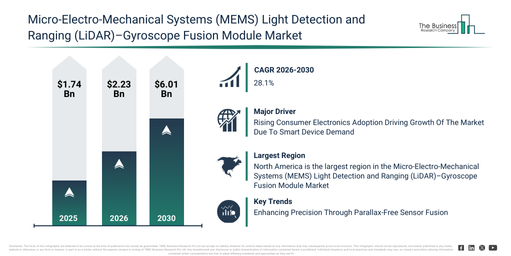
The micro-electro-mechanical systems (MEMS) light detection and ranging (lidar)–gyroscope fusion module market size has experienced significant expansion in recent years. This market is anticipated to increase from $1.74 billion in 2025 to $2.23 billion in 2026, registering a compound annual growth rate (CAGR) of 28.4%. Past growth in this sector stemmed from advancements in MEMS technology, the increasing use of autonomous vehicles, a surge in robotics applications, the creation of high-precision gyroscopes, and escalating demand for industrial automation.
The market for micro-electro-mechanical systems (MEMS) light detection and ranging (lidar)–gyroscope fusion modules is projected to experience substantial growth over the coming years. This market is anticipated to reach $6.01 billion in 2030, exhibiting a compound annual growth rate (CAGR) of 28.1%. Factors contributing to this expansion during the forecast period include the integration with AI-based navigation, a growing demand for compact 3D mapping solutions, the increasing use of UAV applications, advancements in sensor fusion algorithms, and greater adoption in consumer electronics. Key trends expected within this period involve the miniaturization of sensors, enhanced high-precision navigation capabilities, real-time data processing, integrated sensor fusion, and improved 3D mapping accuracy.
Preview The Micro-Electro-Mechanical Systems (MEMS) Light Detection and Ranging (LiDAR)–Gyroscope Fusion Module Market Report With A Free Sample:
Micro-Electro-Mechanical Systems (MEMS) Light Detection and Ranging (LiDAR)–Gyroscope Fusion Module Market Drivers: What Is Fueling Demand Through 2030?
The expanding need for consumer electronics is anticipated to boost the micro-electro-mechanical systems (MEMS) light detection and ranging (LiDAR)–gyroscope fusion module market. Consumer electronics encompasses electronic gadgets for daily personal use, such as smartphones, laptops, televisions, and wearables, which facilitate communication, entertainment, and productivity. This surge in consumer electronics stems from swift technological progress, where innovations like AI integration, IoT connectivity, and 5G networks fuel the desire for smarter, more efficient devices that improve convenience and user experience. The MEMS LiDAR-Gyro Fusion Module assists consumer electronics by improving spatial awareness and stability, enabling functionalities like advanced camera autofocus, obstacle detection in robotics, and fluid motion control in gaming and wearable devices. A relevant example is the projection by Ericsson, a Sweden-based telecommunications firm, which stated in June 2024 that regional mobile subscriptions are expected to grow from 1.2 billion in 2023 to 1.3 billion by 2029. Consequently, the heightened demand for consumer electronics is propelling the expansion of the micro-electro-mechanical systems (MEMS) light detection and ranging (LiDAR)–gyroscope fusion module market.
Micro-Electro-Mechanical Systems (MEMS) Light Detection and Ranging (LiDAR)–Gyroscope Fusion Module Market Segmentation Analysis: Core Categories And Subcategories
The micro-electro-mechanical systems (mems) light detection and ranging (lidar)–gyroscope fusion module market covered in this report is segmented –
1) By Component: Light Detection And Ranging (LiDAR) Sensor, Gyroscope, Control Unit, Software, Other Components
2) By Application: Autonomous Vehicles, Robotics, Unmanned Aerial Vehicle (UAVs), Industrial Automation, Other Application
3) By End-User: Automotive, Aerospace And Defense, Industrial, Consumer Electronics, Other End-Users
Subsegments:
1) By Light Detection And Ranging (Lidar) Sensor: Solid-State, Flash, MEMS (Micro-Electro-Mechanical Systems)
2) By Gyroscope: Fiber-Optic, Vibrating, Ring Laser
3) By Control Unit: Microcontroller, DSP (Digital Signal Processor), FPGA (Field-Programmable Gate Array)
4) By Software: Sensor Fusion Algorithms, Data Processing And Analytics, Navigation And Mapping Software
5) By Other Components: Power Supply, Cables, Connectors
Which Trends Will Define The Micro-Electro-Mechanical Systems (MEMS) Light Detection and Ranging (LiDAR)–Gyroscope Fusion Module Market Through 2030?
Companies operating within the micro-electro-mechanical systems (MEMS) light detection and ranging (LiDAR)–gyroscope fusion module market are concentrating on developing technological advancements, including parallax-free fusion, to improve sensor accuracy, decrease errors, and enable more precise navigation and perception in consumer electronics and autonomous systems. Parallax-free fusion denotes the exact integration of LiDAR and gyro (IMU) data, which eliminates spatial misalignment between the sensors’ optical and measurement axes, thus ensuring accurate depth perception and positioning without parallax errors. As an example, in February 2025, Kyocera Corporation, a Japan-based manufacturing company, introduced the world’s first camera-LIDAR fusion sensor that boasts perfect optical alignment, allowing for ultra-precise depth sensing in advanced imaging and autonomous applications. This product is unique globally for integrating both technologies into a single, perfectly aligned unit, effectively removing parallax and enabling real-time, high-precision object detection. This hardware fusion delivers parallax-free image and depth data, substantially enhancing safety and recognition in autonomous vehicles, robotics, and industrial systems. Furthermore, the sensor provides enhanced durability and resolution, making it suitable for reliable 3D perception across challenging environments.
Micro-Electro-Mechanical Systems (MEMS) Light Detection and Ranging (LiDAR)–Gyroscope Fusion Module Market Major Companies And Industry Participants
Major companies operating in the micro-electro-mechanical systems (MEMS) light detection and ranging (lidar)–gyroscope fusion module market are Ouster Inc., Luminar Technologies Inc., Panasonic Corporation, Northrop Grumman LITEF GmbH, Honeywell International Inc., Valeo S.A., STMicroelectronics, Kyocera Corporation, Vaisala company, HesAI Technology Co. Ltd., Hokuyo Automatic Co. Ltd., Blickfeld GmbH, Innoviz Technologies Ltd., Cepton Inc., LeddarTech Inc., Inertial Labs, ASC Gmbh., RoboSense, Quanergy Systems Inc., Aeva Technologies Inc., SICK AG, GuideNav.
Buy The Full Micro-Electro-Mechanical Systems (MEMS) Light Detection and Ranging (LiDAR)–Gyroscope Fusion Module Global Market Report 2026:
Micro-Electro-Mechanical Systems (MEMS) Light Detection and Ranging (LiDAR)–Gyroscope Fusion Module Market Geographic Analysis: Which Region Accounts For The Biggest Share?
North America was the largest region in the micro-electro-mechanical systems (MEMS) light detection and ranging (LiDAR)–gyroscope fusion module market in 2025. Asia-Pacific is expected to be the fastest-growing region in the forecast period. The regions covered in the micro-electro-mechanical systems (MEMS) light detection and ranging (lidar)–gyroscope fusion module market report are Asia-Pacific, South East Asia, Western Europe, Eastern Europe, North America, South America, Middle East, Africa.
Reach Out To Our Team:
The Business Research Company: https://www.thebusinessresearchcompany.com/
Americas: +1 310-496-7795
Asia: +44 7882 955267 & +91 8897263534
Europe: +44 7882 955267
Email us at: marketing@tbrc.info
Follow us on:
LinkedIn: https://in.linkedin.com/company/the-business-research-company
YouTube: https://www.youtube.com/channel/UC24_fI0rV8cR5DxlCpgmyFQ
Global Market Model: https://www.thebusinessresearchcompany.com/global-market-model

Wasay has over a decade of experience in market research, data modelling, and analytics, with prior experience at GlobalData and Decision Tree Consulting Services. At The Business Research Company , he leads research operations across syndicated studies, customized consulting engagements, and the Global Market Model platform. His professional experience includes supporting organizations such as Boston Consulting Group, KPMG, and Ernst & Young. Wasay holds a degree in Electronics and Communications Engineering, postgraduate management qualifications from International Management Institute Belgium and Indian School of Business and Entrepreneurship, and completed the Integrated Program in Business Analytics from Indian Institute of Management Indore.