The Business Research Company’s 2026 market reports are designed to deliver research that is more actionable and strategically valuable. Key offerings include market attractiveness scoring, total addressable market sizing, company benchmarking matrices, interactive Excel dashboards, deeper supply chain intelligence, emerging startup tracking, and granular product-level insights.
Smart Indoor Co2 Control Market Historical Growth Vs. Forecast Growth: How Do The Numbers Compare?
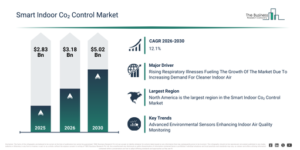
The smart indoor CO2 control market has experienced swift expansion in recent years. It will grow from $2.83 billion in 2025 to $3.18 billion in 2026 at a compound annual growth rate (CAGR) of 12.3%. The expansion during the historic period is largely attributable to factors such as increasing awareness of indoor air quality, the greater integration of HVAC systems, the introduction of regulatory standards for CO2 emissions, a surge in the construction of commercial and residential structures, and the embedding of basic CO2 monitoring features in buildings.
The smart indoor co2 control market size is expected to see rapid growth over the next few years, with projections indicating it will grow to $5.02 billion in 2030 at a compound annual growth rate (CAGR) of 12.1%. This anticipated expansion during the forecast period can be attributed to advancements in AI and machine learning specifically for co2 control, the continued expansion of smart building infrastructure, the increasing adoption of wireless and IoT-enabled sensors, a strong focus on energy efficiency and sustainability initiatives, and the integration with predictive maintenance and broader building management systems. Major trends driving this market in the forecast period include the rise of AI-enabled co2 control systems, an emphasis on energy-efficient indoor air management, the deployment of IoT-integrated ventilation solutions, the development of predictive indoor air quality analytics, and smart HVAC systems with integrated co2 monitoring capabilities.
Start With A Free Sample Of The Smart Indoor Co2 Control Market Research Report:
The Leading Growth Driver In The Smart Indoor Co2 Control Market Explained
The increasing prevalence of respiratory illnesses is projected to boost the expansion of the smart indoor Co2 control market moving forward. These health conditions affect the lungs, airways, and throat, interfering with normal breathing. Their incidence is rising due to air pollution, which contributes to inflammation, diminishes lung function, and elevates infection risks. Smart indoor CO2 control proves beneficial for respiratory illnesses by helping to maintain optimal indoor air quality, thereby reducing the accumulation of pollutants and allergens that can trigger respiratory symptoms and worsen conditions such as asthma or bronchitis. For instance, in October 2024, according to the World Health Organization, a Switzerland-based intergovernmental organization, approximately 8.2 million individuals were newly diagnosed with tuberculosis in 2023, marking a significant rise from the 7.5 million cases recorded in 2022. Consequently, the growing number of respiratory illnesses is propelling the growth of the smart indoor Co2 control market.
Key Segments Shaping The Smart Indoor Co2 Control Market Landscape
The smart indoor co2 control market covered in this report is segmented –
1) By Product Type: Standalone CO2 Controllers, Integrated CO2 Monitoring Systems, Smart Thermostats With CO2 Sensors, Other Product Types
2) By Connectivity: Wired, Wireless
3) By Distribution Channel: Online, Offline
4) By Application: Residential, Commercial, Industrial, Educational Institutions, Healthcare Facilities, Other Applications
5) By End-User: Homeowners, Building Managers, Facility Operators, Other End-Users
Subsegments:
1) By Standalone CO2 Controllers: Wall-Mounted CO2 Controllers, Desktop CO2 Controllers, Wireless CO2 Controllers, Programmable CO2 Controllers
2) By Integrated CO2 Monitoring Systems: HVAC-Integrated CO2 Systems, Building Management System (BMS)-Integrated CO2 Systems, IoT-Enabled CO2 Monitoring Systems, Multi-Parameter Indoor Air Quality (IAQ) Monitoring Systems
3) By Smart Thermostats With CO2 Sensors: Wi-Fi Enabled Smart Thermostats, Zigbee Or Z-Wave Smart Thermostats, Voice-Controlled Smart Thermostats, AI-Enabled Adaptive Smart Thermostats
4) By Other Product Types: Portable CO2 Monitors, CO2 Data Loggers, CO2 Datalogging Sensors With Mobile App Connectivity, Hybrid IAQ And CO2 Control Devices
Smart Indoor Co2 Control Market Trend Spotlight: Key Shifts Shaping Future Demand
Major companies in the smart indoor Co2 control market are concentrating on developing advanced solutions, such as environmental sensors, to assist in ensuring safety and regulatory compliance through continuous detection of harmful environmental changes. Environmental sensors are instruments designed to monitor and measure environmental conditions like air quality, temperature, humidity, or the presence of pollutants. For instance, in April 2025, Axis Communications, a technology company based in Sweden, introduced the AXIS D6210 Air Quality Sensor and AXIS D6310 Air Quality Sensor. The AXIS D6210 and AXIS D6310 are prominent for tracking indoor air quality by identifying vaping and smoking activities. They can also detect various air pollutants, including particulate matter, volatile organic compounds, nitrogen oxides, and carbon dioxide. Furthermore, these devices measure environmental parameters such as relative humidity and temperature, delivering comprehensive indoor air monitoring.
Smart Indoor Co2 Control Market Competitive Analysis: Who Are The Main Competitors?
Major companies operating in the smart indoor co2 control market are Siemens AG, Thermo Fisher Scientific Inc., Schneider Electric SE, Honeywell International Inc., ABB Ltd., Johnson Controls International Plc, Carrier Global Corporation, Trane Technologies Plc, Delta Electronics Inc., Legrand SA, Vaisala Oyj, Amphenol Advanced Sensors, Figaro Engineering Inc., Rotronic AG, Awair Inc., Airthings AS, Senseair AB, E+E Elektronik GmbH, Edinburgh Sensors Ltd., CO2Meter Inc.
Find The Complete Smart Indoor Co2 Control Market Outlook In The Full Report:
Mapping The Smart Indoor Co2 Control Market: Regional Leadership And Global Reach
North America was the largest region in the smart indoor Co2 control market in 2025. Asia-Pacific is expected to be the fastest-growing region in the forecast period. The regions covered in the smart indoor co2 control market report are Asia-Pacific, South East Asia, Western Europe, Eastern Europe, North America, South America, Middle East, Africa.
Reach Out To Our Team:
The Business Research Company: https://www.thebusinessresearchcompany.com/
Americas: +1 310-496-7795
Asia: +44 7882 955267 & +91 8897263534
Europe: +44 7882 955267
Email us at: marketing@tbrc.info
Follow us on:
LinkedIn: https://in.linkedin.com/company/the-business-research-company
YouTube: https://www.youtube.com/channel/UC24_fI0rV8cR5DxlCpgmyFQ
Global Market Model: https://www.thebusinessresearchcompany.com/global-market-model

Wasay has over a decade of experience in market research, data modelling, and analytics, with prior experience at GlobalData and Decision Tree Consulting Services. At The Business Research Company , he leads research operations across syndicated studies, customized consulting engagements, and the Global Market Model platform. His professional experience includes supporting organizations such as Boston Consulting Group, KPMG, and Ernst & Young. Wasay holds a degree in Electronics and Communications Engineering, postgraduate management qualifications from International Management Institute Belgium and Indian School of Business and Entrepreneurship, and completed the Integrated Program in Business Analytics from Indian Institute of Management Indore.