The Business Research Company’s 2026 market reports combine market attractiveness scoring, total addressable market sizing, company benchmarking matrices, interactive Excel dashboards, deeper supply chain intelligence, emerging startup tracking, and granular product-level insights to deliver research that is more actionable and strategically valuable.
Smart Mirror Market Size Review: What Shaped Past Growth And What Will Drive Future Expansion?
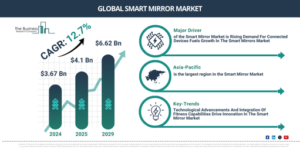
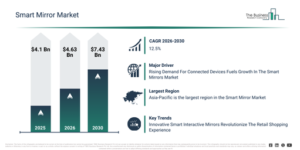
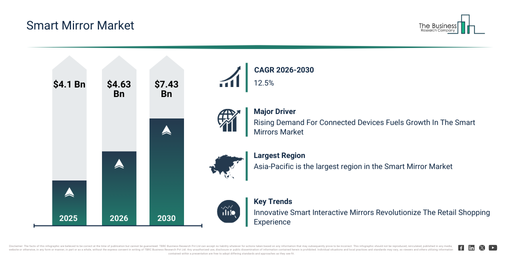
The smart mirror market has experienced significant growth over the past few years. This market is forecast to increase from $4.1 billion in 2025 to $4.63 billion in 2026, registering a compound annual growth rate (CAGR) of 12.8%. Factors contributing to the historical growth include an escalating demand for digital display mirrors, enhanced smart home integration, the initial application of embedded sensors and cameras, rising implementation in retail try-on scenarios, and broader innovation in consumer electronics.
The smart mirror market is anticipated to experience substantial growth in the coming years, with its size forecasted to reach $7.43 billion by 2030, exhibiting a compound annual growth rate (CAGR) of 12.5%. This expansion during the projected period stems from several factors, including the increasing implementation of AR-based mirrors, advancements in AI-driven personalized content delivery, the broader integration of connected retail experiences, augmented commercial utilization in healthcare and fitness, and the ongoing creation of sophisticated sensor-integrated mirror systems. Significant trends anticipated in the forecast duration involve the widespread incorporation of AI-enhanced interactive mirror setups, the proliferation of IoT-connected display mirrors, the emergence of cloud-based personalized interface platforms, further evolution of immersive AR-driven mirror interactions, and the development of smart automated mirror technologies.
Access Free Sample Pages From The Smart Mirror Market Report 2026:
Understanding The Main Driver Of The Smart Mirror Market
The robust demand for internet-connected gadgets is anticipated to boost the smart mirrors market expansion. With technological advancements, consumers have shown considerable interest in exploring the benefits of integrating more devices into the internet and their potential to improve daily life. A relevant illustration is the report from Deloitte, the UK-based multinational professional services organization, which stated in September 2025 that US households expended an average of US$896 on connected devices over the previous year, marking a notable increase from US$764 recorded in 2024. Consequently, this substantial consumer demand for connected devices is a key factor fueling the expansion of smart mirrors.
Smart Mirror Market Segment Mapping For 2026 And Beyond
The smart mirror market covered in this report is segmented –
1) By Component: Hardware, Software, Services
2) By Type: Exterior Mirror, Interior Mirror
3) By Functionality: Connected, Non-Connected
4) By Feature: AR-Smart Mirror, Non AR-Smart Mirror
5) By Application: Automotive, Healthcare, Retail And Marketing, Consumer, Other Applications
Subsegments:
1) By Hardware: Display Panels, Sensors, Camera Systems
2) By Software: Operating Systems, Custom Apps, User Interface Software
3) By Services: Installation Services, Maintenance and Support Services, Subscription Services
What Key Trend Is Expected To Shape The Smart Mirror Market Over The Forecast Period?
Leading businesses within the smart mirror sector are innovating with technologies like smart interactive mirrors, aiming to cater to broader customer demographics, boost sales, and enhance revenue. These smart interactive mirrors are defined as sophisticated, interactive reflective surfaces that incorporate digital functionalities and features. As an illustration, in October 2023, Mirrorroid, a smart mirror technology firm originating from South Korea, introduced its Attachable Smart Mirror at the 15th K-Beauty Expo Korea. This particular product functions as a portable, interactive smart mirror device, featuring digital capabilities like beauty simulation (for hair and style alterations), and is designed for use in retail environments with high foot traffic or within stores.
Smart Mirror Market Major Players And Industry Competition Overview
Major companies operating in the smart mirror market are Perseus Mirrors, Samsung Electronics Co. Ltd., Electric Mirror Inc., Japan Display Inc., Magna International Inc., Ficosa Internacional SA, Magic Fitness, Fiture Holding LLC, Mirror (Vaurum Labs), Oak Labs, Panasonic Corporation, Gentex Corporation, Vercon Smart Mirror Factory, Seura Solutions LLC, HiMirror Inc., MirroCool Inc., HILO Smart Mirror Inc., Memomi Labs Inc., Perch Interactive Inc., SmartSpot Inc., Smart Mirrors Solutions LLC
Full Smart Mirror Market Report: Market Size, Trends, Segments And Key Players:
Smart Mirror Market Geographic Segmentation: Regions Covered In The Report
Asia-Pacific was the largest region in the smart mirror market in 2025. The regions covered in the smart mirror market report are Asia-Pacific, South East Asia, Western Europe, Eastern Europe, North America, South America, Middle East, Africa.
Reach Out To Our Team:
The Business Research Company: https://www.thebusinessresearchcompany.com/
Americas: +1 310-496-7795
Asia: +44 7882 955267 & +91 8897263534
Europe: +44 7882 955267
Email us at: marketing@tbrc.info
Follow us on:
LinkedIn: https://in.linkedin.com/company/the-business-research-company
YouTube: https://www.youtube.com/channel/UC24_fI0rV8cR5DxlCpgmyFQ
Global Market Model: https://www.thebusinessresearchcompany.com/global-market-model

Wasay has over a decade of experience in market research, data modelling, and analytics, with prior experience at GlobalData and Decision Tree Consulting Services. At The Business Research Company , he leads research operations across syndicated studies, customized consulting engagements, and the Global Market Model platform. His professional experience includes supporting organizations such as Boston Consulting Group, KPMG, and Ernst & Young. Wasay holds a degree in Electronics and Communications Engineering, postgraduate management qualifications from International Management Institute Belgium and Indian School of Business and Entrepreneurship, and completed the Integrated Program in Business Analytics from Indian Institute of Management Indore.