With a focus on actionable insights and strategic value, The Business Research Company’s 2026 market reports include market attractiveness scoring, total addressable market sizing, company benchmarking matrices, interactive Excel dashboards, deeper supply chain intelligence, emerging startup tracking, and granular product-level insights.
How Large Could The Smart Personal Protective Equipment (PPE) Market Become By 2030 At A 15.9% CAGR?
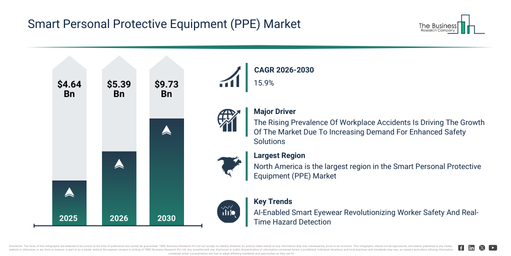
The smart personal protective equipment (ppe) market has seen swift growth in recent years. Its value is forecast to expand from $4.64 billion in 2025 to $5.39 billion in 2026, exhibiting a compound annual growth rate (CAGR) of 16.2%. This historical growth can be attributed to several factors including an increase in workplace accidents, greater recognition of occupational safety, mandatory regulations for protective gear, limited integration of smart technologies, and an expanding industrial workforce.
The smart personal protective equipment (ppe) market is projected for significant expansion in the coming years. This market is forecast to reach $9.73 billion by 2030, exhibiting a compound annual growth rate (CAGR) of 15.9%. Key drivers for this growth throughout the forecast period include the incorporation of IoT and AI into PPE, an increasing need for worker safety in dangerous settings, progress in wearable sensor technology, the digital transformation of industrial processes, and the spread of smart PPE into developing markets. Significant trends anticipated during the same period encompass wearable safety analytics, interconnected PPE systems, intelligent environmental monitoring, real-time worker health monitoring, and proactive hazard avoidance.
Get A Free Smart Personal Protective Equipment (PPE) Market Sample With 2030 Forecast Insights:
Smart Personal Protective Equipment (PPE) Market Outlook: Key Driver Supporting Long-Term Growth
The increasing occurrence of workplace accidents is anticipated to boost the smart personal protective equipment (PPE) market’s expansion. Workplace accidents are unforeseen incidents on the job that lead to injuries, health problems, or property damage. These accidents are on the rise due to inadequate safety training, as unprepared employees are more prone to making dangerous errors. Smart PPE helps reduce workplace incidents by continuously monitoring environmental and health conditions, providing immediate alerts for potential dangers. It enables quicker responses to risks such as falls, fatigue, or hazardous exposure, thereby enhancing overall safety. For instance, in November 2024, according to the Bureau of Labor Statistics (BLS), a US-based government agency, the total number of workplace injuries in private industries rose to 2,368.9 in 2023, compared to 2,343.6 in 2022. Thus, the growing prevalence of workplace accidents is driving the smart personal protective equipment (PPE) market’s growth.
Segmentation Of The Smart Personal Protective Equipment (PPE) Market: Key Categories Explained
The smart personal protective equipment (ppe) market covered in this report is segmented –
1) By Product: Hand Protection, Protective Clothing, Protective Footwear, Respiratory Protection, Head, Eye, And Face Protection, Fall Protection, Hearing Protection, Other Products
2) By Technology: Internet Of Things-Enabled Devices, Wearable Technology, Augmented Reality (AR), Real-Time Monitoring Systems, Data Analytics Tools
3) By Functionality: Safety Monitoring, Environmental Sensing, Communication And Alerts, Fall Detection And Prevention, Ergonomics And Fatigue Monitoring
4) By Distribution Channel: Direct Sales, Retail Stores, Online Sales Platforms, Third-Party Distributors, Trade Shows And Exhibitions
5) By End-Use Industry: Oil And Gas, Construction, Fire Fighting, Manufacturing, Healthcare Facilities, Mining, Other End-Use Industries
Subsegments:
1) By Hand Protection: Smart Gloves With Sensors, Radio Frequency Identification (RFID)-Enabled Gloves, Temperature-Sensing Gloves, Vibration-Detection Gloves
2) By Protective Clothing: Smart Jackets With Environmental Monitoring, Temperature-Regulating Suits, Embedded Bio-Sensor Clothing, Chemical Detection Clothing
3) By Protective Footwear: Smart Insoles For Gait Analysis, Location-Tracking Boots, Impact-Detection Footwear, Slip-Resistance Monitoring Shoes
4) By Respiratory Protection: Connected Respirators With Air Quality Sensors, Smart Masks With Filter Status Indicators, Bluetooth-Enabled Respirators, Voice-Amplifying Respiratory Devices
5) By Head, Eye, And Face Protection: Smart Helmets With AR Display, Eye Protection With Visual Hazard Alerts, Facial Shields With Thermal Imaging, Noise-Canceling Communication Headsets
6) By Fall Protection: Smart Harnesses With Fall Detection, Connected Lanyards, Proximity Alert Systems, Impact-Sensing Belts
7) By Hearing Protection: Smart Earplugs With Noise Level Monitoring, Adaptive Noise-Canceling Headsets, Hearing Protection With Communication Capabilities, Exposure Time Monitoring Devices
8) By Other Products: Wearable Location Trackers, Fatigue Monitoring Bands, Smart Vests With Vital Sign Monitoring, Multi-Sensor Arm Bands
Smart Personal Protective Equipment (PPE) Market Evolving Trends: What Businesses Should Know
Leading firms within the smart personal protective equipment (PPE) market are concentrating on creating sophisticated products like artificial intelligence (AI)-powered eyewear to boost worker safety through instantaneous hazard identification and elevated situational awareness. This AI-integrated eyewear consists of glasses that provide immediate data, visual prompts, and alerts for hazards, thereby improving safety, situational awareness, and hands-free communication in industrial and dangerous environments. As an illustration, Vuzix Corporation, an optical technology enterprise based in the US, introduced its Z100 Smart Glasses in January 2024. These glasses represent a lightweight, safety-certified wearable device intended to effortlessly link frontline employees with AI optimization solutions, granting hands-free entry to current workflow updates, alerts, and AI-powered applications through a heads-up display compatible with both Android and iOS devices. With a weight comparable to conventional eyeglasses and providing up to 48 hours of battery operation, the Z100 seeks to boost productivity and accessibility by embedding AI-driven functionalities directly into the everyday tasks of workers.
Who Competes In The Smart Personal Protective Equipment (PPE) Market? Major Companies Listed
Major companies operating in the smart personal protective equipment (ppe) market are Honeywell International Inc., 3M Company, MSA Safety Inc., Blackline Safety Corp., ProGlove, MCR Safety, RealWear Inc., StrongArm Technologies, German Bionic, Uvex Group, Ekso Bionics, Vuzix Corporation, GuardHat, Sensoria Health Inc., Hexoskin, Active Protective Technologies, Siverus, Aurora Sports, Iristick, Elitac Wearable.
Read The Complete Smart Personal Protective Equipment (PPE) Market Forecast Report Through 2030:
Smart Personal Protective Equipment (PPE) Market Regional Ranking: Which Geography Comes First?
North America was the largest region in the smart personal protective equipment (PPE) market in 2025. Asia-Pacific is expected to be the fastest-growing region in the forecast period. The regions covered in the smart personal protective equipment (ppe) market report are Asia-Pacific, South East Asia, Western Europe, Eastern Europe, North America, South America, Middle East, Africa.
Reach Out To Our Team:
The Business Research Company: https://www.thebusinessresearchcompany.com/
Americas: +1 310-496-7795
Asia: +44 7882 955267 & +91 8897263534
Europe: +44 7882 955267
Email us at: marketing@tbrc.info
Follow us on:
LinkedIn: https://in.linkedin.com/company/the-business-research-company
YouTube: https://www.youtube.com/channel/UC24_fI0rV8cR5DxlCpgmyFQ
Global Market Model: https://www.thebusinessresearchcompany.com/global-market-model

Wasay has over a decade of experience in market research, data modelling, and analytics, with prior experience at GlobalData and Decision Tree Consulting Services. At The Business Research Company , he leads research operations across syndicated studies, customized consulting engagements, and the Global Market Model platform. His professional experience includes supporting organizations such as Boston Consulting Group, KPMG, and Ernst & Young. Wasay holds a degree in Electronics and Communications Engineering, postgraduate management qualifications from International Management Institute Belgium and Indian School of Business and Entrepreneurship, and completed the Integrated Program in Business Analytics from Indian Institute of Management Indore.