Designed to make market research more actionable and strategically valuable, The Business Research Company’s 2026 market reports feature market attractiveness scoring, total addressable market sizing, company benchmarking matrices, interactive Excel dashboards, deeper supply chain intelligence, emerging startup tracking, and granular product-level insights.
How Big Is The Lithium Electricity Equipment Market In 2026, And How Fast Will It Grow?
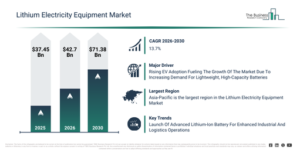
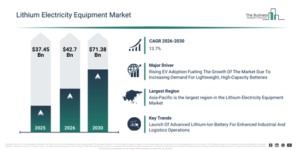
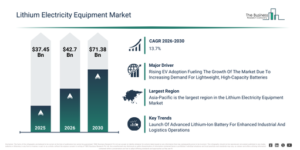
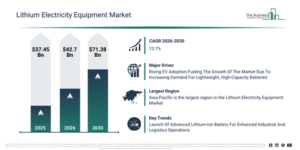
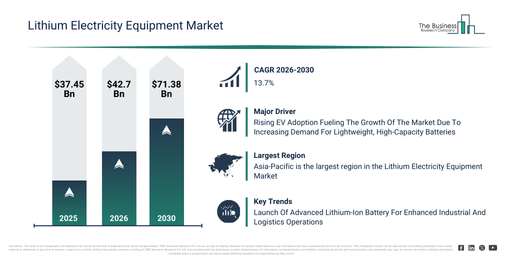
The lithium electricity equipment market has demonstrated rapid expansion in recent years, with its size projected to increase from $37.45 billion in 2025 to $42.7 billion in 2026, exhibiting a compound annual growth rate (CAGR) of 14.0%. This historical growth can be attributed to factors such as increased demand for electric vehicles, expansion in consumer electronics, the uptake of renewable energy solutions, enhancements in lithium-ion battery efficiency, and governmental encouragement for clean energy initiatives.
The lithium electricity equipment market size is projected to experience substantial growth in the next few years. It is anticipated to expand to $71.38 billion in 2030, achieving a compound annual growth rate (CAGR) of 13.7%. This expansion during the forecast period can be attributed to the increasing deployment of grid-level energy storage, advancements in solid-state lithium batteries, the expansion of electric mobility infrastructure, rising industrial electrification, and the integration of smart battery management systems. Major trends anticipated in this period include advanced battery management systems, portable energy storage solutions, grid-scale lithium energy storage, high-efficiency chargers and inverters, and the integration of lithium batteries in industrial equipment.
Download A Free Lithium Electricity Equipment Market Sample Report With Size And Forecast Data:
Lithium Electricity Equipment Market Growth Driver: The Key Factor Behind Rising Demand
The expanding requirement for electric vehicles is anticipated to fuel the future growth of the lithium electricity equipment market. Electric vehicles (EVs) are vehicles that run entirely or partly on electricity, employing electric motors and batteries instead of traditional internal combustion engines. The increasing consumer interest in electric vehicles is driven by governments worldwide introducing stricter emissions regulations and offering incentives, such as tax rebates and subsidies, to encourage the adoption of cleaner transportation options. Lithium electricity equipment is essential for electric vehicles because it provides them with lightweight, high-capacity batteries that enable longer driving ranges and faster charging. For example, in December 2024, the Energy Information Administration, a US-based government agency, reported that the combined market share of hybrid, plug-in hybrid electric, and battery electric vehicles (BEVs) in total new light-duty vehicle (LDV) sales in the United States increased from 19.1% in the second quarter of 2024 to 21.2% in the third quarter of 2024. Therefore, the growing demand for electric vehicles is significantly boosting the lithium electricity equipment market.
Lithium Electricity Equipment Market Segmentation: Key Segments And Subsegments Covered
The lithium electricity equipment market covered in this report is segmented –
1) By Product Type: Lithium-ion Batteries, Battery Management Systems, Chargers, Inverters, Other Product Types
2) By Technology: Traditional Lithium-Ion Technology, Advanced Lithium Battery Technologies, Solid-State Lithium Batteries, Hybrid Lithium Batteries, Lithium-Sulfur Batteries
3) By Application: Electric Vehicles, Energy Storage Systems, Consumer Electronics, Industrial Equipment, Other Applications
4) By Distribution Channel: Online, Offline
5) By End-User: Automotive Industry, Consumer Electronics Sector, Renewable Energy Systems, Telecommunications, Healthcare Equipment
Subsegments:
1) By Lithium-Ion Batteries: Power Lithium-Ion Batteries, Energy Storage Lithium-Ion Batteries, Electric Vehicle (EV) Lithium-Ion Batteries, Consumer Electronics Lithium-Ion Batteries
2) By Battery Management Systems: Automotive BMS, Energy Storage System (ESS) BMS, Industrial BMS, Consumer Electronics BMS
3) By Chargers: Electric Vehicle Chargers, Portable Chargers, Wireless Chargers, Fast Chargers
4) By Inverters: Grid-Tied Inverters, Off-Grid Inverters, Hybrid Inverters, Microinverters
5) By Other Product Types: Power Conversion Systems, DC-DC Converters, Battery Pack Assembly, Battery Protection Circuits
Lithium Electricity Equipment Market Trends: Key Developments Shaping 2026 And Beyond
Leading companies in the lithium electricity equipment market are prioritizing the development of innovative solutions, such as advanced lithium-ion batteries, to boost energy storage, efficiency, and overall performance. An advanced lithium-ion battery represents an enhanced version of traditional lithium-ion batteries, engineered to deliver superior energy density, charging speed, lifespan, and safety. For instance, in October 2024, Exide Technologies, a US-based storage battery manufacturing company, introduced the Solition Material Handling battery, a novel lithium-ion solution aimed at optimizing industrial and logistics operations. Leveraging advanced lithium iron phosphate (LiFePO4) technology, this battery offers double the capacity of conventional lead-acid batteries, alongside exceptional safety, rapid charging, and an extended lifespan of up to 4,000 cycles. It significantly reduces the total cost of ownership through its higher efficiency, reduced maintenance, and smart monitoring capabilities. With its modular design and adherence to stringent safety standards, the Solition battery promotes sustainable, reliable, and cost-effective material handling, establishing itself as a transformative solution for modern industrial fleets.
Leading Companies Operating In The Lithium Electricity Equipment Market
Major companies operating in the lithium electricity equipment market are BYD Company Limited, Panasonic Corporation, Contemporary Amperex Technology Co. Limited, Toshiba Corporation, LG Energy Solution Ltd., Samsung SDI Co. Ltd., GS Yuasa Corporation, EnerSys, Wuxi Lead Intelligent Equipment Co. Ltd., Exide Technologies, Northvolt AB, CKD Corporation, Redwood Materials Inc., Microvast Holdings Inc., SVOLT Energy Technolog, Lyten Inc., Tenergy Corporation, South 8 Technologies Inc., Tianjin Lishen Battery Joint-Stock Co. Ltd., Cadenza Innovation Inc., Sunwoda Electronic Co. Ltd., Polinovel
Access The Full Lithium Electricity Equipment Market Research Report:
Lithium Electricity Equipment Market Regional Analysis: Largest Region And Key Geographies Covered
Asia-Pacific was the largest region in the lithium electricity equipment market in 2025. Asia-Pacific is expected to be the fastest-growing region in the forecast period. The regions covered in the lithium electricity equipment market report are Asia-Pacific, South East Asia, Western Europe, Eastern Europe, North America, South America, Middle East, Africa.
Reach Out To Our Team:
The Business Research Company: https://www.thebusinessresearchcompany.com/
Americas: +1 310-496-7795
Asia: +44 7882 955267 & +91 8897263534
Europe: +44 7882 955267
Email us at: marketing@tbrc.info
Follow us on:
LinkedIn: https://in.linkedin.com/company/the-business-research-company
YouTube: https://www.youtube.com/channel/UC24_fI0rV8cR5DxlCpgmyFQ
Global Market Model: https://www.thebusinessresearchcompany.com/global-market-model

Wasay has over a decade of experience in market research, data modelling, and analytics, with prior experience at GlobalData and Decision Tree Consulting Services. At The Business Research Company , he leads research operations across syndicated studies, customized consulting engagements, and the Global Market Model platform. His professional experience includes supporting organizations such as Boston Consulting Group, KPMG, and Ernst & Young. Wasay holds a degree in Electronics and Communications Engineering, postgraduate management qualifications from International Management Institute Belgium and Indian School of Business and Entrepreneurship, and completed the Integrated Program in Business Analytics from Indian Institute of Management Indore.