
Delivering more actionable and strategically valuable research, The Business Research Company’s 2026 market reports feature market attractiveness analysis, total addressable market evaluation, company benchmarking matrices, interactive Excel dashboards, expanded supply chain intelligence, emerging startup coverage, and detailed product insights.
Robotic Glass Installation Market Growth Potential: How Will Market Size Change Through 2030?
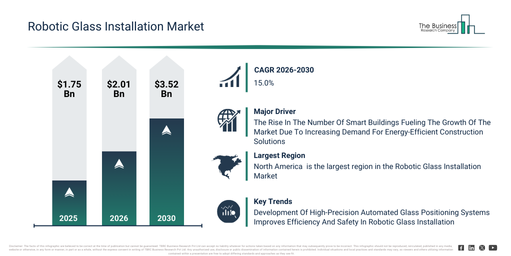
The robotic glass installation market size has seen swift expansion over recent years. It is anticipated to expand from $1.75 billion in 2025 to $2.01 billion in 2026, achieving a compound annual growth rate (CAGR) of 14.9%. This historical growth can be attributed to several factors including an increasing demand for automated glass installation, the rising adoption of robotic arms in construction, the growing utilization of precision sensors, the expansion of installation services, and the integration of vision-based placement systems.
The robotic glass installation market size is expected to experience significant expansion in the coming years. It is projected to achieve $3.52 billion by 2030, demonstrating a compound annual growth rate (CAGR) of 15.0%. This growth throughout the forecast period can be attributed to the rising implementation of AI-driven robots, the increasing adoption of mobile robotic platforms, the growing integration of multi-arm collaborative robots, the broadening of semi-automated glass handling solutions, and the advancement of sophisticated robotic calibration and control systems. Prominent trends for this period encompass the incorporation of AI-assisted glass placement systems, the embrace of robotic suction and handling technologies, the deployment of smart vision and sensor systems, the expansion of automated glass installation platforms, and the development of connected robotic glass ecosystems.
Download A Free Sample Report For Comprehensive Market Insights:
Robotic Glass Installation Market Development Factors: Which Trends Are Supporting Demand?
The increasing prevalence of smart buildings is projected to drive expansion within the robotic glass installation market going forward. These intelligent structures feature sophisticated automation systems, Internet of Things (IoT) devices, and integrated technologies aimed at improving energy efficiency, security, occupant comfort, and overall operational control. The growing count of smart buildings stems from a rising demand for energy-efficient solutions, which contribute to decreased energy usage, reduced operational expenses, and enhanced building performance. Robotic glass installation systems benefit smart buildings by facilitating accurate and efficient positioning of glass panels, thereby cutting down on manual effort and boosting safety throughout the construction phase. These systems simplify the placement of substantial glazing units, leading to better operational efficiency and supporting the performance and sustainability goals of contemporary constructions. An example demonstrating this trend is that in October 2024, data from the Central Statistics Office, an Ireland-based government agency, indicated nearly 28% of internet users utilized connected devices and systems like thermostats, smart meters for electricity and gas, and smart lighting for managing home energy, which represents a six-percentage-point increase compared to the corresponding period in 2022. Consequently, the expansion in the number of smart buildings is a key factor propelling the development of the robotic glass installation market.
Robotic Glass Installation Market Segmentation And Category Breakdown
The robotic glass installation market covered in this report is segmented –
1) By Product Type: Automated Glass Handling Robots, Glass Installation Drones, Collaborative Robots, Other Product Types
2) By Automation Level: Semi-Automated, Fully Automated
3) By Application Type: Residential, Commercial, Industrial, Infrastructure
4) By End-User: Construction Companies, Glass Manufacturers, Renovation And Maintenance Service Providers, Other End-Users
Subsegments:
1) By Automated Glass Handling Robots: Robotic Suction Lifter, Robotic Arm With Gripper, Robotic Transport Platform, Robotic Window Mount
2) By Glass Installation Drones: Quadcopter Glass Installer, Hexacopter Glass Installer, Autonomous Flying Glass Handler, Remote Controlled Glass Drone
3) By Collaborative Robots: Human Assistive Glass Robot, Cooperative Multi Arm Robot, Lightweight Mobile Glass Robot, Interactive Assembly Robot
4) By Other Product Types: Robotic Glass Polishing Machine, Robotic Glass Cutting System, Robotic Glass Cleaning Device, Robotic Glass Inspection System
Robotic Glass Installation Market Transformation Trends: Which Innovations Are Driving Change?
Major companies in the robotic glass installation market are prioritizing the development of advanced technological solutions, such as high-precision automated glass positioning systems, to enhance efficiency, safety, and accuracy during the installation of heavy glazing units. A high-precision automated glass positioning system is a robotic solution that utilizes sophisticated sensors and control mechanisms to precisely lift, align, and install glass panels, thereby minimizing risks associated with manual handling and improving precision in large-scale construction projects. For instance, in April 2025, Qingdao Toyo Industry Co., Ltd, a China-based manufacturer of glass handling, lifting, and installation machinery and systems, introduced a Glazing Robot designed for managing and installing jumbo glass sheets. This robot can handle glass panels weighing between approximately 300 kg and 800 kg, making it suitable for large-format façade installations. It offers a lifting height of up to 3,500 mm with a horizontal extension of 650 mm, enabling its use in complex or high-elevation building scenarios. Additionally, it features a walkie-type mobile system with large wheels, ensuring smooth and stable movement across indoor and outdoor construction environments, thus improving on-site safety and installation efficiency.
Robotic Glass Installation Market Competitive Analysis Of Major Industry Participants
Major companies operating in the robotic glass installation market are Fanuc Corporation, KUKA Aktiengesellschaft, Glaston Corporation, Hegla GmbH And Co. KG, GGR Group Ltd., Qingdao Toyo Industry Co. Ltd., Smiley Lifting Solutions, Forel S.p.A., Yaskawa Electric Corporation, LISEC Austria GmbH, Himor Lift Co. Ltd., Ergo Robotic Solutions LLC, Quattrolifts LLC, Singh Automation Pvt. Ltd., Smartlift A/S, Tecauma SAS, Cowest Machinery Co. Ltd., Heavydrive GmbH, Premier Industries Inc., Winlet A/S
Access The Complete Robotic Glass Installation Market Report:
Robotic Glass Installation Market Regional Analysis And Leading Geography
North America was the largest region in the robotic glass installation market in 2025. Asia-Pacific is expected to be the fastest-growing region in the forecast period. The regions covered in the robotic glass installation market report are Asia-Pacific, South East Asia, Western Europe, Eastern Europe, North America, South America, Middle East, Africa.
Get in touch with us:
The Business Research Company: https://www.thebusinessresearchcompany.com/
Americas: +1 310-496-7795
Asia: +44 7882 955267 & +91 8897263534
Europe: +44 7882 955267
Email us at: marketing@tbrc.info
Follow us on:
LinkedIn: https://in.linkedin.com/company/the-business-research-company
YouTube: https://www.youtube.com/channel/UC24_fI0rV8cR5DxlCpgmyFQ
Global Market Model: https://www.thebusinessresearchcompany.com/global-market-model

Wasay has over a decade of experience in market research, data modelling, and analytics, with prior experience at GlobalData and Decision Tree Consulting Services. At The Business Research Company , he leads research operations across syndicated studies, customized consulting engagements, and the Global Market Model platform. His professional experience includes supporting organizations such as Boston Consulting Group, KPMG, and Ernst & Young. Wasay holds a degree in Electronics and Communications Engineering, postgraduate management qualifications from International Management Institute Belgium and Indian School of Business and Entrepreneurship, and completed the Integrated Program in Business Analytics from Indian Institute of Management Indore.