With a focus on actionable insights and strategic value, The Business Research Company’s 2026 market reports include market attractiveness scoring, total addressable market sizing, company benchmarking matrices, interactive Excel dashboards, deeper supply chain intelligence, emerging startup tracking, and granular product-level insights.
Baby Cereal Market Size Analysis: Historical Growth And Future Revenue Projections
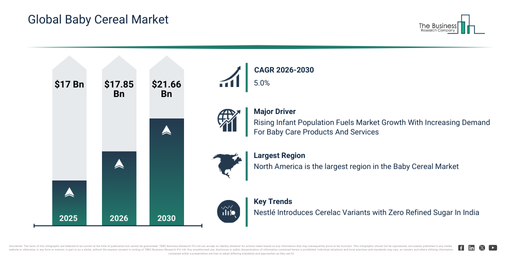
The baby cereal market has experienced significant expansion in recent years. Projections indicate it will grow from $17 billion in 2025 to $17.85 billion in 2026, achieving a compound annual growth rate (CAGR) of 5.0%. The primary drivers for its historical growth include rising birth rates in emerging markets, the broader availability of packaged infant food, increasing awareness of infant nutrition, the growing demographic of urban working parents, and enhanced distribution of baby food products.
The baby cereal market is anticipated to experience consistent expansion over the upcoming years. By 2030, this market is projected to reach a value of $21.66 billion, demonstrating a compound annual growth rate (CAGR) of 5.0%. Factors contributing to this growth during the forecast period include the rising demand for organic baby nutrition, an increased emphasis on early-life health outcomes, the broadening of premium infant food categories, the expansion of e-commerce grocery platforms, and enhanced regulatory supervision of infant nutrition. Key trends for the forecast period encompass the increasing demand for organic and clean-label baby foods, a growing inclination towards iron-fortified infant cereals, the development of multigrain and functional formulations, a heightened focus on food safety and traceability, and the expansion of online infant food retailing.
Preview The Baby Cereal Market Report With A Free Sample:
Baby Cereal Market Drivers: What Is Fueling Demand Through 2030?
A rising infant population is projected to boost the expansion of the baby cereal market in the coming period. This refers to the count of newborns or babies up to one year old within a specific region or demographic segment. This increase stems from various factors, such as higher birth rates, enhanced healthcare services, and immigration, collectively leading to a larger global infant count. Baby cereals are vital for supporting infants by offering a well-balanced and easily digestible initial foray into solid foods, crucial for their healthy development and growth. As an example, the Office for National Statistics, a UK-based government body, reported in October 2024 that England and Wales registered 591,072 live births in 2023. Consequently, the expanding infant population is a key driver for the growth observed in the baby cereal market.
Baby Cereal Market Segmentation Analysis: Core Categories And Subcategories
The baby cereal market covered in this report is segmented –
1) By Product Type: Rice Cereal, Oatmeal Cereal, Barley Cereal, Mixed Grain Cereal, Fruit-Based Cereal
2) By Form: Powder, Dry Mix, Pre-Mixed Liquid, Ready-To-Use
3) By Age Group: 4 To 6 Months, 6 To 8 Months, 8 To 10 Months, 10 To 12 Months
4) By Organic Status: Organic, Conventional
5) By Application: Store-Based Retailing, Online Retailing
Subsegments:
1) By Rice Cereal: Organic Rice Cereal, Fortified Rice Cereal, Gluten-Free Rice Cereal
2) By Oatmeal Cereal: Whole Grain Oatmeal Cereal, Iron-Fortified Oatmeal Cereal, Organic Oatmeal Cereal
3) By Barley Cereal: Multivitamin-Enriched Barley Cereal, Whole Grain Barley Cereal, Organic Barley Cereal
4) By Mixed Grain Cereal: Multigrain Cereal with Fruits, Fortified Multigrain Cereal, Organic Mixed Grain Cereal
5) By Fruit-Based Cereal: Apple-Based Cereal, Banana-Based Cereal, Berry Blend Cereal
Which Trends Will Define The Baby Cereal Market Through 2030?
Leading companies within the baby cereal market are prioritizing the development of innovative products, such as food items without refined sugar, to meet the rising consumer demand for healthier, more natural alternatives that support infants’ nutritional requirements and foster early-stage development. Zero refined sugar food products are defined as those that do not contain added refined sugars, including white sugar, corn syrup, or high-fructose corn syrup. For example, in October 2024, Nestlé S.A., a Switzerland-based food company, introduced Cerelac variants with zero refined sugar into the Indian market, directly addressing concerns regarding added sugar in baby food. These new variants are designed to deliver essential nutrients while promoting a more natural method for infant nutrition. Lacking refined sugar, the product relies on natural components like fruits for sweetness, ensuring a purer, healthier choice for babies. The formulation retains all crucial vitamins and minerals necessary for growth and development, and the brand’s commitment to quality ensures the food is easy for infants to digest and safe for consumption.
Baby Cereal Market Major Companies And Industry Participants
Major companies operating in the baby cereal market are Nestlé S.A., Danone S.A., Royal FrieslandCampina N.V., DMK Deutsches Milchkontor GmbH, Hero Group, HiPP GmbH & Co. Vertrieb KG, Bellamy’s Organic Pty. Ltd., Dana Dairy Group, Mead Johnson Nutrition, Organix Brands Limited, Kendal Nutricare Ltd., Danalac S.A., The Kraft Heinz Company, Bambino Foods, Holle Baby Food GmbH, Hain Celestial Group, Baby Gourmet Foods Inc., Nutrimed Healthcare, Nutrimed Healthcare Pvt. Ltd., Titus Health Tech Pvt. Ltd.
Buy The Full Baby Cereal Global Market Report 2026:
Baby Cereal Market Geographic Analysis: Which Region Accounts For The Biggest Share?
North America was the largest region in the baby cereal market in 2025. Asia-Pacific is expected to be the fastest-growing region in the forecast period. The regions covered in the baby cereal market report are Asia-Pacific, South East Asia, Western Europe, Eastern Europe, North America, South America, Middle East and Africa.
Reach Out To Our Team:
The Business Research Company: https://www.thebusinessresearchcompany.com/
Americas: +1 310-496-7795
Asia: +44 7882 955267 & +91 8897263534
Europe: +44 7882 955267
Email us at: marketing@tbrc.info
Follow us on:
LinkedIn: https://in.linkedin.com/company/the-business-research-company
YouTube: https://www.youtube.com/channel/UC24_fI0rV8cR5DxlCpgmyFQ
Global Market Model: https://www.thebusinessresearchcompany.com/global-market-model

Wasay has over a decade of experience in market research, data modelling, and analytics, with prior experience at GlobalData and Decision Tree Consulting Services. At The Business Research Company , he leads research operations across syndicated studies, customized consulting engagements, and the Global Market Model platform. His professional experience includes supporting organizations such as Boston Consulting Group, KPMG, and Ernst & Young. Wasay holds a degree in Electronics and Communications Engineering, postgraduate management qualifications from International Management Institute Belgium and Indian School of Business and Entrepreneurship, and completed the Integrated Program in Business Analytics from Indian Institute of Management Indore.