Designed to make market research more actionable and strategically valuable, The Business Research Company’s 2026 market reports feature market attractiveness scoring, total addressable market sizing, company benchmarking matrices, interactive Excel dashboards, deeper supply chain intelligence, emerging startup tracking, and granular product-level insights.
What Is The Projected CAGR Of The Baby Food Market Through 2030?
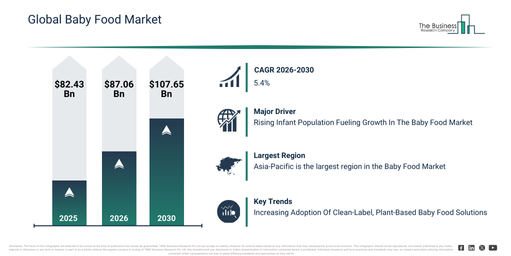
The baby food market size has experienced strong growth in recent years. It is forecast to expand from $82.43 billion in 2025 to $87.06 billion in 2026, at a compound annual growth rate (CAGR) of 5.6%. Historically, this growth can be ascribed to a rising urban population and an increasing number of working parents, growing awareness concerning infant nutrition, the expansion of organized retail channels, greater availability of packaged baby food products, and increasing disposable income levels.
The baby food market is projected to experience robust growth in the coming years. It is expected to expand to $107.65 billion by 2030, driven by a compound annual growth rate (CAGR) of 5.4%. This anticipated growth can be attributed to factors such as the increasing demand for organic infant nutrition, a rise in online baby food sales penetration, an expanding focus on personalized nutrition for infants, the proliferation of premium baby food products, and a stronger regulatory emphasis on infant food safety. Significant trends during this forecast period include the growing demand for organic and clean-label baby food, an increasing preference for ready-to-feed formats, a heightened focus on nutritional fortification, the expansion of e-commerce distribution channels, and an enhanced commitment to food safety and traceability.
Claim Your Free Baby Food Market Sample Report With Key Data And Trends:
Baby Food Market Demand Analysis: The Driving Force Behind Expansion
The expanding infant population is anticipated to boost the growth of the baby food market moving forward. The term “infant population” refers to the count of infants or newborns within a particular demographic group or geographical location, ranging from birth up to one year of age. Baby food is manufactured and prepared to be safe and easily consumable for infants, fulfilling their dietary and developmental requirements. For example, in April 2025, the Centers for Disease Control and Prevention (CDC), a U.S.-based health agency, indicated that the number of live births in the United States reached 3,622,673, representing an increase of 1% from 2023. Therefore, the increasing infant population is a significant driver for the expansion of the baby food market.
Breaking Down The Baby Food Market By Segment
The baby food market covered in this report is segmented –
1) By Type: Milk Formula, Dried Baby Food, Ready to Feed Baby Food, Other Types
2) By Category: Organic, Conventional
3) By Distribution Channel: Hypermarkets, Supermarkets, Drug Stores, Specialty Stores, Online
Subsegments:
1) By Milk Formula: Infant Formula, Follow-On Formula, Special Medical Formulas
2) By Dried Baby Food: Powdered Cereals, Freeze-Dried Meals, Dehydrated Snacks
3) By Ready to Feed Baby Food: Jarred Baby Food, Pouches, Meal Kits
4) By Other Types: Homemade Baby Food Kits, Baby Snacks
Top Trend Influencing The Baby Food Market Outlook
Leading companies in the baby food market are consistently developing new products, including plant-based and toddler-friendly options, to offer healthier and more sustainable choices for today’s parents. Plant-based baby/toddler foods encompass meals, purees, snacks, or formulas formulated for infants or toddlers, utilizing ingredients sourced from plants (such as legumes, grains, and vegetables) rather than conventional animal-based proteins or dairy, thereby addressing the desire for clean-label, vegetarian, or allergy-aware selections. As an illustration, in April 2024, Else Nutrition, an Israel-based nutrition firm focused on plant-based infant and toddler formula, introduced its stage-2 follow-on formula and stage-3 toddler drink in Australia, providing soy-free, plant-based nourishment for infants from 6–12 months and toddlers from 12–36 months.
Baby Food Market Competitive Landscape And Major Players
Major companies operating in the baby food market are Abbott Nutrition, Bellamy Organics, Danone SA, Mead Johnson & Company LLC, Nestle SA, Perrigo Company plc, Royal FrieslandCampina NV, Hain Celestial Group Inc., Reckitt Benckiser Group plc, Inner Mongolia Yili Industrial Group Company Ltd., Deutsches Milchkontor GmbH, SMA Nutrition, Aptamil, HiPP GmbH & Co, Ella’s Kitchen Group Ltd., Holle Baby Food, BUBS Australia Ltd., Happy Tot, NurturMe, Peter Rabbit Ltd., Pure Spoon, Serenity Kids Inc., Earth’s Best Organic
Read The Full Baby Food Market Report By The Business Research Company:
Where Is The Baby Food Market Largest? Key Regional Insights
Asia-Pacific was the largest region in the baby food market in 2025 and is expected to be the fastest-growing region in the forecast period. The regions covered in the baby food market report are Asia-Pacific, South East Asia, Western Europe, Eastern Europe, North America, South America, Middle East and Africa.
Reach Out To Our Team:
The Business Research Company: https://www.thebusinessresearchcompany.com/
Americas: +1 310-496-7795
Asia: +44 7882 955267 & +91 8897263534
Europe: +44 7882 955267
Email us at: marketing@tbrc.info
Follow us on:
LinkedIn: https://in.linkedin.com/company/the-business-research-company
YouTube: https://www.youtube.com/channel/UC24_fI0rV8cR5DxlCpgmyFQ
Global Market Model: https://www.thebusinessresearchcompany.com/global-market-model

Wasay has over a decade of experience in market research, data modelling, and analytics, with prior experience at GlobalData and Decision Tree Consulting Services. At The Business Research Company , he leads research operations across syndicated studies, customized consulting engagements, and the Global Market Model platform. His professional experience includes supporting organizations such as Boston Consulting Group, KPMG, and Ernst & Young. Wasay holds a degree in Electronics and Communications Engineering, postgraduate management qualifications from International Management Institute Belgium and Indian School of Business and Entrepreneurship, and completed the Integrated Program in Business Analytics from Indian Institute of Management Indore.