The Business Research Company’s 2026 market reports combine market attractiveness scoring, total addressable market sizing, company benchmarking matrices, interactive Excel dashboards, deeper supply chain intelligence, emerging startup tracking, and granular product-level insights to deliver research that is more actionable and strategically valuable.
Is The Bioengineered Food Market Expanding? Latest Size Estimates And 2030 Projections
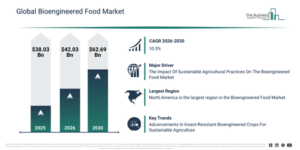
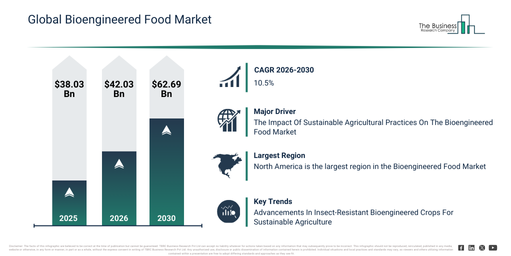
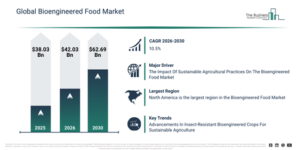
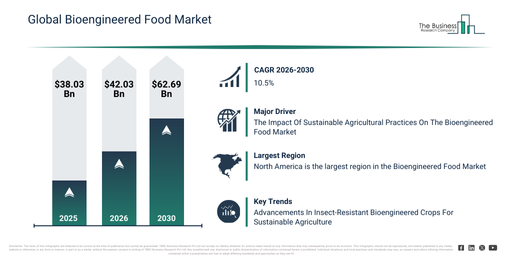
The bioengineered food market has seen a rapid increase in its size over recent years. This market is set to expand from $38.03 billion in 2025 to $42.03 billion in 2026, demonstrating a compound annual growth rate (CAGR) of 10.5%. The expansion observed during the past period is attributable to several factors, including the rising worldwide food demand, the broader cultivation of GM crops, the early integration of biotechnology in agriculture, increased investment in agricultural research and development, and the regulatory clearances granted for bioengineered crops.
The bioengineered food market is projected for swift expansion in the coming years, reaching $62.69 billion by 2030, driven by a compound annual growth rate (CAGR) of 10.5%. This growth is primarily fueled by the increasing demand for crops resilient to climate change, a heightened emphasis on global food security, the advancement of precision breeding techniques, greater investments in developing alternative proteins, and a wider acceptance of bioengineered food items. Key trends anticipated during this period include the wider adoption of CRISPR-based crop development, an elevated focus on improving nutritional traits, the growing application of cellular agriculture methods, the broader commercialization of bioengineered foods, and increased attention on ensuring yield stability.
Free Bioengineered Food Market Sample: Market Size, Growth Drivers And Competitive Landscape:
Bioengineered Food Market Drivers Explained: What Is Supporting A 10.5% CAGR?
The increasing need for sustainable farming methods is projected to boost the expansion of the bioengineered food market in the coming years. These practices encompass farming techniques designed to meet current food and fiber needs without compromising the ability of future generations to meet their own. The rise in demand for sustainable agricultural approaches stems from heightened worries regarding environmental decline, the imperative to safeguard biodiversity, and efforts to achieve food security amidst difficulties posed by climate change. Such practices aid in advancing and augmenting the utilization of bioengineered food by fostering environmentally sound, effective, and resource-aware food production strategies. A relevant example is from May 2023, when the Organic Trade Association, a US based advocacy group, reported that U.S. sales of certified organic products reached US$ 69.7 billion, marking a 3.4% increase compared to 2022. Consequently, the escalating call for sustainable agricultural practices is indeed fueling the growth of the bioengineered food market.
Bioengineered Food Market Segment Guide: Main Divisions And Subsegments
The bioengineered food market covered in this report is segmented –
1) By Product Type: Vegetables, Fruits, Crops, Other Product Types
2) By Type Of Modification: Cellular Agriculture, Genetic Modification
3) By Technology: Clustered Regularly Interspaced Short Palindromic Repeats (CRISPR), Tissue Culture
4) By Trait: Disease Resistance, Herbicide Tolerance, Insect Resistance, Nutritional Enhancement
5) By Application: Food And Beverage, Animal Feed, Pharmaceuticals, Other Applications
Subsegments:
1) By Vegetables: Genetically Modified (GM) Tomatoes, GM Eggplant, GM Potatoes, GM Peppers
2) By Fruits: GM Apples, GM Bananas, GM Strawberries
3) By Crops: GM Soybeans, GM Cotton, GM Rice, GM Canola
4) By Other Product Types: Bioengineered Meat, Bioengineered Dairy Products, Bioengineered Grains
Bioengineered Food Market Trends And Opportunities For 2026–2030
Companies operating in the bioengineered food market are largely focused on developing advanced products, such as transgenic insect-resistant food, to enhance crop yields while simultaneously fostering sustainable agricultural practices. Transgenic insect-resistant food comprises crops that have been genetically modified to include genes that confer resistance to insect pests. This technological advancement aims to reduce reliance on chemical insecticides, improve crop protection, and boost overall yields by increasing the plants’ natural resilience to pests. For example, in January 2024, the Federal Government of Nigeria officially approved the commercial release of TELA maize varieties. These specific maize varieties, including SAMMAZ 72T, SAMMAZ 73T, SAMMAZ 74T, and SAMMAZ 75T, are engineered to withstand major pests like the stemborer and fall armyworm. Furthermore, these varieties are drought-tolerant, making them particularly suitable for regions experiencing irregular rainfall. They are capable of yielding up to 10 tons per hectare under optimal conditions, a figure that significantly exceeds the national average of 6 tons for similar hybrid types. Adaptable to rainforests, guinea, and Sudan savannas, their primary objective is to mitigate maize production losses attributed to pests. This innovation has the potential to save millions of metric tons of maize, thereby contributing substantially to food security across Africa.
Which Major Players Are Active In The Bioengineered Food Market?
Major companies operating in the bioengineered food market are BASF SE, Bayer AG, Syngenta AG, Corteva Agriscience, DuPont de Nemours Inc., J.R. Simplot Corp., Sakata Seed Corporation, International Rice Research Institute, Rothamsted Research, Okanagan Specialty Fruits Inc., GreenVenus LLC, AquaBounty Technologies Inc., Calyxt Inc., Nuseed Global, Norfolk Healthy Produce, Monsanto (Bayer Crop Science), KWS SAAT SE, Dow AgroSciences, Pairwise, Arcadia Biosciences
Unlock The Complete Bioengineered Food Market Report With Company Benchmarking:
Bioengineered Food Market World Regions Compared: Which Leads In Revenue?
North America was the largest region in the bioengineered food market in 2025. Asia-Pacific is expected to be the fastest-growing region in the forecast period. The regions covered in the bioengineered food market report are Asia-Pacific, South East Asia, Western Europe, Eastern Europe, North America, South America, Middle East and Africa.
Reach Out To Our Team:
The Business Research Company: https://www.thebusinessresearchcompany.com/
Americas: +1 310-496-7795
Asia: +44 7882 955267 & +91 8897263534
Europe: +44 7882 955267
Email us at: marketing@tbrc.info
Follow us on:
LinkedIn: https://in.linkedin.com/company/the-business-research-company
YouTube: https://www.youtube.com/channel/UC24_fI0rV8cR5DxlCpgmyFQ
Global Market Model: https://www.thebusinessresearchcompany.com/global-market-model

Wasay has over a decade of experience in market research, data modelling, and analytics, with prior experience at GlobalData and Decision Tree Consulting Services. At The Business Research Company , he leads research operations across syndicated studies, customized consulting engagements, and the Global Market Model platform. His professional experience includes supporting organizations such as Boston Consulting Group, KPMG, and Ernst & Young. Wasay holds a degree in Electronics and Communications Engineering, postgraduate management qualifications from International Management Institute Belgium and Indian School of Business and Entrepreneurship, and completed the Integrated Program in Business Analytics from Indian Institute of Management Indore.