Market attractiveness scoring, total addressable market sizing, company benchmarking matrices, interactive Excel dashboards, deeper supply chain intelligence, emerging startup tracking, and granular product-level insights are among the key offerings featured in The Business Research Company’s 2026 market reports, designed to deliver more actionable and strategically valuable research.
What Is The Carbon Neutral Food Market Size In 2026, And Where Is It Heading By 2030?
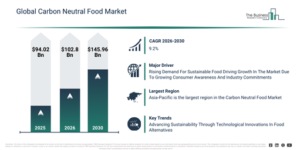
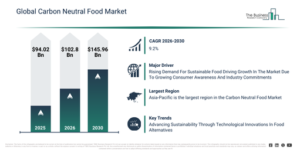
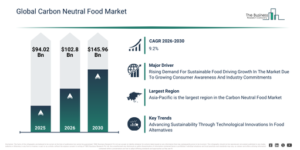
The carbon neutral food market has experienced significant expansion in recent years. Projections indicate it will increase from $94.02 billion in 2025 to $102.8 billion by 2026, exhibiting a compound annual growth rate (CAGR) of 9.3%. This historical growth was largely fueled by factors such as the rising consumption of organic and sustainable food, heightened environmental consciousness among consumers, the early implementation of carbon offset programs, a wider range of eco-labeled food products, and advancements in sustainable farming practices.
The carbon neutral food market is projected to experience substantial growth over the coming years. It is anticipated to expand to $145.96 billion by 2030, demonstrating a compound annual growth rate (CAGR) of 9.2%. This growth during the forecast period can be primarily attributed to several factors, including an increased demand for verified carbon-neutral foods, a heightened regulatory focus on food sustainability disclosures, broader investments in regenerative farming, a growing consumer preference for low-impact diets, and the expanding application of blockchain-based traceability. Key trends anticipated during this period encompass the proliferation of food products derived from regenerative agriculture, the increasing implementation of carbon footprint labeling, a heightened demand for sustainable protein alternatives, greater utilization of renewable energy sources in food production, and improved transparency across the supply chain.
Request Your Free Carbon Neutral Food Market Sample With Segment And Regional Data:
Carbon Neutral Food Market Growth Drivers And Their Impact On Future Demand
The carbon-neutral food market is anticipated to experience growth during the forecast period, propelled by the increasing demand for sustainable food. Sustainable food is defined as food produced, processed, and consumed in ways that are environmentally, socially, and economically responsible, thereby ensuring that future generations can fulfill their needs without compromising the health of the planet or its inhabitants. The heightened demand for sustainable foods stems from a growing awareness of the environmental, social, and health consequences associated with traditional food production systems. Consumers are becoming more conscious of the substantial carbon emissions, depletion of resources, and loss of biodiversity linked to conventional agriculture and industrial food systems. This rising demand for sustainable food encourages producers to adopt carbon-neutral food practices, such as utilizing renewable energy, implementing regenerative agriculture, and engaging in carbon offset programs, ultimately leading to a reduction in greenhouse gas emissions throughout the food supply chain. For example, a report published by Sodexo, a France-based food services and facilities management company, in January 2025, indicated that 68% of consumers in 2024 continued to view sustainable food positively, which was nearly identical to the 69% recorded in the previous year. The company has committed to ensuring that by 2030, 70% of its main dishes in its UK and Ireland locations will be classified as low-carbon. This objective includes reducing the carbon footprint of these dishes to just 0.9 kg CO₂e, a significant decrease from the current average of 2–2.5 kg CO₂e. Therefore, the escalating demand for sustainable food is a key driver for the carbon-neutral food market.
What Categories Define The Carbon Neutral Food Market?
The carbon neutral food market covered in this report is segmented –
1) By Type: Vegetables And Fruits, Meat And Poultry, Dairy Foods, Other Types
2) By Carbon Footprint: Carbon Neutral, Carbon Negative, Low-Carbon
3) By Target Consumer: Environmentalists, Health-Conscious Consumers, Vegan And Vegetarian Consumers
4) By Application: Food Manufacturing, Retail, Distribution
Subsegments:
1) By Vegetables And Fruits: Organic Vegetables and Fruits, Regenerative Agriculture Produce, Hydroponic and Vertical Farm Produce, Locally Sourced Seasonal Produce, Exotic and Superfoods, Carbon-Neutral Packaged Fruits And Vegetables
2) By Meat and Poultry: Grass-Fed and Pasture-Raised Meat, Free-Range Poultry, Carbon-Neutral Processed Meat, Low-Emission Feed Livestock, Lab-Grown (Cultured) Meat, Insect-Based Protein Meat Alternatives
3) By Dairy Foods: Carbon-Neutral Milk, Organic and Grass-Fed Dairy Products, Low-Emission Cheese and Butter, Regenerative Dairy Farming Products, Dairy Alternatives, Cultured Dairy Products
4) By Other Types: Carbon-Neutral Grains And Cereals, Sustainable Seafood And Aquaculture Products, Plant-Based Protein And Meat Substitutes, Carbon-Neutral Snacks And Processed Foods, Low-Carbon Beverages, Sustainable Fats And Oils
What New Developments Are Emerging In The Carbon Neutral Food Market?
Leading companies in the carbon-neutral food market are concentrating on creating innovative products, such as plant-based meats, to provide a sustainable, ethical, and healthier option compared to conventional meat by lessening environmental impact, ending animal cruelty, and frequently having reduced cholesterol and saturated fats. Plant-based meats are food items created from plant components, such as soy, peas, or wheat, engineered to mimic the flavor, feel, and nutritional composition of traditional animal meat. As an example, in September 2024, vEEF, an Australia-based meat brand, launched a range of four carbon-neutral products, all offered at prices competitive with or below those of traditional animal-based options. This selection comprises plant-based smokey sausages, plant-based classic sausages, beef mince, and chorizo sausages. These offerings are expertly prepared, packed with nutrients, and utilize 50% less plastic packaging than vEEF’s prior products. This aligns with the main motivations for decreasing meat intake: enhancing health, safeguarding the environment, and controlling expenses.
Major Players Driving Competition In The Carbon Neutral Food Market
Major companies operating in the carbon neutral food market are Kroger, Mars Incorporated, Sodexo, Charoen Pokphand Foods PCL, Conagra Brands Inc., Maple Leaf Foods Inc., Yorkshire Tea, Quorn Foods, Gerber, Leon Restaurants Ltd., LightLife Foods Inc., Bread Alone, Alter Eco, Planet FWD, Puffin Produce, Future Farm, Alara Wholefoods Ltd., Neutral Foods Inc., Organic Tap, vEEF
View The Comprehensive Carbon Neutral Food Market Analysis:
Carbon Neutral Food Market Regional Leaders: Insights From The 2026 Report
Asia-Pacific was the largest region in the canola meal market in 2025. The regions covered in the carbon neutral food market report are Asia-Pacific, South East Asia, Western Europe, Eastern Europe, North America, South America, Middle East and Africa.
Reach Out To Our Team:
The Business Research Company: https://www.thebusinessresearchcompany.com/
Americas: +1 310-496-7795
Asia: +44 7882 955267 & +91 8897263534
Europe: +44 7882 955267
Email us at: marketing@tbrc.info
Follow us on:
LinkedIn: https://in.linkedin.com/company/the-business-research-company
YouTube: https://www.youtube.com/channel/UC24_fI0rV8cR5DxlCpgmyFQ
Global Market Model: https://www.thebusinessresearchcompany.com/global-market-model

Wasay has over a decade of experience in market research, data modelling, and analytics, with prior experience at GlobalData and Decision Tree Consulting Services. At The Business Research Company , he leads research operations across syndicated studies, customized consulting engagements, and the Global Market Model platform. His professional experience includes supporting organizations such as Boston Consulting Group, KPMG, and Ernst & Young. Wasay holds a degree in Electronics and Communications Engineering, postgraduate management qualifications from International Management Institute Belgium and Indian School of Business and Entrepreneurship, and completed the Integrated Program in Business Analytics from Indian Institute of Management Indore.