The Business Research Company’s 2026 market reports combine market attractiveness scoring, total addressable market sizing, company benchmarking matrices, interactive Excel dashboards, deeper supply chain intelligence, emerging startup tracking, and granular product-level insights to deliver research that is more actionable and strategically valuable.
Food And Beverages Market Size Review: What Shaped Past Growth And What Will Drive Future Expansion?
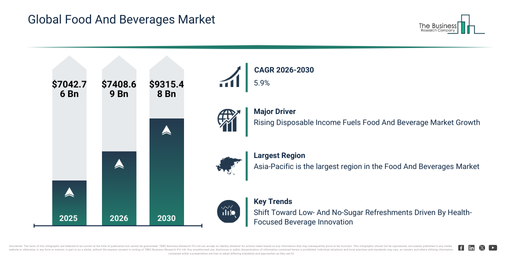
The food and beverages market size has demonstrated strong growth over recent years. It is anticipated to expand from $7042.76 billion in 2025 to $7408.69 billion in 2026, achieving a compound annual growth rate (CAGR) of 5.2%. This historical growth can be linked to factors such as the expansion of global food consumption, an increase in packaged and processed foods, a rising urban population, improved cold chain infrastructure, and advancements in food preservation technologies.
The market for food and beverages is projected to experience substantial expansion over the upcoming years. This market is anticipated to reach $9315.48 billion by 2030, exhibiting a compound annual growth rate (CAGR) of 5.9%. Key drivers for this growth during the forecast period include a heightened demand for personalized nutrition, increased investments in food innovation, the broadening of plant-based food categories, a greater emphasis on supply chain transparency, and the growing integration of smart retail technologies. Significant trends observed within this period encompass a rising consumer preference for organic and clean-label products, the increasing implementation of smart food processing systems, a sharpened focus on functional and nutrient-enriched food items, the expansion of e-commerce platforms for food distribution, and an intensified commitment to sustainable packaging solutions.
Access Free Sample Pages From The Food And Beverages Market Report 2026:
Understanding The Main Driver Of The Food And Beverages Market
An increase in disposable income is anticipated to drive expansion in the food and beverage market. This income represents the funds individuals or households can spend or save once taxes are removed from their total earnings. A greater financial capacity often leads consumers to favor expenditures on high-quality, specialized, and nutritious food and beverages. Consequently, this trend boosts consumer spending, encourages dining outside the home, and promotes the exploration of novel culinary experiences. For example, in September 2024, the Office for National Statistics, a UK-based Government agency, reported a 2.3% increase in the median household disposable income, reaching $ 17.73 ($16,400), attributed to government initiatives aimed at easing living costs. However, a significant disparity was observed, as the mean household disposable income for the wealthiest fifth was six times greater than that of the poorest fifth, recorded at approximately $82,900 and $15,000, respectively. Thus, the expanding disposable income is a key factor propelling the future growth of the food and beverages market.
Food And Beverages Market Segment Mapping For 2026 And Beyond
The food and beverages market covered in this report is segmented –
1) By Type: Alcoholic – Beverages, Non-Alcoholic – Beverages, Grain Products, Bakery And Confectionery, Frozen, Other Types
2) By Nature: Organic, Conventional
3) By Distribution Channel: Supermarkets Or Hypermarkets, Convenience Stores, E-Commerce, Other Distribution Channels
Subsegments:
1) By Alcoholic Beverages: Beer, Wine, Spirits, Ciders, Ready-To-Drink Cocktails
2) By Non-Alcoholic Beverages: Soft Drinks, Juices, Bottled Water, Coffee And Tea, Energy Drinks
3) By Grain Products: Rice, Wheat, Oats, Barley, Corn-Based Products
4) By Bakery And Confectionery: Bread, Cakes And Pastries, Biscuits And Cookies, Chocolates And Candies, Doughnuts
5) By Frozen Foods: Frozen Vegetables, Frozen Meat And Seafood, Frozen Ready Meals, Frozen Desserts, Frozen Pizzas
6) By Other Types: Dairy Products, Sauces And Condiments, Snack Foods, Spices And Seasonings, Packaged Meals
What Key Trend Is Expected To Shape The Food And Beverages Market Over The Forecast Period?
Major companies operating in the food and beverages market are concentrating on developing healthy beverages, such as low- and no-sugar refreshments, to gain a competitive advantage. Low-sugar and no-sugar refreshments describe drinks with reduced or zero sugar content, offering choices for individuals looking for healthier alternatives with less sugar intake. For instance, in August 2024, Citizen Spritz’s, a UK-based company specializing in creating non-alcoholic spritz beverages, introduced ready-to-drink (RTD) non-alcoholic spritzes. This launch indicates Citizen Spritz’s entry into the expanding RTD market, following their earlier release of instant spritz mixes in bottles. The RTD format is designed for ease of use, appealing to consumers seeking ready-made options for various drinking occasions, such as outdoor gatherings or relaxed moments at home.
Food And Beverages Market Major Players And Industry Competition Overview
Major companies operating in the food and beverages market are Nestlé S.A, PepsiCo Inc, JBS S.A, Anheuser-Busch InBev, Tyson Foods Inc, Archer-Daniels-Midland Company, Mars Incorporated, The Coca-Cola Company, Cargill, Dabur, Amul, Red Bull, Del Monte Fresh Produce Ltd, Fonterra, Dali Foods Group, Hangzhou Wahaha Group, Nongfu Spring, Britannia Industries Ltd, Otsuka Holdings Co Ltd, Suntory Beverage & Food Ltd, Glanbia Plc, Royal FrieslandCampina N.V, Associated British Foods, Arla Foods, Südzucker AG, Tönnies Group, Dr. August Oetker KG, Mondelez, Diageo, General Mills, The Hain Celestial Group, Campbell Soup Company, Maple Leaf Foods, Olymel, Adams & Brooks Inc, The Kraft Heinz Company, Monster Energy Company, Unilever, Arcor, Starbucks, Ambev, Almarai Company, Agthia Group PJSC, Lifeway Foods, Arizona Beverages Company, Cadbury Nigeria, FrieslandCampina WAMCO Nigeria PLC, CHI Limited, Nigerian Breweries Plc, SABMiller
Full Food And Beverages Market Report: Market Size, Trends, Segments And Key Players:
Food And Beverages Market Geographic Segmentation: Regions Covered In The Report
Asia-Pacific was the largest region in the food and beverages market in 2025. Western Europe was the second-largest region of the food and beverages market. The regions covered in the food and beverages market report are Asia-Pacific, South East Asia, Western Europe, Eastern Europe, North America, South America, Middle East and Africa.
Reach Out To Our Team:
The Business Research Company: https://www.thebusinessresearchcompany.com/
Americas: +1 310-496-7795
Asia: +44 7882 955267 & +91 8897263534
Europe: +44 7882 955267
Email us at: marketing@tbrc.info
Follow us on:
LinkedIn: https://in.linkedin.com/company/the-business-research-company
YouTube: https://www.youtube.com/channel/UC24_fI0rV8cR5DxlCpgmyFQ
Global Market Model: https://www.thebusinessresearchcompany.com/global-market-model

Wasay has over a decade of experience in market research, data modelling, and analytics, with prior experience at GlobalData and Decision Tree Consulting Services. At The Business Research Company , he leads research operations across syndicated studies, customized consulting engagements, and the Global Market Model platform. His professional experience includes supporting organizations such as Boston Consulting Group, KPMG, and Ernst & Young. Wasay holds a degree in Electronics and Communications Engineering, postgraduate management qualifications from International Management Institute Belgium and Indian School of Business and Entrepreneurship, and completed the Integrated Program in Business Analytics from Indian Institute of Management Indore.