Market attractiveness scoring, total addressable market sizing, company benchmarking matrices, interactive Excel dashboards, deeper supply chain intelligence, emerging startup tracking, and granular product-level insights are among the key offerings featured in The Business Research Company’s 2026 market reports, designed to deliver more actionable and strategically valuable research.
Food Cold Chain Market Valued At $237.15 Billion In 2026, Projected To Reach $342.09 Billion By 2030
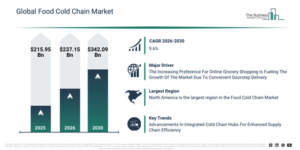
The food cold chain market has shown significant growth in recent years. It is anticipated to expand from $215.95 billion in 2025 to $237.15 billion in 2026, achieving a compound annual growth rate (CAGR) of 9.8%. Historically, this market’s expansion can be linked to the increased consumption of frozen and processed foods, the rise of organized food retail, a growing demand for food availability throughout the year, advancements in refrigerated transport infrastructure, and stricter food safety regulations.
The food cold chain market is projected to experience robust expansion over the coming years. By 2030, its size is anticipated to reach $342.09 billion, demonstrating a compound annual growth rate (CAGR) of 9.6%. This projected growth is driven by factors such as the expanding online grocery delivery sector, increased investments in cold storage facilities, the development of pharmaceutical-grade cold chains for food products, a heightened emphasis on carbon-neutral logistics solutions, and the wider integration of smart cold chain technologies. Key trends anticipated during this period involve the greater implementation of IoT-based temperature monitoring, an escalating need for multi-temperature warehousing, the increasing adoption of energy-efficient refrigeration systems, the enlargement of last-mile cold chain logistics, and a stronger focus on adherence to food safety standards.
Request A Complimentary Food Cold Chain Market Research Sample:
Key Factor Propelling The Food Cold Chain Market Forward
A rising inclination towards online grocery purchasing is projected to drive expansion in the food cold chain market in the future. This involves procuring both temperature-sensitive and shelf-stable food products via digital platforms, such as websites or mobile applications, facilitated by home delivery or pickup options. Consumers are gravitating towards online grocery services primarily because of the time efficiency and ease offered by home delivery. This growing inclination necessitates robust food cold chain systems, given that maintaining stable temperatures is crucial for preserving the freshness and safety of delicate items like fruits, vegetables, dairy, and meat throughout their storage, transit, and final delivery stages. For example, data released in August 2025 by the Singapore Department of Statistics, a government data portal based in Singapore, indicated a significant increase in the online proportion of sales for supermarkets and hypermarkets during 2023, climbing from 11.3% (Jan 2023) to 13.4% (Feb 2023) and further to 13.6% (Mar 2023), which clearly illustrates increasing e-grocery participation in this sector. Consequently, the heightened consumer preference for online grocery services is fueling the expansion of the food cold chain market.
Food Cold Chain Market Segments And Subsegments Explained
The food cold chain market covered in this report is segmented –
1) By Type Of Cold Chain: Refrigerated Transportation, Cold Storage, Ice Cream Logistics, Temperature-Controlled Warehousing
2) By Technology: Blast Freezing, Vapor Compression, Programmable Logic Controller (PLC), Evaporating Cooling, Cryogenic Systems, Other Technologies
3) By Distribution Channel: Direct Sales, Distributors And Wholesalers, Online Sales, Third-Party Logistics Providers (3PL)
4) By Application: Fruits And Vegetables, Dairy And Frozen Desserts, Fish, Meat, And Seafood, Bakery And Confectionery, Other Applications
Subsegments:
1) By Refrigerated Transportation: Road Transport, Rail Transport, Sea Transport, Air Transport, Last-Mile Delivery, Intermodal Transport
2) By Cold Storage: Chilled Storage, Frozen Storage, Deep-Freeze Storage, Controlled Atmosphere Storage, Blast Freezing Rooms
3) By Ice Cream Logistics: Hardening And Blast Freezing, Deep-Freeze Storage, Frozen Line-Haul Transport, Frozen Last-Mile Delivery, Temperature-Validated Packaging, Store Replenishment Distribution
4) By Temperature-Controlled Warehousing: Public Refrigerated Warehousing, Contract Refrigerated Warehousing, Multi-Temperature Warehousing, Bonded Cold Warehousing, Cross-Dock Warehousing, Online Grocery Fulfillment Warehousing
Emerging Trends Transforming The Food Cold Chain Market
Leading companies operating within the food cold chain market are concentrating on developing cold chain infrastructure. This effort aims to improve efficiency, reduce transit times, and ensure that perishable goods are handled under temperature-controlled conditions throughout the supply chain. Cold chain infrastructure refers to an organized system comprising temperature-regulated storage facilities, transportation equipment, and monitoring technologies, all designed to keep perishable items safe and fresh from their point of production until final delivery. For instance, in July 2025, Maersk A/S, a logistics company based in Denmark, inaugurated its Integrated Packing and Cold Storage Hub in Olmos, Peru. The Olmos facility operates as an advanced fruit logistics hub, created to optimize the region’s export operations. It integrates essential logistics activities such as processing, cold storage, and depot warehousing within Maersk’s global supply chain network. Additionally, the hub provides extra services, including container depot management, inland refrigerated transport, and on-site customs processing, to ensure a completely integrated and efficient customer experience.
Food Cold Chain Market Key Players: Major Companies In The 2026 Report
Major companies operating in the food cold chain market are DHL Supply Chain, DSV A/S, XPO Logistics Inc., Nichirei Logistics Group, Americold Logistics LLC, NewCold Advanced Cold Logistics, ColdEX Logistics Pvt. Ltd., Celcius Logistics Pvt. Ltd., Crystal Logistic Cool Chain Ltd., Rinac Pvt. Ltd., Interstate Cold Storage, Siddhi Cold Chain Pvt. Ltd., ColdStar Logistics Pvt. Ltd., ALC Cold Chain Logistics Pvt. Ltd., WareIQ Solutions Pvt. Ltd., Indicold Private Ltd., Reefer Express Pvt. Ltd., Arihant Cold Storage Pvt. Ltd., Godamwale Cold Storage Pvt. Ltd., Kaveri Cold Chain Logistics Pvt. Ltd.
Explore The Full Food Cold Chain Market Report With Forecasts To 2030:
Food Cold Chain Market By Region: Where Is Demand Strongest?
North America was the largest region in the food cold chain market in 2025. Asia-Pacific is expected to be the fastest-growing region in the forecast period. The regions covered in the food cold chain market report are Asia-Pacific, South East Asia, Western Europe, Eastern Europe, North America, South America, Middle East and Africa.
Reach Out To Our Team:
The Business Research Company: https://www.thebusinessresearchcompany.com/
Americas: +1 310-496-7795
Asia: +44 7882 955267 & +91 8897263534
Europe: +44 7882 955267
Email us at: marketing@tbrc.info
Follow us on:
LinkedIn: https://in.linkedin.com/company/the-business-research-company
YouTube: https://www.youtube.com/channel/UC24_fI0rV8cR5DxlCpgmyFQ
Global Market Model: https://www.thebusinessresearchcompany.com/global-market-model

Wasay has over a decade of experience in market research, data modelling, and analytics, with prior experience at GlobalData and Decision Tree Consulting Services. At The Business Research Company , he leads research operations across syndicated studies, customized consulting engagements, and the Global Market Model platform. His professional experience includes supporting organizations such as Boston Consulting Group, KPMG, and Ernst & Young. Wasay holds a degree in Electronics and Communications Engineering, postgraduate management qualifications from International Management Institute Belgium and Indian School of Business and Entrepreneurship, and completed the Integrated Program in Business Analytics from Indian Institute of Management Indore.