With a focus on actionable insights and strategic value, The Business Research Company’s 2026 market reports include market attractiveness scoring, total addressable market sizing, company benchmarking matrices, interactive Excel dashboards, deeper supply chain intelligence, emerging startup tracking, and granular product-level insights.
How Large Could The Frozen, Canned and Dried Food Market Become By 2030 At A 5.9% CAGR?
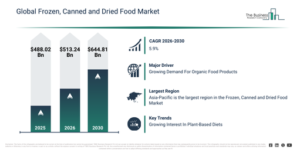
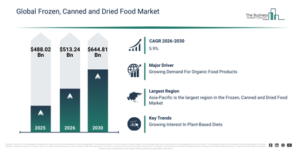
The frozen, canned and dried food market size has shown robust growth over recent years. Its value is anticipated to rise from $488.02 billion in 2025 to $513.24 billion in 2026, achieving a compound annual growth rate (CAGR) of 5.2%. This historical expansion can be attributed to the increasing consumption of packaged foods, the evolution of urban lifestyles, broader acceptance of canned products, enhancements in food preservation technologies, and a growing need for emergency food supplies.
The frozen, canned and dried food market size is projected to undergo significant expansion over the next few years, with its value expected to reach $644.81 billion in 2030, exhibiting a compound annual growth rate (CAGR) of 5.9%. This projected growth is primarily fueled by factors such as the increasing consumer demand for convenience foods, the proliferation of e-commerce grocery platforms, an elevated focus on food security, rising investments in food processing infrastructure, and a growing preference for products with extended shelf-lives. During the forecast period, notable trends include the expanding demand for shelf-stable food products, the increasing availability of ready-to-eat and ready-to-cook meals, a greater emphasis on long-term food preservation, the rising adoption of advanced packaging solutions, and an enhanced demand for multi-format food options.
Get A Free Frozen, Canned and Dried Food Market Sample With 2030 Forecast Insights:
Frozen, Canned and Dried Food Market Outlook: Key Driver Supporting Long-Term Growth
The increasing consumer demand for locally sourced, sustainable, and organic food production is anticipated to positively influence the frozen, canned and dried food market during the forecast period. Organic food production, encompassing segments such as organic frozen and fruit and vegetable markets, places significant importance on consumer health, environmental protection, and animal welfare. Consumers are becoming more attentive to how their food is grown and prepared, and are prepared to pay extra for items they consider healthy. For example, in May 2023, the Organic Trade Association, a US-based organic industry organization, reported that total organic sales in 2022, including organic non-food products, reached $60 billion. By 2023, this figure had climbed to a record $67.6 billion, indicating a substantial rise in the organic sector’s market value, which is likely to drive the market during the forecast period. The growing demand for convenience food is expected to propel the growth of the frozen, canned, and dried food market. Convenience food encompasses pre-packaged or processed food items that are quick and simple to prepare, requiring minimal cooking or effort, often designed for individuals seeking on-the-go or time-saving meal solutions. Consumers are looking for convenient meal options that involve little preparation, making these preserved food categories a preferred choice for busy individuals and households. Furthermore, the longer shelf life and ease of storage associated with these products significantly contribute to their increasing demand and market expansion. For instance, in 2023, according to the United States Department of Agriculture, a US-based federal agency, the total value of US processed food products exported from the country increased to $36.59 billion, representing a 1.7% rise compared to the previous year. Therefore, the rising demand for convenience food is driving the growth of the frozen, canned and dried food market moving forward.
Segmentation Of The Frozen, Canned and Dried Food Market: Key Categories Explained
The frozen, canned and dried food market covered in this report is segmented –
1) By Type: Frozen Foods, Canned Foods, Dried And Dehydrated Foods
2) By Distribution Channel: Supermarkets Or Hypermarkets, Convenience Stores, E-Commerce, Other Distribution Channels
3) By User: Food Service Industry, Retail Users
Subsegments:
1) By Frozen Foods: Frozen Vegetables, Frozen Fruits, Frozen Ready Meals, Frozen Snacks, Frozen Meat, Frozen Poultry, Frozen Seafood
2) By Canned Foods: Canned Vegetables, Canned Fruits, Canned Meat, Canned Poultry, Canned Seafood, Canned Soups & Stews, Canned Ready Meals
3) By Dried And Dehydrated Foods: Dried Vegetables, Dried Fruits, Dehydrated Ready Meals, Instant Noodles, Dried Pasta & Grains, Powdered And Dehydrated Soups
Frozen, Canned and Dried Food Market Evolving Trends: What Businesses Should Know
Leading companies in the frozen, canned, and dried food markets are prioritizing the creation of plant-based food products to secure a competitive advantage. Plant-based items are defined as products primarily composed of plant-derived ingredients, intentionally avoiding or minimizing the inclusion of animal-derived components. For example, in August 2023, Nestlé S.A., a Switzerland-based food company, introduced shelf-stable plant-based products under its Maggi Veg brand. This new assortment features their initial shelf-stable plant-based minced meat, crafted from soy, delivering a high-quality source of protein and fiber. These products serve as a substitute for meat in popular recipes like tacos, empanadas, or spaghetti Bolognese, offering delicious and nutritious alternatives. Moreover, Nestlé’s updated Maggi Veg line in Chile includes a lentil, rice, and vegetable soup, which is also rich in protein and fiber, giving consumers the flexibility to enhance their meals with additional ingredients.
Who Competes In The Frozen, Canned and Dried Food Market? Major Companies Listed
Major companies operating in the frozen, canned and dried food market are Nestlé S.A., Unilever plc, Tyson Foods Inc., The Kraft Heinz Company, Toyo Suisan Kaisha Ltd., General Mills Inc., Kellogg Company, Hormel Foods Corporation, Conagra Brands Inc., Ajinomoto Co. Inc., The Campbell Soup Company, McCain Foods Limited, Nichirei Corporation, Birds Eye Foods Inc., Greenyard NV, Maruha Nichiro Corporation, Lamb Weston Holdings Inc., Pinnacle Foods Inc., Nomad Foods Ltd., The Schwan Food Company, Bonduelle SCA, Del Monte Pacific Limited, B&G Foods Inc., The Hain Celestial Group Inc., Seneca Foods Corporation, Dr. Oetker GmbH
Read The Complete Frozen, Canned and Dried Food Market Forecast Report Through 2030:
Frozen, Canned and Dried Food Market Regional Ranking: Which Geography Comes First?
Asia-Pacific was the largest region in the frozen, canned, and dried food market in 2025. Western Europe was the second-largest region in the frozen, canned, and dried food market. The regions covered in the frozen, canned and dried food market report are Asia-Pacific, South East Asia, Western Europe, Eastern Europe, North America, South America, Middle East and Africa.
Reach Out To Our Team:
The Business Research Company: https://www.thebusinessresearchcompany.com/
Americas: +1 310-496-7795
Asia: +44 7882 955267 & +91 8897263534
Europe: +44 7882 955267
Email us at: marketing@tbrc.info
Follow us on:
LinkedIn: https://in.linkedin.com/company/the-business-research-company
YouTube: https://www.youtube.com/channel/UC24_fI0rV8cR5DxlCpgmyFQ
Global Market Model: https://www.thebusinessresearchcompany.com/global-market-model

Wasay has over a decade of experience in market research, data modelling, and analytics, with prior experience at GlobalData and Decision Tree Consulting Services. At The Business Research Company , he leads research operations across syndicated studies, customized consulting engagements, and the Global Market Model platform. His professional experience includes supporting organizations such as Boston Consulting Group, KPMG, and Ernst & Young. Wasay holds a degree in Electronics and Communications Engineering, postgraduate management qualifications from International Management Institute Belgium and Indian School of Business and Entrepreneurship, and completed the Integrated Program in Business Analytics from Indian Institute of Management Indore.