Designed to make market research more actionable and strategically valuable, The Business Research Company’s 2026 market reports feature market attractiveness scoring, total addressable market sizing, company benchmarking matrices, interactive Excel dashboards, deeper supply chain intelligence, emerging startup tracking, and granular product-level insights.
How Fast Is The Herbage Market Growing? Market Size, CAGR And Forecast Insights
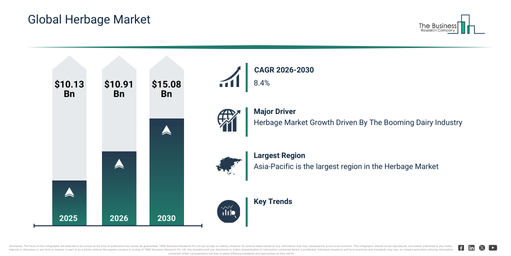
The herbage market has experienced significant growth over the past few years. This market is projected to expand from $10.13 billion in 2025 to $10.91 billion in 2026, demonstrating a compound annual growth rate (CAGR) of 7.7%. Historically, this growth can be ascribed to several factors, including the expansion of livestock farming activities, a rising demand for dairy and meat products, continued dependence on traditional grazing methods, the availability of agro-industrial by-products, and the development of organized animal husbandry.
The herbage market is projected to demonstrate significant growth in the coming years, with its size expanding to $15.08 billion by 2030, reflecting a compound annual growth rate (CAGR) of 8.4%. During the forecast period, this expansion is driven by a heightened emphasis on optimized animal nutrition, an increasing need for high-yield livestock feed, the extension of sustainable grazing practices, wider adoption of fortified feed formulations, and greater integration of feed quality monitoring. Noteworthy trends for the forecast timeframe include the increasing adoption of nutrient-enriched animal feed blends, a rising demand for high-protein forage inputs, the growing application of functional feed additives, the expansion of agro-industrial by-product utilization, and an enhanced focus on livestock nutrition efficiency.
Unlock Herbage Market Insights With A Free Sample Report:
Herbage Market Momentum: Key Driver Expected To Boost Growth Through 2030
The expansion of the dairy industry is projected to drive the future growth of the herbage market. This industry encompasses the creation and transformation of all milk products at either dairy plants or dairy farms. Within dairy operations, herbage serves as a crucial resource, offering grazing materials for animals to enhance their milk production. As an illustration, the Department for Environment, Food & Rural Affairs, a UK government body, stated in October 2024 that UK dairies processed 1,143 million litres of milk in August 2024. Consequently, the increasing activity within the dairy industry will stimulate the herbage industry.
Herbage Market Driver: Herbage Market Contribution To Vegan Diet Adoption
The expanding adoption of vegan diets is anticipated to boost the future growth of the herbage market. Embracing a vegan diet entails refraining from animal product consumption, instead focusing on plant-based foods for sustenance. The herbage market plays a role in the growing trend of veganism by offering a wide variety of plant-derived alternatives, which assists individuals in their decision to avoid animal products and fosters a lifestyle that is both sustainable and compassionate. For example, a survey by Finder.com LLC, a US financial comparison website, indicated in January 2024 that the number of vegans reached 2.5 million in early 2024, a notable rise from 1.1 million in 2023. Consequently, the increasing shift towards vegan diets is stimulating the expansion of the herbage market.
Herbage Market Segments: A Category-By-Category Overview
The herbage market covered in this report is segmented –
1) By Herbage Type: Grasses, Legumes, Mixed Herbage, Other Herbage Types
2) By Form: Fresh Grazing Herbage, Hay, Silage, Dried Herbage
3) By Application: Beef Cattle, Dairy Cattle, Sheep, Goats, Other Ruminants
4) By Production System: Organic, Conventional
5) By End User: Livestock Farms, Dairy Farms, Pasture-Based Animal Operations, Other End Users
Subsegments:
1) By Grasses: Ryegrass, Bermuda Grass, Fescue, Timothy Grass, Orchard Grass, Brome Grass
2) By Legumes: Alfalfa, Clover, Vetch, Lucerne, Trefoil
3) By Mixed Herbage: Grass–Legume Mixtures, Permanent Pasture Mixes, Seasonal Forage Mixes, Multi-Species Pasture Blends
4) By Other Herbage Types: Forage Herbs (Chicory, Plantain), Native Pasture Species, Natural Meadow Herbage, Regrowth and Volunteer Herbage
Herbage Market Key Participants: Prominent Companies At A Glance
Major companies operating in the herbage market are Barenbrug Group, DLF Seeds A/S, S&W Seed Company, Advanta Seeds, RAGT Semences, PGG Wrightson Seeds, Germinal Group, KWS SAAT SE & Co. KGaA, Corteva Agriscience, Syngenta AG, Limagrain Group, Royal Barenbrug Group, Ampac Seed Company, Mountain View Seeds, Seed Force New Zealand, Heritage Seeds, Seedmark, Jacklin Seed Company, Sharp Bros Seed, Agricom
Get Detailed Herbage Market Forecasts In The Complete Report:
Top Region In The Herbage Market: A Global Perspective
Asia-Pacific was the largest region in the herbage market in 2025. The regions covered in the herbage market report are Asia-Pacific, South East Asia, Western Europe, Eastern Europe, North America, South America, Middle East and Africa.
Reach Out To Our Team:
The Business Research Company: https://www.thebusinessresearchcompany.com/
Americas: +1 310-496-7795
Asia: +44 7882 955267 & +91 8897263534
Europe: +44 7882 955267
Email us at: marketing@tbrc.info
Follow us on:
LinkedIn: https://in.linkedin.com/company/the-business-research-company
YouTube: https://www.youtube.com/channel/UC24_fI0rV8cR5DxlCpgmyFQ
Global Market Model: https://www.thebusinessresearchcompany.com/global-market-model

Wasay has over a decade of experience in market research, data modelling, and analytics, with prior experience at GlobalData and Decision Tree Consulting Services. At The Business Research Company , he leads research operations across syndicated studies, customized consulting engagements, and the Global Market Model platform. His professional experience includes supporting organizations such as Boston Consulting Group, KPMG, and Ernst & Young. Wasay holds a degree in Electronics and Communications Engineering, postgraduate management qualifications from International Management Institute Belgium and Indian School of Business and Entrepreneurship, and completed the Integrated Program in Business Analytics from Indian Institute of Management Indore.