
The Business Research Company’s 2026 market reports combine market attractiveness scoring, total addressable market sizing, company benchmarking matrices, interactive Excel dashboards, deeper supply chain intelligence, emerging startup tracking, and granular product-level insights to deliver research that is more actionable and strategically valuable.
Infrared (IR) Viewers Market Size Trajectory: Key Numbers Every Industry Stakeholder Should Know
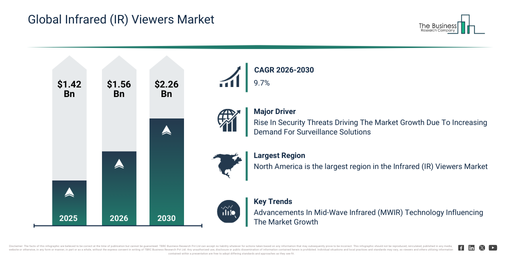
The infrared (ir) viewers market size has demonstrated significant growth in recent years. It is anticipated to expand from $1.42 billion in 2025 to $1.56 billion in 2026, achieving a compound annual growth rate (CAGR) of 9.9%. This historical development can be linked to factors such as the broadening of military night surveillance programs, increased application of infrared systems in industrial maintenance, greater integration into fiber optic inspection, the advancement of defense modernization initiatives, and the accessibility of compact infrared sensor technologies.
The market for infrared (ir) viewers is projected to experience substantial expansion over the upcoming years. This market is forecast to reach $2.26 billion by 2030, exhibiting a compound annual growth rate (CAGR) of 9.7%. Factors driving this growth during the forecast period include a rising need for sophisticated situational awareness tools, greater adoption of AI-based image enhancement, the broadening of infrared uses in healthcare diagnostics, increasing investments in intelligent surveillance systems, and a growing requirement for portable inspection devices. Key trends anticipated for the same period encompass the growing popularity of wearable infrared viewing devices, an escalating demand for high-resolution thermal imaging, the expanding application of ir viewers in industrial inspections, the wider use of night vision and surveillance technologies, and improved integration with various digital imaging platforms.
Looking For Reliable Infrared (IR) Viewers Market Data? Request A Free Sample:
What Is Behind The Rising Demand In The Infrared (IR) Viewers Market?
The increasing prevalence of security threats is projected to stimulate the growth of the infrared (IR) viewers market moving forward. Security threats refer to potential hazards or actions that can endanger individuals, organizations, or national safety through violence, espionage, or sabotage. These threats are escalating primarily due to increased digitalization, which broadens the potential targets for cybercriminals more quickly than robust cybersecurity measures can be implemented. Elevated security concerns, therefore, drive the need for advanced imaging technologies capable of detecting threats in low-visibility or nighttime conditions. For instance, in January 2025, according to the Office for National Statistics (ONS), a UK-based government agency, approximately 9.5 million incidents of headline crime were recorded in England and Wales in September 2024, showing a 12% rise compared to 8.5 million incidents in the previous year. Additionally, police-recorded crimes amounted to 6.7 million during the same period. Consequently, these rising crime rates are fueling the demand for IR viewers and surveillance solutions.
Infrared (IR) Viewers Market Segment Coverage And Subsegment Analysis
The infrared (ir) viewers market covered in this report is segmented –
1) By Type Of Infrared Viewers: Handheld Infrared Viewers, Portable Infrared Viewers, Fixed Infrared Viewers, Wearable Infrared Viewers
2) By Technology: Cooled Infrared (IR) Sensors, Uncooled Infrared (IR) Sensors, Shortwave Infrared (SWIR), Longwave Infrared (LWIR)
3) By Application: Military And Defense, Industrial, Medical, Research And Development, Other Applications
4) By Distribution Channel: Online Sales, Offline Sales
5) By End User: Telecommunications, Healthcare, Construction, Aerospace And Defense, Manufacturing
Subsegments:
1) By Handheld Infrared (IR) Viewers: Monocular Infrared Viewers, Binocular Infrared Viewers, Smartphone-Compatible Infrared Viewers, Pistol Grip Infrared Viewers
2) By Portable Infrared (IR) Viewers: Tripod-Mounted Infrared Viewers, Backpack-Integrated Infrared Viewers, Battery-Operated Infrared Viewers, Foldable Or Compact Portable Infrared Viewers
3) By Fixed Infrared (IR) Viewers: Wall-Mounted Infrared Viewers, Ceiling-Mounted Infrared Viewers, Pole-Mounted Infrared Viewers, Integrated Surveillance System Infrared Viewers
4) By Wearable Infrared (IR) Viewers: Head-Mounted Infrared Viewers, Helmet-Mounted Infrared Viewers, Eyewear Or Goggle-Type Infrared Viewers, Augmented Reality (AR) Or Virtual Reality (VR) Integrated Infrared Viewers
Infrared (IR) Viewers Market Future Trends: Where Is The Industry Heading?
Leading firms within the infrared (IR) viewers market are prioritizing the creation of advanced solutions like mid-wave infrared (MWIR) cameras, aiming to improve image clarity and detection capabilities under difficult conditions. These mid-wave infrared (MWIR) cameras function as imaging tools, sensing infrared radiation across the 3–5 micrometer wavelength spectrum, which enables them to acquire thermal imagery even in complete darkness or amidst smoke and haze. An example of this trend is the November 2023 introduction by Sierra-Olympia Technologies, Inc., a US-based manufacturer, of the Ventus Compact MK2. This next-generation mid-wave infrared (MWIR) camera was specifically engineered for seamless integration into compact platforms, including drones, handheld units, and various low-SWaP (Size, Weight, and Power) applications. The Ventus Compact MK2 boasts a 19–275 mm continuous zoom optic coupled with one-touch autofocus. Its sophisticated image processing functions include electronic image stabilization, de-noising, and linear histogram AGC, all supported by a unified software architecture to simplify system integration. Such technological advancements significantly boost image clarity and detection performance in demanding settings like total darkness, smoke, or haze, rendering them highly suitable for defense, surveillance, and search and rescue operations.
Infrared (IR) Viewers Market Top Players List For 2026
Major companies operating in the infrared (ir) viewers market are Fluke corporation, Teledyne FLIR LLC, Wuhan Guide Sensmart Tech Co. Ltd., Nippon Avionics Co. Ltd., Lumasense Technologies Inc, Exergen Corporation, Optris Gmbh, Thermoteknix Systems Limited, IRay Technology Co. Ltd, Viper Imaging LLC, Testo SE & Co. KGaA, SatIR Europe, Process Sensors Corporation, ULIRvision Technology Co. Ltd., Workswell s.r.o., Wuhan JOHO Technology Co. Ltd., DIAS Infrared GmbH, InfraTec GmbH Infrarotsensorik und Messtechnik, VisionTIR S.L., NEC Avio Infrared Technologies Co. Ltd
Order Your Copy Of The Infrared (IR) Viewers Market Report 2026:
How Does The Infrared (IR) Viewers Market Vary By Region?
North America was the largest region in the infrared (IR) viewers market in 2025. Asia-Pacific is expected to be the fastest-growing region in the forecast period. The regions covered in the infrared (ir) viewers market report are Asia-Pacific, South East Asia, Western Europe, Eastern Europe, North America, South America, Middle East and Africa.
Reach Out To Our Team:
The Business Research Company: https://www.thebusinessresearchcompany.com/
Americas: +1 310-496-7795
Asia: +44 7882 955267 & +91 8897263534
Europe: +44 7882 955267
Email us at: marketing@tbrc.info
Follow us on:
LinkedIn: https://in.linkedin.com/company/the-business-research-company
YouTube: https://www.youtube.com/channel/UC24_fI0rV8cR5DxlCpgmyFQ
Global Market Model: https://www.thebusinessresearchcompany.com/global-market-model

Wasay has over a decade of experience in market research, data modelling, and analytics, with prior experience at GlobalData and Decision Tree Consulting Services. At The Business Research Company , he leads research operations across syndicated studies, customized consulting engagements, and the Global Market Model platform. His professional experience includes supporting organizations such as Boston Consulting Group, KPMG, and Ernst & Young. Wasay holds a degree in Electronics and Communications Engineering, postgraduate management qualifications from International Management Institute Belgium and Indian School of Business and Entrepreneurship, and completed the Integrated Program in Business Analytics from Indian Institute of Management Indore.

