With a focus on actionable insights and strategic value, The Business Research Company’s 2026 market reports include market attractiveness scoring, total addressable market sizing, company benchmarking matrices, interactive Excel dashboards, deeper supply chain intelligence, emerging startup tracking, and granular product-level insights.
How Much Will The Vehicle-Integrated Inverter Market Be Worth By 2030?
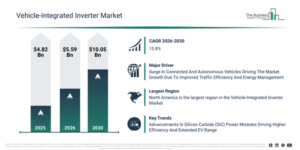
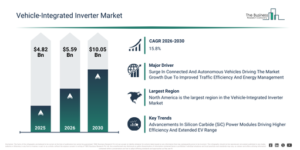
The vehicle-integrated inverter market size has observed substantial growth in recent years. This market is forecasted to increase from $4.82 billion in 2025 to $5.59 billion in 2026, achieving a compound annual growth rate (CAGR) of 16.1%. The expansion seen historically can be linked to factors such as a surge in demand for electric vehicles, enhancements in battery technologies, governmental efforts to promote low-emission vehicles, more stringent energy efficiency standards, and the overall development of automotive electronics.
The vehicle-integrated inverter market is anticipated to experience substantial expansion over the next few years, with its size projected to reach $10.05 billion by 2030, growing at a compound annual growth rate (CAGR) of 15.8%. This growth during the forecast period is attributed to the increasing adoption of solid-state inverters, their integration with vehicle-to-grid (V2G) systems, the ongoing expansion of commercial EV fleets, a strong emphasis on lightweight vehicle architectures, and advancements in high-voltage power electronics. Significant trends expected during this period include designs for high-efficiency inverters, the emergence of modular and scalable inverter systems, optimization of thermal management, the introduction of lightweight and compact inverter solutions, and enhanced integration of advanced power electronics.
Get Access To A Free Vehicle-Integrated Inverter Market Report Sample:
The Key Driver Behind The Vehicle-Integrated Inverter Market’s 0% CAGR
The increasing prevalence of connected and autonomous vehicles is projected to fuel the expansion of the vehicle-integrated inverter market in the future. Connected and autonomous vehicles (CAVs) utilize sophisticated technologies to operate independently and interact with their surroundings, thereby enhancing road safety and operational efficiency. The growing adoption of connected and autonomous vehicles is propelled by the demand for improved traffic efficiency, given their capacity to optimize vehicle movement and mitigate congestion on roads. Vehicle-integrated inverters facilitate connected and autonomous vehicles by effectively regulating power transfer between the battery and drivetrain, simultaneously powering onboard electronics, sensors, and communication systems crucial for seamless automation and connectivity. For example, in December 2022, according to the National Association of Insurance Commissioners, a US-based non-profit organization, it is forecasted that 4.5 million autonomous vehicles will be operating on US roads by 2030. Consequently, the rise of connected and autonomous vehicles is a key factor propelling the growth of the vehicle-integrated inverter market.
Vehicle-Integrated Inverter Market Classification: Main Segments And Detailed Subsegments
The vehicle-integrated inverter market covered in this report is segmented –
1) By Power Output: Up To 50 Kilowatt (Kw), 51–100 Kilowatt (Kw), Above 100 Kilowatt (Kw)
2) By Propulsion Type: Battery Electric Vehicles, Plug-In Hybrid Electric Vehicles, Hybrid Electric Vehicles, Fuel Cell Electric Vehicles
3) By Vehicle Type: Passenger Cars, Commercial Vehicles, Off-Highway Vehicles
4) By Application: Original Equipment Manufacturer (OEM), Aftermarket
Subsegments:
1) By Up To 50 Kilowatt (Kw): Passenger Electric Vehicles, Light Commercial Electric Vehicles, Micro Electric Vehicles, Low-Speed Electric Vehicles
2) By 51–100 Kilowatt (Kw): Mid-Size Passenger Electric Vehicles, Commercial Electric Vans, Plug-In Hybrid Electric Vehicles (PHEV), Battery Electric Vehicles (BEV)
3) By Above 100 Kilowatt (Kw): Heavy-Duty Electric Trucks, Electric Buses, High-Performance Battery Electric Vehicles (BEV), Fuel Cell Electric Vehicles (FCEV)
Vehicle-Integrated Inverter Market Strategic Shifts: What Leading Players Are Prioritizing
Leading firms within the vehicle-integrated inverter market are prioritizing the creation of cutting-edge offerings, specifically next-generation silicon carbide (SiC) power modules, with the goal of boosting energy efficiency and extending the range of electric vehicles. These next-generation SiC power modules are advanced semiconductor components capable of efficiently handling elevated voltages, frequencies, and temperatures, thereby allowing for more compact designs, minimizing energy wastage, and improving performance in both electric vehicles and industrial uses. An example of this is DENSO Corporation, a Japan-based mobility company, which unveiled its inaugural inverter employing SiC semiconductors in March 2023. This innovation substantially decreases power loss and enhances energy efficiency in electric vehicles. Integrated into the eAxle electric driving module, this specific inverter finds application in the new Lexus RZ, which is Lexus’s premier dedicated battery electric vehicle. SiC power semiconductors are effective in cutting power loss to less than half when contrasted with conventional silicon semiconductors, consequently prolonging the cruising range of electric vehicles. Furthermore, DENSO’s proprietary trench-type metal-oxide-semiconductor (MOS) structure boosts output by mitigating power loss caused by heat generation.
Vehicle-Integrated Inverter Market Company Analysis: Major Industry Participants
Major companies operating in the vehicle-integrated inverter market are Toyota Motor Corporation, Tesla Inc., Robert Bosch GmbH, BYD Company Limited, Siemens AG, LG Electronics Inc., Denso Corporation, ZF Friedrichshafen AG, HyundAI Mobis Co. Ltd., Magna International Inc., Mitsubishi Electric Corporation, Valeo SE, Lear Corporation, Infineon Technologies AG, Nidec Corporation, BorgWarner Inc., Renesas Electronics Corporation, Dana Incorporated, Vitesco Technologies GmbH, Hitachi Astemo Ltd.
Get Full Access To The Vehicle-Integrated Inverter Market Report 2026:
Vehicle-Integrated Inverter Market Global Regional Breakdown: Key Regions Analyzed
North America was the largest region in the vehicle-integrated inverter market in 2025. Asia-Pacific is expected to be the fastest-growing region in the forecast period. The regions covered in the vehicle-integrated inverter market report are Asia-Pacific, South East Asia, Western Europe, Eastern Europe, North America, South America, Middle East, Africa.
Reach Out To Our Team:
The Business Research Company: https://www.thebusinessresearchcompany.com/
Americas: +1 310-496-7795
Asia: +44 7882 955267 & +91 8897263534
Europe: +44 7882 955267
Email us at: marketing@tbrc.info
Follow us on:
LinkedIn: https://in.linkedin.com/company/the-business-research-company
YouTube: https://www.youtube.com/channel/UC24_fI0rV8cR5DxlCpgmyFQ
Global Market Model: https://www.thebusinessresearchcompany.com/global-market-model

Wasay has over a decade of experience in market research, data modelling, and analytics, with prior experience at GlobalData and Decision Tree Consulting Services. At The Business Research Company , he leads research operations across syndicated studies, customized consulting engagements, and the Global Market Model platform. His professional experience includes supporting organizations such as Boston Consulting Group, KPMG, and Ernst & Young. Wasay holds a degree in Electronics and Communications Engineering, postgraduate management qualifications from International Management Institute Belgium and Indian School of Business and Entrepreneurship, and completed the Integrated Program in Business Analytics from Indian Institute of Management Indore.