With a focus on actionable insights and strategic value, The Business Research Company’s 2026 market reports include market attractiveness scoring, total addressable market sizing, company benchmarking matrices, interactive Excel dashboards, deeper supply chain intelligence, emerging startup tracking, and granular product-level insights.
Matcha Market Size Forecast Points To $7.15 Billion In Revenue By 2030
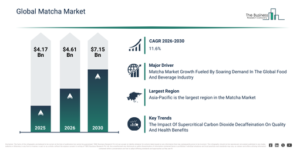
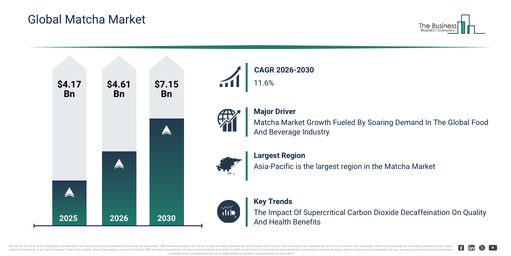
Recent years have witnessed rapid growth in the matcha market size. This market is projected to expand from $4.17 billion in 2025 to $4.61 billion in 2026, exhibiting a compound annual growth rate (CAGR) of 10.6%. Historically, this growth has been fueled by the expansion of tea consumption in Asia, an increasing understanding of its antioxidant benefits, the embrace of matcha within café culture, its growing utilization in traditional ceremonies, and the availability of premium tea cultivation practices.
The matcha market is projected to experience substantial expansion in the coming years, with its valuation predicted to reach $7.15 billion by 2030, demonstrating a compound annual growth rate (CAGR) of 11.6%. This projected growth is driven by several factors, including the surging demand for plant-based wellness items, broader applications in functional drinks, the global spread of specialty tea retail, increasing consumption of premium teas, and advancements in matcha processing and packaging methods. Key developments during this period include a rise in functional tea consumption, the growing appeal of matcha-infused beverages, its increasing incorporation into food and dessert items, its expanding presence in personal care products, and a heightened emphasis on ceremonial grade quality.
Get A Free Matcha Market Sample Covering Drivers, Trends And Key Players:
Matcha Market Driver Analysis: Key Factor Supporting Revenue Growth
An anticipated surge in the consumption of food and beverages is projected to drive the expansion of the matcha market in the future. These encompass edible and drinkable items crucial for human nutrition, sustenance, and enjoyment. Matcha holds considerable importance within food and beverages due to its unique taste, vivid hue, health benefits, and cultural importance. Its adaptability means it can be incorporated into numerous culinary creations, satisfying diverse palates and offering prospective health advantages. For example, reports from the FoodNavigator, a prominent UK-based online B2B digital media platform, indicated that in December 2024, overall “CPG” (consumer-packaged-goods) store-sales volumes for food & beverage increased by 1.1% in 2024, marking the first rise observed in three years. Consequently, the escalating need for food and beverages is fueling the advancement of the matcha market.
Matcha Market Segmentation Framework: Major Segments At A Glance
The matcha market covered in this report is segmented –
1) By Product: Regular, Flavored
2) By Form: Powder, Liquid
3) By Grade: Café, Ceremonial, Culinary
4) By Distribution Channel: Hypermarket And Supermarket, Specialty Retail Stores, Online Retail Stores, Other Distribution Channels
5) By Application: Regular Tea, Matcha Beverages, Food, Personal Care, Other Applications
Subsegments:
1) By Regular: Ceremonial Grade, Culinary Grade
2) By Flavored: Vanilla Matcha, Chocolate Matcha, Berry Matcha, Spiced Matcha
Latest Matcha Market Developments And Emerging Trends
Leading companies in the matcha market are concentrating on advanced techniques such as supercritical carbon dioxide decaffeination to improve the excellence and purity of their products. This allows them to provide matcha with reduced caffeine levels while safeguarding the vibrant taste and nutritional advantages consumers anticipate. Supercritical carbon dioxide extraction is a process that employs carbon dioxide in a supercritical state, where it exhibits characteristics of both a gas and a liquid, to remove caffeine from tea leaves or coffee beans. This method efficiently eliminates caffeine while retaining the flavor compounds and essential nutrients, including catechins. For example, in January 2024, Tsuji Riichi Honten Co. Ltd., a tea manufacturing firm based in Japan, launched Decaf Matcha. Matha Direct utilizes a modern decaffeination process involving supercritical carbon dioxide. This technique effectively decreases the caffeine content to approximately 4–8 mg per serving, which is equivalent to decaf coffee, while preserving almost 100% of the beneficial catechins, the functional nutrients found in matcha.
Which Companies Are Shaping The Matcha Market?
Major companies operating in the matcha market are Nestle S.A., Unilever PLC, Starbucks Corporation, ITO EN Ltd., The Hain Celestial Group Inc., Akira Matcha, The Republic of Tea, Clearspring Ltd., The AOI Tea Company LLC, Marukyu-Koyamaen Co. Ltd., Two Hills Tea, Tea Spot Inc., Aiya Co. Ltd., Tenzo Tea Inc., Encha Ceremonial Grade, Grace Matcha, Matchaful, Breakaway Matcha, Kettl, Matchaeologist, MatchaBar, MatchaKari
Dive Deeper Into The Matcha Market With The Full Report:
Matcha Market Regional Distribution: Where Is Revenue Concentrated?
Asia-Pacific was the largest region in the matcha market in 2025. North America is expected to be the fastest-growing region in the forecast period. The regions covered in the matcha market report are Asia-Pacific, South East Asia, Western Europe, Eastern Europe, North America, South America, Middle East and Africa.
Reach Out To Our Team:
The Business Research Company: https://www.thebusinessresearchcompany.com/
Americas: +1 310-496-7795
Asia: +44 7882 955267 & +91 8897263534
Europe: +44 7882 955267
Email us at: marketing@tbrc.info
Follow us on:
LinkedIn: https://in.linkedin.com/company/the-business-research-company
YouTube: https://www.youtube.com/channel/UC24_fI0rV8cR5DxlCpgmyFQ
Global Market Model: https://www.thebusinessresearchcompany.com/global-market-model

Wasay has over a decade of experience in market research, data modelling, and analytics, with prior experience at GlobalData and Decision Tree Consulting Services. At The Business Research Company , he leads research operations across syndicated studies, customized consulting engagements, and the Global Market Model platform. His professional experience includes supporting organizations such as Boston Consulting Group, KPMG, and Ernst & Young. Wasay holds a degree in Electronics and Communications Engineering, postgraduate management qualifications from International Management Institute Belgium and Indian School of Business and Entrepreneurship, and completed the Integrated Program in Business Analytics from Indian Institute of Management Indore.