Market attractiveness scoring, total addressable market sizing, company benchmarking matrices, interactive Excel dashboards, deeper supply chain intelligence, emerging startup tracking, and granular product-level insights are among the key offerings featured in The Business Research Company’s 2026 market reports, designed to deliver more actionable and strategically valuable research.
Wireless Electric Vehicle (EV) Charging Communication Market Growth Outlook: How Much Bigger Will The Market Be By 2030?
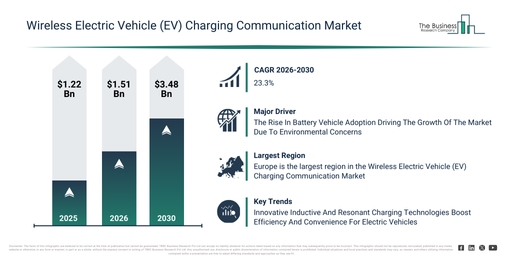
The market for wireless electric vehicle (EV) charging communication has experienced significant growth in recent years. Projections indicate it will expand from $1.22 billion in 2025 to $1.51 billion in 2026, demonstrating a compound annual growth rate (CAGR) of 23.6%. Historically, this expansion has been driven by factors such as rising EV adoption, the development of wireless charging prototypes, government incentives for clean energy, the growth of urban charging infrastructure, and the early integration of V2X communication standards.
The wireless electric vehicle (EV) charging communication market size is projected to experience substantial expansion over the coming years. This market is set to reach $3.48 billion in 2030, exhibiting a compound annual growth rate (CAGR) of 23.3%. The projected growth during this period stems from several factors, including the proliferation of public wireless charging networks, enhancements in AI-powered charging optimization, the increasing introduction of V2G-enabled vehicles, closer integration with smart grid systems, and a heightened need for fleet electrification. Key developments expected during the forecast period involve the rising integration of wireless charging systems into urban environments, the evolution of sophisticated vehicle-to-grid (V2G) communication protocols, the incorporation of real-time fault detection and diagnostic features within EV chargers, a growing need for charging solutions compatible across various vehicle types, and the broadening reach of intelligent charging management platforms.
Request A Free Wireless Electric Vehicle (EV) Charging Communication Market Sample From The Business Research Company:
How Is The Key Growth Driver Influencing The Wireless Electric Vehicle (EV) Charging Communication Market?
The expanding use of battery vehicles is anticipated to fuel the growth of the wireless electric vehicle (EV) charging communication market in the future. Battery vehicles are electric vehicles powered entirely by rechargeable batteries, which store energy to operate an electric motor without relying on internal combustion engines. This growing adoption of battery vehicles is primarily driven by environmental concerns, as they emit fewer greenhouse gases and contribute to reduced air pollution compared to conventional fossil-fuel vehicles. Wireless electric vehicle (EV) charging communication further enhances the efficiency and convenience of battery vehicles through seamless, contactless power transfer, real-time monitoring, and intelligent energy management. For example, in February 2024, data from the U.S. Department of Energy, a US-based federal agency, showed significant year-over-year growth in monthly EV sales over the past three years. Monthly sales reached a peak of approximately 100,000 in 2023, marking a 25% increase from the previous year. Thus, the rising adoption of battery vehicles is a significant catalyst for the wireless electric vehicle (EV) charging communication market’s expansion.
Wireless Electric Vehicle (EV) Charging Communication Market Segmentation By Category: What Does The 2026 Report Cover?
The wireless electric vehicle (EV) charging communication market covered in this report is segmented –
1) By Component: Hardware, Software, Services
2) By Vehicle Type: Passenger Cars, Commercial Vehicles, Two-Wheelers, Other Vehicle Types
3) By Communication Protocol: Vehicle-To-Grid (V2G), Vehicle-To-Everything (V2X), Open Charge Point Protocol (OCPP), Other Communication Protocols
4) By Application: Public Charging, Private Charging, Fleet Charging, Other Applications
5) By End-User: Automotive Original Equipment Manufacturers (OEMs), Charging Infrastructure Providers, Utilities, Other End-Users
Subsegments:
1) By Hardware: Charging Pad, Vehicle Coil, Power Electronics, Communication Module
2) By Software: Charging Management Software, Monitoring And Diagnostics Software, Energy Optimization Software, Security And Authentication Software
3) By Services: Installation Services, Maintenance Services, Consulting Services, Technical Support Services
How Are Industry Players Changing The Wireless Electric Vehicle (EV) Charging Communication Market Landscape?
Leading companies within the wireless electric vehicle (EV) charging communication market are prioritizing the development of inventive solutions, such as inductive and resonant wireless charging technologies, to improve the efficiency, user convenience, and interoperability of charging for electric vehicles. Inductive wireless charging transfers energy via a magnetic field between a charging pad and a vehicle coil, whereas resonant wireless charging employs tuned resonant circuits to facilitate effective energy transfer over slightly greater distances. For instance, in January 2024, Valeo SE, a France-based company that designs and manufactures automobile components, launched a wireless charging system for electric vehicles named Ineeze Air Charging to enhance the ease and effectiveness of EV charging. This Air Charging system features an ultra-low operating frequency around 3 kHz, which makes the system 50% lighter and simpler than conventional wireless chargers while maintaining high efficiency above 90% from grid to battery. It provides worldwide compatibility with all wall boxes, national grids (1 or 3 phases), and EVs with 400-800V batteries; it also supports Vehicle-to-Grid (V2G) functionality for 7-22 kW power solutions and is prepared for autonomous vehicles to self-charge in inductive charging areas.
Wireless Electric Vehicle (EV) Charging Communication Market Global Key Players And Competitive Overview
Major companies operating in the wireless electric vehicle (EV) charging communication market are Bayerische Motoren Werke Aktiengesellschaft (BMW AG), HyundAI Motor Company, Siemens AG), Continental AG, Qualcomm Incorporated, Valeo SE., Toshiba Corporation, ZTE Corporation, Texas Instruments Incorporated, Delta Electronics Inc., Daihen Corporation, ENRX Group, Telit Cinterion GmbH, InductEV Inc., WiTricity Corporation, Ideanomics Inc., Powermat Technologies Ltd., Electreon Wireless Ltd., HEVO Inc., Mojo Mobility Inc.
Explore Comprehensive Wireless Electric Vehicle (EV) Charging Communication Market Coverage In The Full Report:
Regional Analysis Of The Wireless Electric Vehicle (EV) Charging Communication Market: Where Is The Industry Concentrated?
Europe was the largest region in the wireless electric vehicle (EV) charging communication market in 2025. Asia-Pacific is expected to be the fastest-growing region in the forecast period. The regions covered in the wireless electric vehicle (EV) charging communication market report are Asia-Pacific, South East Asia, Western Europe, Eastern Europe, North America, South America, Middle East, Africa.
Reach Out To Our Team:
The Business Research Company: https://www.thebusinessresearchcompany.com/
Americas: +1 310-496-7795
Asia: +44 7882 955267 & +91 8897263534
Europe: +44 7882 955267
Email us at: marketing@tbrc.info
Follow us on:
LinkedIn: https://in.linkedin.com/company/the-business-research-company
YouTube: https://www.youtube.com/channel/UC24_fI0rV8cR5DxlCpgmyFQ
Global Market Model: https://www.thebusinessresearchcompany.com/global-market-model

Wasay has over a decade of experience in market research, data modelling, and analytics, with prior experience at GlobalData and Decision Tree Consulting Services. At The Business Research Company , he leads research operations across syndicated studies, customized consulting engagements, and the Global Market Model platform. His professional experience includes supporting organizations such as Boston Consulting Group, KPMG, and Ernst & Young. Wasay holds a degree in Electronics and Communications Engineering, postgraduate management qualifications from International Management Institute Belgium and Indian School of Business and Entrepreneurship, and completed the Integrated Program in Business Analytics from Indian Institute of Management Indore.