The Business Research Company’s 2026 market reports combine market attractiveness scoring, total addressable market sizing, company benchmarking matrices, interactive Excel dashboards, deeper supply chain intelligence, emerging startup tracking, and granular product-level insights to deliver research that is more actionable and strategically valuable.
Is The Wireless Local Area Network (WLAN) Devices Market Expanding? Latest Size Estimates And 2030 Projections
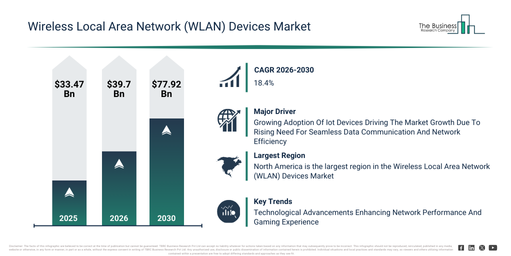
The wireless local area network (WLAN) devices market has shown rapid expansion in recent years. Its market size is anticipated to grow from $33.47 billion in 2025 to $39.7 billion in 2026, achieving a compound annual growth rate (CAGR) of 18.6%. The historical growth of this market can be attributed to several factors, including the extensive adoption of Wi-Fi 5 devices, the development of enterprise WLAN networks, the implementation of centralized controllers, a rise in indoor access point installations, and the expansion of IT and telecom infrastructure.
The market size for wireless local area network (WLAN) devices is set for significant expansion over the coming years. It is anticipated to grow to $77.92 billion by 2030, exhibiting a compound annual growth rate (CAGR) of 18.4%. This projected growth during the forecast period is driven by the swift adoption of Wi-Fi 6/6E technology, the proliferation of cloud-managed WLAN solutions, increasing demand for high-speed multigigabit networks, the broadening scope of WLAN tracking and location analytics, and rising WLAN deployments within healthcare, retail, and BFSI sectors. Key trends for this period involve the expansion of cloud-managed WLAN solutions tailored for enterprises, the growing uptake of Wi-Fi 6 and Wi-Fi 6E access points, the integration of advanced multigigabit switching to facilitate high-speed data transfer, the development of location-based WLAN services for tracking and analytical purposes, and an increase in hybrid deployments of both indoor and outdoor access points.
Free Wireless Local Area Network (WLAN) Devices Market Sample: Market Size, Growth Drivers And Competitive Landscape:
Wireless Local Area Network (WLAN) Devices Market Drivers Explained: What Is Supporting A 0% CAGR?
The expanding use of internet of things (IoT) devices is expected to fuel the growth of the wireless local area network (WLAN) devices market in the coming years. IoT devices are defined as physical objects equipped with sensors, software, and connectivity, enabling them to collect and exchange data over the internet. The quantity of internet of things (IoT) devices is increasing due to the wider embrace of smart automation, which improves efficiency and convenience by allowing devices to communicate and make decisions without human intervention. Wireless local area network (WLAN) devices assist IoT devices by offering dependable wireless connectivity, ensuring seamless data transmission, communication, and control among interconnected smart devices within a local network. For example, in April 2025, Ericsson, a Sweden-based telecommunications company, reported approximately 4 billion cellular IoT connections by the close of 2024. They further projected that by 2030, about 60% of these connections will comprise Broadband IoT. Thus, the growing adoption of internet of things (IoT) devices is significantly propelling the growth of the wireless local area network (WLAN) devices market.
Wireless Local Area Network (WLAN) Devices Market Segment Guide: Main Divisions And Subsegments
The wireless local area network (wlan) devices market covered in this report is segmented –
1) By Type: Wireless Access Points, Access Point Antennas, Wireless Local Area Network Controllers, Multigigabit Switching, Wireless Location Appliance
2) By Technology: Wi-Fi 5 (802.11ac), Wi-Fi 6 (802.11ax), Wi-Fi 6E, Older Standards
3) By Distribution Channel: Online Retail, Offline Retail, Distributors Or Wholesalers, Direct Sales
4) By Application: Residential, Commercial, Industrial, Other Applications
5) By End-User: Banking, Financial Services, And Insurance, Healthcare, Retail, Information Technology And Telecommunications, Other End Users
Subsegments:
1) By Wireless Access Points: Indoor Access Points, Outdoor Access Points, Cloud-Managed Access Points
2) By Access Point Antennas: Omnidirectional Antennas, Directional Antennas, Sector Antennas
3) By Wireless Local Area Network Controllers: Centralized Controllers, Cloud-Based Controllers, Embedded Controllers
4) By Multigigabit Switching: 2.5 GbE Switches, 5 GbE Switches, 10 GbE Switches
5) By Wireless Location Appliance: Wi-Fi Tracking Systems, Radio Frequency Identification-Based Location Systems, Bluetooth Low Energy Beacon Systems
Wireless Local Area Network (WLAN) Devices Market Trends And Opportunities For 2026–2030
Leading companies within the wireless local area network (WLAN) devices market are concentrating on developing AI-powered gaming routers to improve network performance, decrease latency, and provide optimized connectivity for high-speed gaming and streaming. An AI-powered gaming router is defined as a smart networking device that utilizes artificial intelligence to automatically optimize network operations by managing bandwidth, minimizing latency, and prioritizing gaming traffic for smoother and faster online gaming experiences. For instance, in January 2025, ASUSTeK Computer Inc., a Taiwan-based technology company, introduced an Asus ROG Rapture GT-BE19000AI. This product features a built-in neural processing unit (NPU) designed to deliver advanced networking intelligence, automation, and efficiency for gamers, creators, and smart home enthusiasts. It offers ultra-fast WiFi 7 connectivity, advanced game traffic prioritization to reduce latency by up to 34%, and robust security features such as AiProtection Pro. Its integrated Docker engine allows running edge AI and smart home applications locally, offering gamers and smart home enthusiasts a powerful, efficient, and secure all-in-one networking solution.
Which Major Players Are Active In The Wireless Local Area Network (WLAN) Devices Market?
Major companies operating in the wireless local area network (wlan) devices market are Huawei Technologies Co. Ltd., Cisco Systems Inc., Intel Corporation, Qualcomm Technologies Inc., ZTE Corporation, MediaTek Inc., Arista Networks Inc., Fortinet Inc., CommScope Holding Company Inc., Advantech Co. Ltd., Ubiquiti Networks Inc., Extreme Networks Inc., Netgear Inc., TP-Link Technologies Co. Ltd., Zyxel Communications Corporation, Allied Telesis Holdings K.K., Cambium Networks Corporation, Actiontec Electronics Inc., Peplink International Ltd., D-Link Corporation
Unlock The Complete Wireless Local Area Network (WLAN) Devices Market Report With Company Benchmarking:
Wireless Local Area Network (WLAN) Devices Market World Regions Compared: Which Leads In Revenue?
North America was the largest region in the wireless local area network (WLAN) devices market in 2025. Asia-Pacific is expected to be the fastest-growing region in the forecast period. The regions covered in the wireless local area network (wlan) devices market report are Asia-Pacific, South East Asia, Western Europe, Eastern Europe, North America, South America, Middle East, Africa.
Reach Out To Our Team:
The Business Research Company: https://www.thebusinessresearchcompany.com/
Americas: +1 310-496-7795
Asia: +44 7882 955267 & +91 8897263534
Europe: +44 7882 955267
Email us at: marketing@tbrc.info
Follow us on:
LinkedIn: https://in.linkedin.com/company/the-business-research-company
YouTube: https://www.youtube.com/channel/UC24_fI0rV8cR5DxlCpgmyFQ
Global Market Model: https://www.thebusinessresearchcompany.com/global-market-model

Wasay has over a decade of experience in market research, data modelling, and analytics, with prior experience at GlobalData and Decision Tree Consulting Services. At The Business Research Company , he leads research operations across syndicated studies, customized consulting engagements, and the Global Market Model platform. His professional experience includes supporting organizations such as Boston Consulting Group, KPMG, and Ernst & Young. Wasay holds a degree in Electronics and Communications Engineering, postgraduate management qualifications from International Management Institute Belgium and Indian School of Business and Entrepreneurship, and completed the Integrated Program in Business Analytics from Indian Institute of Management Indore.